
R中的双圈:使用.name_repair指定修复?
我在R中有这个数据集:
set.seed(123)

myFun <- function(n = 5000) {
  a <- do.call(paste0, replicate(5, sample(LETTERS, n, TRUE), FALSE))
  paste0(a, sprintf("%04d", sample(9999, n, TRUE)), sample(LETTERS, n, TRUE))
}

col1 = myFun(100)
col2 = myFun(100)
col3 = myFun(100)
col4 = myFun(100)
group <- c("A","B","C","D")
group = sample(group, 100, replace=TRUE)

example = data.frame(col1, col2, col3, col4, group)

       col1       col2       col3       col4 group
1 SKZDZ9876D BTAMF8110T LIBFV6882H ZFIPL4295E     A
2 NXJRX7189Y AIZGY5809C HSMIH4556D YJGJP8022H     C
3 XPTZB2035P EEKXK0873A PCPNW1021S NMROS4134O     A
4 LJMCM3436S KGADK2847O SRMUI5723N RDIXI7301N     B
5 ADITC6567L HUOCT5660P AQCNE3753K FUMGY1428B     D
6 BAEDP8491P IAGQG4816B TXXQH6337M SDACH5752D     C
我编写了这个循环,比较(col1,col2)和(col3,col4)的所有组合之间的不同字符串距离度量:
method = c("osa", "lv", "dl", "hamming", "lcs", "qgram", "cosine", "jaccard", "jw","soundex")

library(stringdist)

results = list()

for (i in 1:length(method))

{

method_i = method[i]
name_1_i = paste0("col1_col_2", method_i)
 name_2_i = paste0("col3_col_4", method_i)

p1_i = stringdistmatrix(col1, col2, method =  method_i, useNames = "string") %>%
            as_tibble(rownames = "a") %>%
            pivot_longer(-1, names_to = "b", values_to = name_1_i)

p2_i = stringdistmatrix(col3, col4, method =  method_i, useNames = "string") %>%
            as_tibble(rownames = "a") %>%
            pivot_longer(-1, names_to = "b", values_to = name_2_i)

p1_i = p1_i[,3]
p2_i = p2_i[,3]

final_i = cbind(p1_i, p2_i)

results[[i]] = final_i
}

final = do.call(cbind.data.frame, results)
final = cbind(col1,col2, col3,col4, final)

average_col1_col2_dist = (final$col1_col_2osa  + final$col1_col_2lv + final$col1_col_2dl      + final$col1_col_2hamming + final$col1_col_2lcs +     final$col1_col_2qgram  + final$col1_col_2cosine    + final$col1_col_2jaccard + final$col1_col_2jw   + final$col1_col_2soundex)/10

 average_col3_col4_dist =  ( final$col3_col_4osa     +    final$col3_col_4lv       +     final$col3_col_4dl  +     final$col3_col_4hamming +  final$col3_col_4lcs +  final$col3_col_4qgram  +   final$col3_col_4cosine +    final$col3_col_4jaccard  +    final$col3_col_4jw     +   final$col3_col_4soundex)/10

final = data.frame( col1, col2, col3, col4, average_col1_col2_dist,  average_col3_col4_dist)
final = scale(final)现在,我想把它变成一个“双循环”,并进行相同的比较,但是应该只在每个“组”:中进行比较。
results = list()


for (i in 1:length(method))
for (j in 1:length(unique(example$group))

{

{

groups_j = unique(example$group[j])
my_data_i = file[which(file$fsa == groups_j  ), ]


method_i = method[i]
name_1_i = paste0("col1_col_2", method_i)
 name_2_i = paste0("col3_col_4", method_i)

p1_i = stringdistmatrix(my_data_i$col1, my_data_i$col2, method =  method_i, useNames = "string") %>%
            as_tibble(rownames = "a") %>%
            pivot_longer(-1, names_to = "b", values_to = name_1_i)

p2_i = stringdistmatrix(my_data_i$col3, my_data_i$col4, method =  method_i, useNames = "string") %>%
            as_tibble(rownames = "a") %>%
            pivot_longer(-1, names_to = "b", values_to = name_2_i)

p1_i = p1_i[,3]
p2_i = p2_i[,3]

final_i = cbind(p1_i, p2_i)
 results[[i]] = final_i

}

}

final = do.call(cbind.data.frame, results)
final = cbind(col1,col2, col3,col4, final)

average_col1_col2_dist = (final$col1_col_2osa  + final$col1_col_2lv + final$col1_col_2dl      + final$col1_col_2hamming + final$col1_col_2lcs +     final$col1_col_2qgram  + final$col1_col_2cosine    + final$col1_col_2jaccard + final$col1_col_2jw   + final$col1_col_2soundex)/10

 average_col3_col4_dist =  ( final$col3_col_4osa     +    final$col3_col_4lv       +     final$col3_col_4dl  +     final$col3_col_4hamming +  final$col3_col_4lcs +  final$col3_col_4qgram  +   final$col3_col_4cosine +    final$col3_col_4jaccard  +    final$col3_col_4jw     +   final$col3_col_4soundex)/10

final = data.frame( col1, col2, col3, col4, average_col1_col2_dist,  average_col3_col4_dist)
final = scale(final)
但是我不断地发现这个错误:
Error:
! Column 1 must be named.
Use .name_repair to specify repair.
Caused by error in `repaired_names()`:
! Names can't be empty.
x Empty name found at location 1.
有人知道我怎么解决这个问题吗?
谢谢!
回答 1
Stack Overflow用户
发布于 2022-11-26 19:12:26
在试图理解您所做的工作的过程中,我偏离了您的原始代码。它的大部分并不一定有什么问题!
你的代码
至于你的分组代码..。
你开始的时候
for(this in that)
   for(this in that)
   {
       {
括号嵌套在for语句中的内容。你需要
for(this in that) {
   for(this in that) {

# or this works
for(this in that)
   {
   for(this in that)
{当您指定您的for标准时,您使用整数。但是,您可以只使用字符串,如
for(i in method) { # i is a string

# versus

for(i in 1:length(method)) { # i is an integer当您编写嵌套的for语句时,忽略了一个结束括号。
for(j in 1:length(unique(example$group)) # end parentheses missing!

# should have been

for(j in 1:length(unique(example$group)))

# easier to see like this:

for(j in 1:length(
                  unique(
                         example$group
                        )
                  )
    )
你知道吗?您可以将RStudio设置为使用“彩虹括号”,这对于确保您不会错过结束括号或括号非常好。转到Tools -> Global Options -> Code (弹出式左菜单) ->显示(菜单弹出中的顶部菜单)&“彩虹括号”是列表中的最后一项。这就是我当前外观设置的样子:
提取组时,您选择了数据集行,而不是唯一值。
# this selects jth row, then looks for unique values
groups_j = unique(example$group[j])

# you need to get the unique values, then iterate
group_j = unique(example$group)[j]

# the j goes outside the call for unique()在这段代码中,您编写了file和file$fsa。我假设这相当于example和example$group,因为在file中没有任何东西。
所有这些代码行都是这样做的。请记住,group在数据框架中,但它本身也是环境中的一个对象。
my_data_i = example[which(example$group == group_j), ] # this would work
my_data_i <- filter(example, groups == group_j)        # this would work
my_data_i <- example[group == group_j, ]               # this would work
my_data_i <- example[example$group == group_j, ] # this would work如果您迭代组而不是索引,可以跳过group_j的创建,这是您使用j的唯一一次。
for(j in unique(example$group)) {
    my_data_i <- example[example$group == j, ]
}当您单独使用i和i发送结果时,您将在j上用每次迭代覆盖数据。
第一组迭代可以在results[[i]]中进行,但下一个group可以绑定到该数据,也可以放在列表中的列表中。
例如:
results[[1]] <- group 1, method 1
results[[1]] <- rbind(results[[1]], [group 2, method 1])

# or

results[[1]][[1]] <- group 1, method 1
results[[1]][[2]] <- group 2, method 1
考虑到列表的这两个选项(上面),第一个选项将允许您剩下的代码(创建最终代码、平均值等)。没有任何变化就能工作。但是,如果使用第二个选项(上面),则需要修改该代码。
如果您将for(j留给1:length,这将起作用:
if(j < 2) {
  results[[i]] <- final_i
} else {
  results[[i]] <- rbind(results[[i]], final_i)
}如果您使用for(j in unique(example$group)),您可以使用以下内容:
if(isTRUE(j == unique(example$group)[1])) { # isTRUE() to avoid null errors
  results[[i]] <- final_i
} else {
  results[[i]] <- rbind(results[[i]], final_i)
}嵌套的for语句都在一个块中。
results = list()
for (i in 1:length(method)) {  # bracket missing here; it was in the wrong place
  for (j in 1:length(unique(example$group))) { # missing a parentheses here
    # { # this needs to be after each for statement

    # groups_j = unique(example$group[j]) # you have selected the jth row, not the jth unique

    group_j = unique(example$group)[j] # the selection goes outside the call for unique()
    # use things like print or message to check what your function does
    # print(group_j)
    # message('this is a message ', group_j) # notice the different color in the console?

    my_data_i <- example[group == group_j, ] # this would work

    method_i = method[i]
    name_1_i = paste0("col1_col_2", method_i)
    name_2_i = paste0("col3_col_4", method_i)

    p1_i = stringdistmatrix(my_data_i$col1, my_data_i$col2, method =  method_i, useNames = "string") %>%
      as_tibble(rownames = "a") %>%
      pivot_longer(-1, names_to = "b", values_to = name_1_i)

    p2_i = stringdistmatrix(my_data_i$col3, my_data_i$col4, method =  method_i, useNames = "string") %>%
      as_tibble(rownames = "a") %>%
      pivot_longer(-1, names_to = "b", values_to = name_2_i)

    p1_i = p1_i[,3]
    p2_i = p2_i[,3]

    final_i = cbind(p1_i, p2_i)

    # results[[i]] = final_i # you replace this content everytime you change groups
    # you need to append the values between groups (assuming you want one column per test type)
    # first append, then combine
    if(j < 2) { # use < instead of == to avoid null error
      results[[i]] <- final_i
    } else {
      results[[i]] <- rbind(results[[i]], final_i)
    }
  }
}
我的代码可以完成同样的任务
我增加了一些制衡,以使它更有活力。可以将任意数量的列、方法或组发送到grpComp。
它使用tidyverse、glue和stringdist。
第一个函数由另一个函数调用。
library(tidyverse)
library(stringdist)
library(glue)

strD <- function(c1, c2, mm) { # input column 1; column 2; measurement method
  res <- stringdistmatrix(c1, c2, method = mm, useNames = 'string')
  f_res <- matrix(res) # extract values and flatten
}
这是按组函数计算的距离。
grpComp <- function(fr, methods, grp) { # data frame of columns to compare,
  # methods to use, groups (vector same length as df rows)
  cnames <- names(fr)
  if(length(cnames) %% 2 != 0) {
    message('there are an uneven number of columns to compare')
    break # something's wrong
  }
  if(length(grp) != nrow(fr)) {
    message('there groups vector length must match number of rows in the data')
    break # something's wrong
  }
  # extract distances
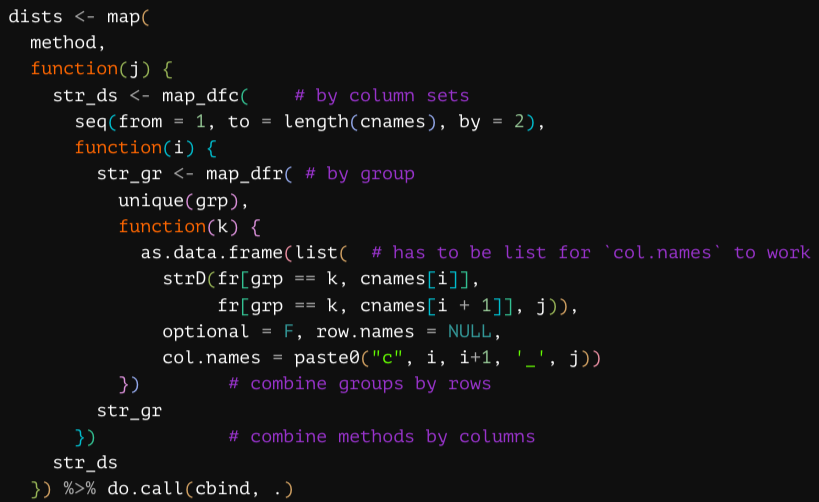
  dists <- map(
    method,
    function(j) {
      str_ds <- map_dfc(    # by column sets
        seq(from = 1, to = length(cnames), by = 2),
        function(i) {
          str_gr <- map_dfr( # by group
            unique(grp),
            function(k) {
              as.data.frame(list(  # has to be list for `col.names` to work
                strD(fr[grp == k, cnames[i]],
                     fr[grp == k, cnames[i + 1]], j)),
                optional = F, row.names = NULL,
                col.names = paste0("c", i, i+1, '_', j))
            })        # combine groups by rows
          str_gr
        })            # combine methods by columns
      str_ds
    }) %>% do.call(cbind, .)
  ncnames <- names(dists) %>% substr(1, 3) %>% unique() # determine unique col groups
  for(m in ncnames) { # get averages for each comparison set
    dists <- mutate(dists,
                    "ave_{m}" := rowMeans(across(contains(m))) %>% scale())
  }
  dists <- select(dists, contains('ave'))
}
这就是你使用这段代码的方式。
test5 <- grpComp(example[, 1:4], methods, example$group)尽管您对非分组数据的功能是有效的,但我想我也会包括该代码。
strComp <- function(fr, methods) { # data frame of columns to compare, methods to use
  cnames <- names(fr)
  if(length(cnames) %% 2 != 0) {
    message('there are an uneven number of columns to compare')
    break # something's wrong
  }
  # extract distances
  dists <- map(
    method,
    function(j) {
      str_ds <- map_dfc(
        seq(from = 1, to = length(cnames), by = 2),
        function(i) {
          as.data.frame(list(  # has to be list for `col.names` to work
            strD(fr[, cnames[i]], fr[, cnames[i + 1]], j)), optional = F,
            col.names = paste0("c", i, i+1, '_', j))
        })
      str_ds
    }) %>% do.call(cbind, .)
  ncnames <- names(dists) %>% substr(1, 3) %>% unique() # determine unique col groups
  for(k in ncnames) { # get averages for each comparison set
    dists <- mutate(dists,
                    "ave_{k}" := rowMeans(across(contains(k))) %>% scale())
  }
  dists <- select(dists, contains('ave'))
}
要使用此功能:
test4 <- strComp(example[, 1:4], methods)https://stackoverflow.com/questions/74557454
复制相似问题
腾讯云开发者

Copyright © 2013 - 2026 Tencent Cloud. All Rights Reserved. 腾讯云 版权所有
深圳市腾讯计算机系统有限公司 ICP备案/许可证号:粤B2-20090059  粤公网安备44030502008569号
腾讯云计算(北京)有限责任公司 京ICP证150476号 | 京ICP备11018762号