
K-移位数组插入排序的时间复杂度
K-移位数组插入排序的时间复杂度
提问于 2022-11-23 12:05:13
这个问题是在我的算法课程作业中提出的。
--一开始有n个大小的排序数组。假设是
n=10,数组是[1,2,3,4,5,6,7,8,9,10]。然后它被循环地移到了k的右边,假设是k=3。现在数组是[8,9,10,1,2,3,4,5,6,7]。
如果根据n和k对此数组应用插入排序,那么时间复杂度是多少?
我对这个问题做了很多研究,但在网上找不到解决办法。如何确定这种移位数组插入排序的时间复杂度?
回答 1
Stack Overflow用户
发布于 2022-11-23 12:05:13
首先,插入排序:
static void insertionSort(int[] array) {
    for (int i = 1; i < array.length; i++) {
        int key = array[i];
        int j = i - 1;

        while (j >= 0 && array[j] > key) {
            array[j + 1] = array[j];
            j--;
        }

        array[j + 1] = key;
    }
}
时间复杂性主要取决于以下几行,因为比较和交换操作就是在这里完成的。
while (j >= 0 && array[j] > key) {
    array[j + 1] = array[j];
    j--;
}
取一张纸,为每个j值绘制一个交换表。
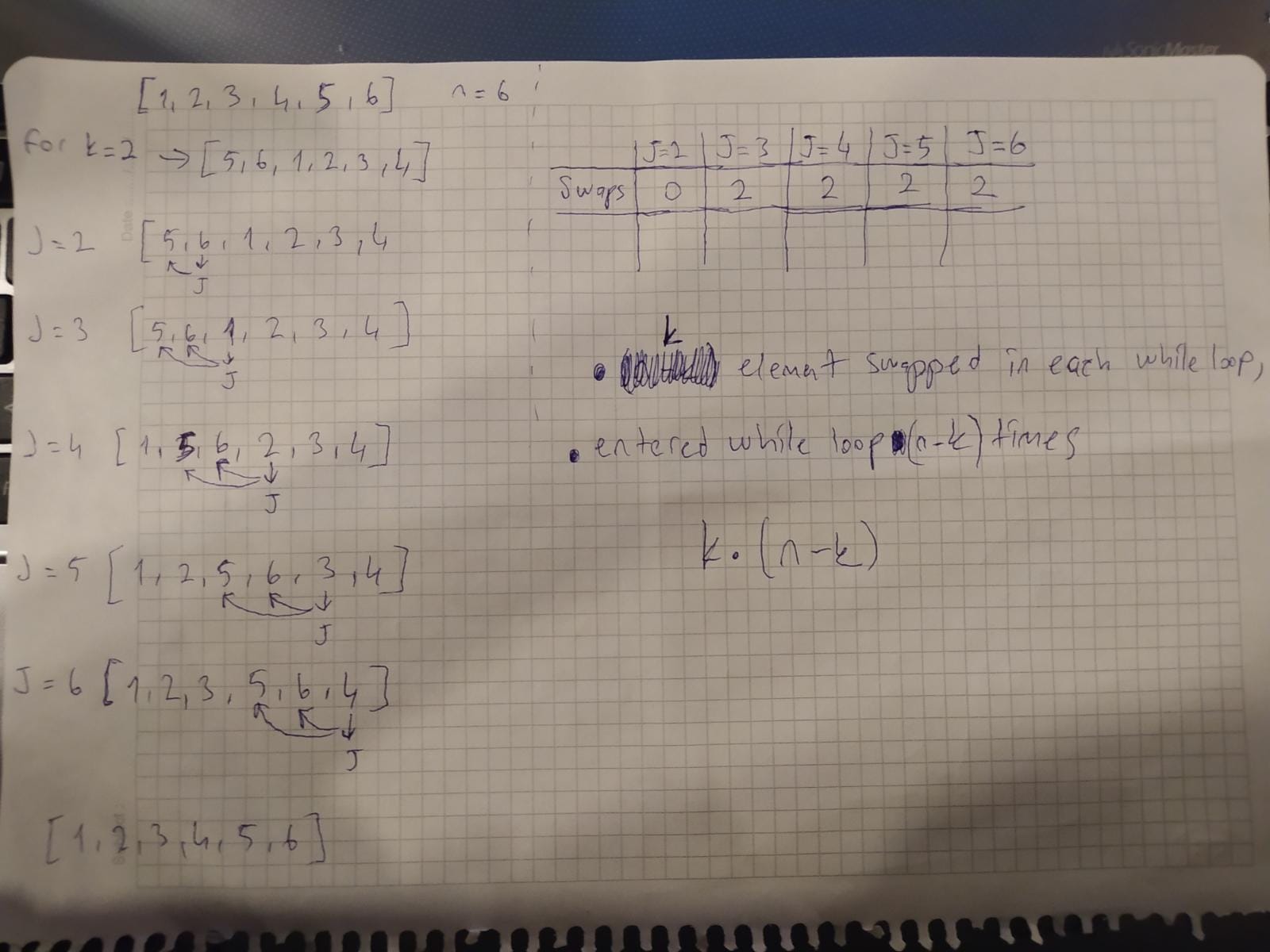
最后,您将了解到,该算法进入does循环(n-k)时间,每当它进入时,它就会交换操作k时间。因此,时间复杂性是(n-k)*k。
我们来证明一下。
在算法中放置一个交换计数器变量。
static int insertionSort(int[] array) {
    int swapCount = 0;

    for (int i = 1; i < array.length; i++) {
        int key = array[i];
        int j = i - 1;
        while (j >= 0 && array[j] > key) {
            array[j + 1] = array[j];
            j--;
            swapCount++;
        }

        array[j + 1] = key;
    }

    return swapCount;
}
现在,让我们在问题中描述的数组上尝试一下。
public class App {
    public static void main(String[] args) throws Exception {
        int[] baseArray = { 1, 2, 3, 4, 5, 6, 7, 8, 9, 10 };

        int n = baseArray.length;
        int k = 3;

        // Shift base array by k
        int[] shiftedArray = shiftArray(baseArray, k);

        // Calculate how many swaps done by the insertion sort
        int swapCount = InsertionSort.insertionSort(shiftedArray);

        // Theroitical value is calculated by using the formula (n-k)*k
        int timeComplexityTheoritical = (n - k) * k;

        System.out.print("Theoritical Time Complexity based on formula: " + timeComplexityTheoritical);

        System.out.print(" - Swap Count: " + swapCount);

        System.out.print(" - Is formula correct:" + (timeComplexityTheoritical == swapCount) + "\n");
    }

    // Shift array to the right circularly by k positions
    static int[] shiftArray(int[] array, int k) {
        int[] resultArray = array.clone();

        int temp, previous;
        for (int i = 0; i < k; i++) {
            previous = resultArray[array.length - 1];
            for (int j = 0; j < resultArray.length; j++) {
                temp = resultArray[j];
                resultArray[j] = previous;
                previous = temp;
            }
        }

        return resultArray;
    }

    static class InsertionSort {

        static int insertionSort(int[] array) {
            int swapCount = 0;

            for (int i = 1; i < array.length; i++) {
                int key = array[i];
                int j = i - 1;
                while (j >= 0 && array[j] > key) {
                    array[j + 1] = array[j];
                    j--;
                    swapCount++;
                }

                array[j + 1] = key;
            }

            return swapCount;
        }
    }
}
产出:
基于公式的
理论时间复杂度: 21 -交换计数: 21 -公式正确:真
我在大小为2^16的数组上试过,每次公式都是正确的,并将其移动2^16-1次。
我们发现的时间复杂度不是上界或下界,而是这种情况的精确紧界。所以它就是Theta。Θ((n-k)k)。
页面原文内容由Stack Overflow提供。腾讯云小微IT领域专用引擎提供翻译支持
原文链接:
https://stackoverflow.com/questions/74546513
复制相关文章
相似问题
腾讯云开发者

Copyright © 2013 - 2026 Tencent Cloud. All Rights Reserved. 腾讯云 版权所有
深圳市腾讯计算机系统有限公司 ICP备案/许可证号:粤B2-20090059  粤公网安备44030502008569号
腾讯云计算(北京)有限责任公司 京ICP证150476号 | 京ICP备11018762号