
为什么我的IDFT计算与值np.fft.ifft不同?
为什么我的IDFT计算与值np.fft.ifft不同?
提问于 2022-11-12 01:20:23
我试着验证我写的一个简单的IDFT例程-
###############################################################
#My IDFT Routines
###############################################################
def simple_idft(data_f):
    data_t_r = []
    data_t_i = []
    for ii in range(0,len(data_f)):
      tmp_r=0.00
      tmp_i=0.00
      scale = 1.00/len(data_f)
      for jj in range(0,len(data_f)):
        tmp_r += data_f[jj].real*math.cos(2.00*math.pi*ii*jj/len(data_f)) - data_f[jj].imag*math.sin(2.00*math.pi*ii*jj/len(data_f))
        tmp_i += data_f[jj].real*math.sin(2.00*math.pi*ii*jj/len(data_f)) + data_f[jj].imag*math.cos(2.00*math.pi*ii*jj/len(data_f))
      tmp_r *=scale
      tmp_i *=scale
      data_t_r.append(tmp_r)
      data_t_i.append(tmp_i)
   return data_t_r, data_t_i


def rms_idft(data_t_r, data_t_i):
    rms = []
    for ii in range(0,len(data_t_r)):
        rms.append(math.sqrt(data_t_r[ii]**2 + data_t_i[ii]**2))
    return rms

def do_idft(data_t):
    data_t_r, data_t_i = simple_idft(data_t)
    rms = rms_idft(data_t_r, data_t_i)
    return(rms)
反对那些粗野的IDFT节目-
################################################################
#Transform OFDM Data to time domain
################################################################
def IDFT(OFDM_data):
    return np.fft.ifft(OFDM_data)
当我运行这些数据(64点数据)时,我似乎得到了非常不同的结果-
OFDM_time = IDFT(OFDM_data)
print ("Number of OFDM samples in time-domain before CP: ", len(OFDM_time))
print(OFDM_time)
plt.plot(OFDM_time)
plt.show()
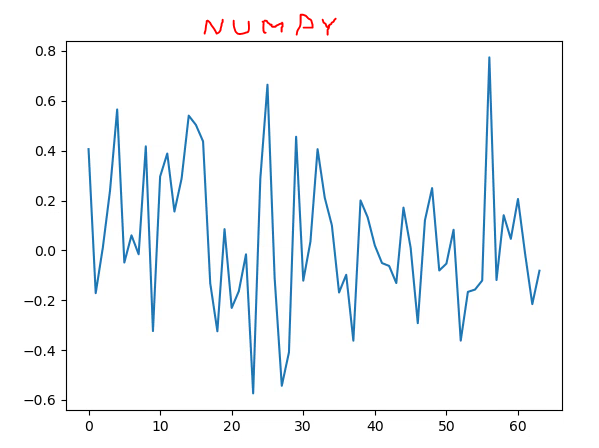
rms = []
rms = do_idft(OFDM_data)
plt.plot(rms,label='raj')
plt.legend()
plt.show()
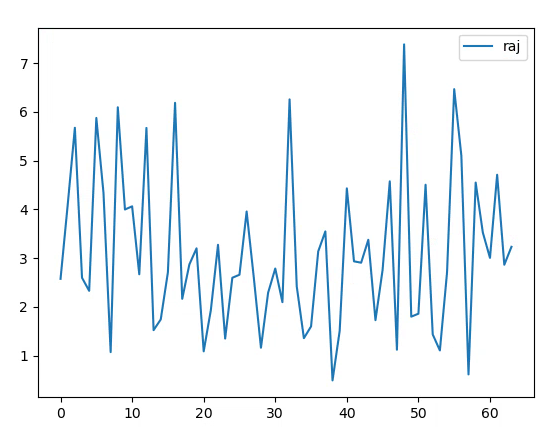
你能看到我算法中的错误吗?
回答 1
Stack Overflow用户
回答已采纳
发布于 2022-11-12 16:05:39
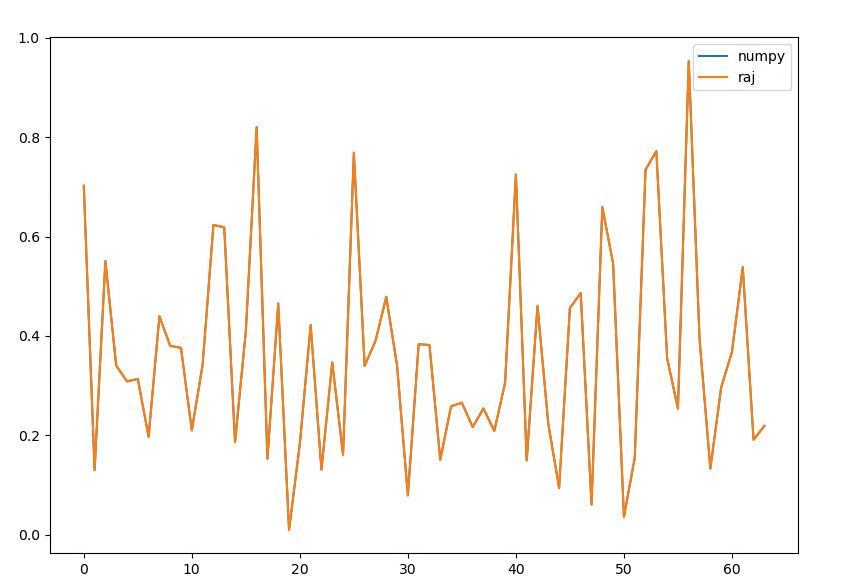
好吧我发现了问题..。Numpy IDFT例程输出的绘制是错误的,而应该是-
################################################################
#Transform OFDM Data to time domain
################################################################
def IDFT(OFDM_data):
    return np.fft.ifft(absOFDM_data)

OFDM_time = IDFT(OFDM_data)
print ("Number of OFDM samples in time-domain before CP: ", len(OFDM_time))
print(OFDM_time)
plt.plot(abs(OFDM_time))  **##need to take the absolute val**
plt.show()
页面原文内容由Stack Overflow提供。腾讯云小微IT领域专用引擎提供翻译支持
原文链接:
https://stackoverflow.com/questions/74409694
复制相关文章
相似问题
腾讯云开发者

Copyright © 2013 - 2026 Tencent Cloud. All Rights Reserved. 腾讯云 版权所有
深圳市腾讯计算机系统有限公司 ICP备案/许可证号:粤B2-20090059  粤公网安备44030502008569号
腾讯云计算(北京)有限责任公司 京ICP证150476号 | 京ICP备11018762号