
将熊猫的数据重新安排到引文网络
将熊猫的数据重新安排到引文网络
提问于 2022-10-19 14:18:45
编辑:
让我们把故事尽可能简单地说出来。我在熊猫工作。
我的数据是引用其他节点(docdb_id)的节点(cited_patents)。在这种情况下,ddocdb_id中节点的距离为min(Dist_cited_patents)+1,距离为0的节点被认为具有字段!=“”。我想构造一个名为New_var的变量。在这种情况下,逻辑很简单,因为New_var应该以最小的距离接受Cited_patents的值,如Dist_cited_patents所示。因此,在我们的示例中,原始df是:
docdb_id Cited_patents Dist_cited_patents   Fields.
1              [7,3]            [1,1]            ""
2              [1,5]            [2,1]           ['Math']
3              [1,2,6]          [2,0,2]          ""
4              [7]              [1]             ['1. Natural Sciences' '3. Medical and Health Sciences']
5              [1,2]            [2,0]             ""
6              [5,8]            [1,1]             ""
7              [4,8]            [0,1]            ""
8              [4]              [0]              ""
预期结果是:
docdb_id Cited_patents Dist_cited_patents   Fields     New_var
1              [7,3]            [1,1]        ""    [Natural Sciences, Medical and Health Sciences, Math]
2              [1,5]            [2,1]        ['Math']       Math
3              [1,2,6]          [2,0,2]      ""         Math
4              [7]              [1]         ['1. Natural Sciences' '3. Medical and Health Sciences']    Natural Sciences, Medical and Health Sciences,
5              [1,2]            [2,0]         ""        Math
6              [5,8]            [1,1]         ""    [Natural Sciences, Medical and Health Sciences,, Math]
7              [4,8]            [0,1]         ""      Science
8              [4]              [0]           ""      Science
数据提供如下:
# initialize list of lists
data = [[1, [7,3], [1,1], ""], [2, [1,5], [2,1], "Math"], [3, [1,2,6], [2,0,2], ""],[4, [7], [1], "Science"],[5, [1,2], [2,0], ""],[6, [5,8], [1,1], ""],[7, [4,8], [0,1], ""],[8, [4], [0], ""]]

# Create the pandas DataFrame
df = pd.DataFrame(data, columns=['docdb', 'cited_patents','dist_cited_patents','Fields'])
谢谢!
回答 1
Stack Overflow用户
发布于 2022-10-19 15:07:28
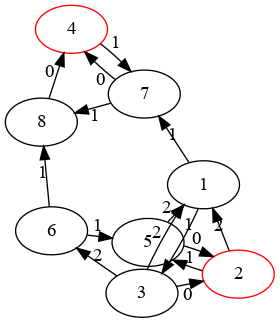
这可以看作是一个图形问题,您可以用networkx来解决它。
# identify terminal nodes (leafs)
m = df['Fields'].eq('')
leafs = set(df.loc[~m, 'docdb'])
# {2, 4}

# generate exploded version of DataFrame to be able to construct the graph
df2 = df.explode(['cited_patents', 'dist_cited_patents'])

# build the directed graph with weights
import networkx as nx

G = nx.from_pandas_edgelist(df2.rename(columns={'dist_cited_patents': 'weight'}),
                            source='docdb', target='cited_patents',
                            edge_attr='weight',
                            create_using=nx.DiGraph)

# find closest leaf for each node
def distance(n, leaf):
    try:
        return nx.dijkstra_path_length(G, n, leaf, weight='weight')
    except nx.NetworkXNoPath:
        return float('inf')

mapper = {n: min(leafs, key=lambda leaf: distance(n, leaf)) for n in G.nodes}

# map leaf to field
fields = df[~m].set_index('docdb')['Fields']

# map each node to terminal leafs to field
df['New_var'] = df2['cited_patents'].map(mapper).map(fields).groupby(level=0).agg(set)

print(df)
产出:
   docdb cited_patents dist_cited_patents   Fields          New_var
0      1        [7, 3]             [1, 1]           {Science, Math}
1      2        [1, 5]             [2, 1]     Math           {Math}
2      3     [1, 2, 6]          [2, 0, 2]                    {Math}
3      4           [7]                [1]  Science        {Science}
4      5        [1, 2]             [2, 0]                    {Math}
5      6        [5, 8]             [1, 1]           {Science, Math}
6      7        [4, 8]             [0, 1]                 {Science}
7      8           [4]                [0]                 {Science}
图表:
页面原文内容由Stack Overflow提供。腾讯云小微IT领域专用引擎提供翻译支持
原文链接:
https://stackoverflow.com/questions/74127008
复制相关文章
相似问题
腾讯云开发者

Copyright © 2013 - 2026 Tencent Cloud. All Rights Reserved. 腾讯云 版权所有
深圳市腾讯计算机系统有限公司 ICP备案/许可证号:粤B2-20090059  粤公网安备44030502008569号
腾讯云计算(北京)有限责任公司 京ICP证150476号 | 京ICP备11018762号