
(python)不使用内置函数对日期进行排序
(python)不使用内置函数对日期进行排序
提问于 2022-09-29 02:33:46
在函数sort()中不使用build的python排序日期,但我想要的期望是
['2010-01-12', '2010-01-14', '2010-02-07', '2010-02-11', '2010-11-16',
'2010-11-22', '2010-11-23', '2010-11-26', '2010-12-02', '2010-12-13',
'2011-02-04', '2011-06-02', '2011-08-05', '2011-11-30']
我确实读过类似的问题,并试图解决它,但仍然是股票。
How to sort things, without using the sorted build-in function?
第一版代码:
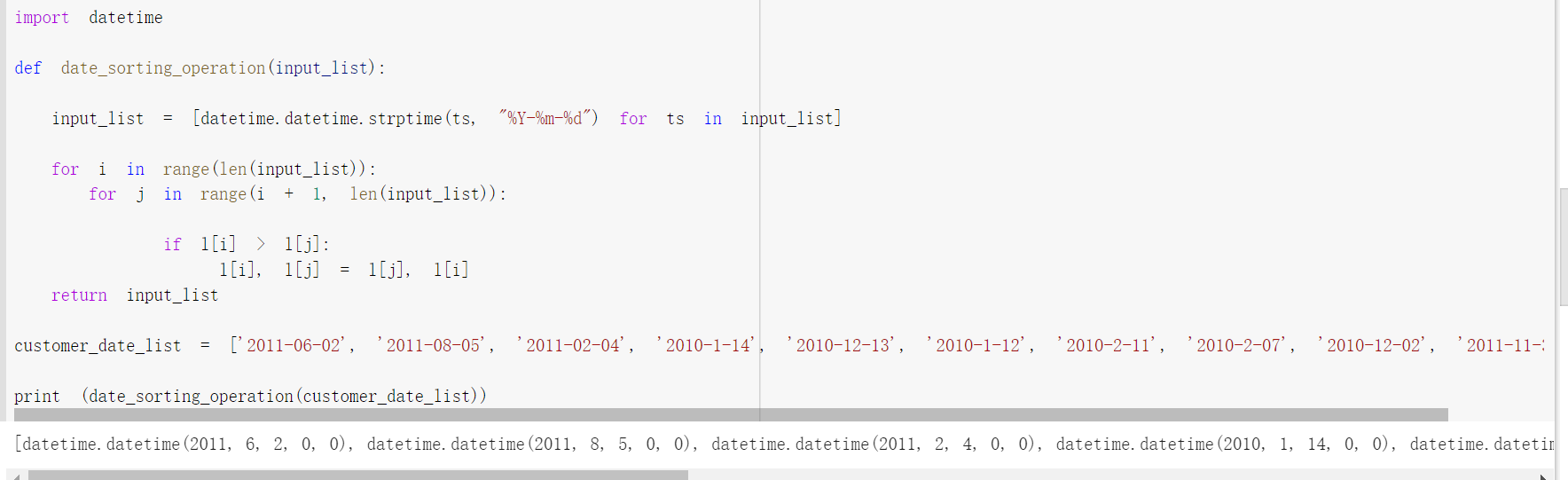
import datetime

def date_sorting_operation(input_list):

  input_list = [datetime.datetime.strptime(ts, "%Y-%m-%d") for ts in input_list]

  for i in range(len(input_list)):
    for j in range(i + 1, len(input_list)):

        if l[i] > l[j]:
           l[i], l[j] = l[j], l[i]
  return input_list

customer_date_list = ['2011-06-02', '2011-08-05', '2011-02-04', '2010-1-14', '2010-12-13', '2010-1-12', '2010-2-11', '2010-2-07', '2010-12-02', '2011-11-30']

print (date_sorting_operation(customer_date_list))
第二版代码:
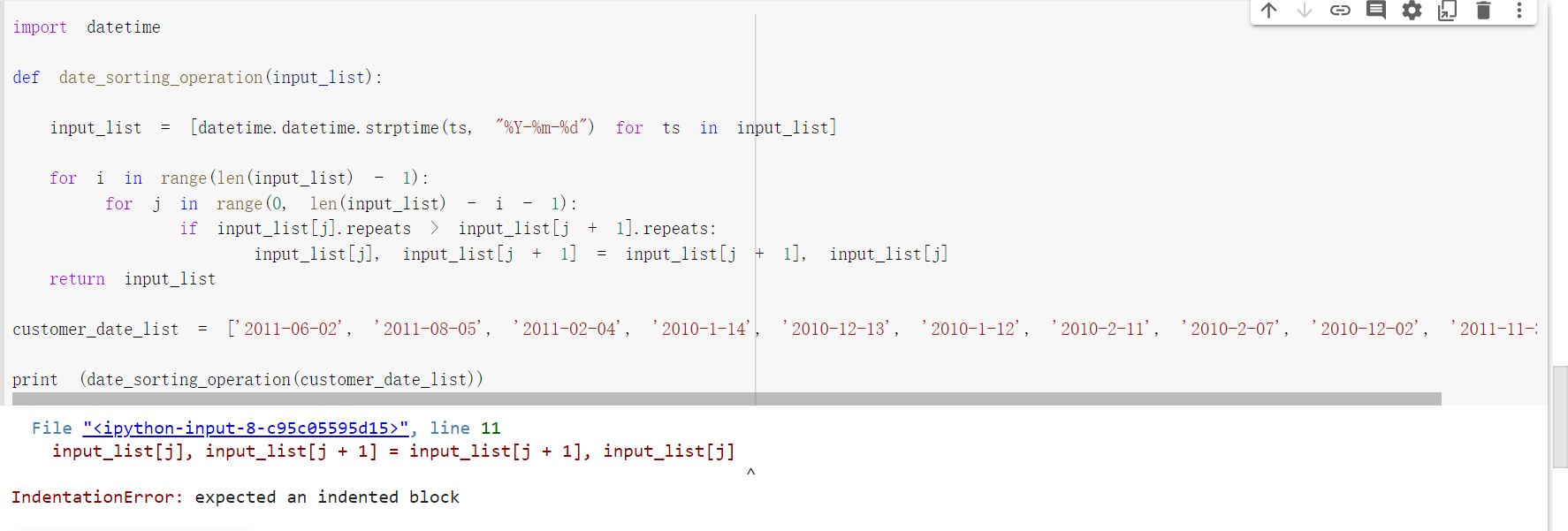
import datetime

def date_sorting_operation(input_list):

  input_list = [datetime.datetime.strptime(ts, "%Y-%m-%d") for ts in input_list]

  for i in range(len(input_list) - 1):
     for j in range(0, len(input_list) - i - 1):
         if input_list[j].repeats > input_list[j + 1].repeats:
             input_list[j], input_list[j + 1] = input_list[j + 1], input_list[j]
  return input_list

customer_date_list = ['2011-06-02', '2011-08-05', '2011-02-04', '2010-1-14', '2010-12-13', '2010-1-12', '2010-2-11', '2010-2-07', '2010-12-02', '2011-11-30']

print (date_sorting_operation(customer_date_list))
(pic)关于代码和输出第一版:
(pic)关于代码和输出第二版:
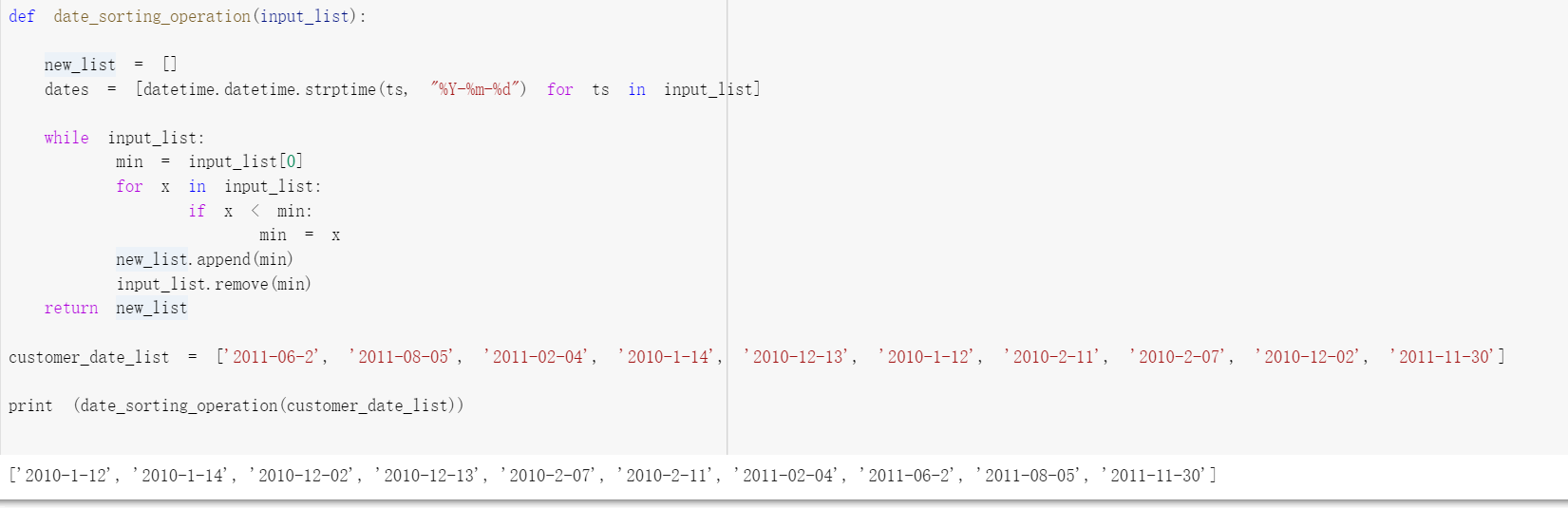
(第三版)只试着使用"input_list",删除"new_list“以节省内存--如果那样的话,我怎么做?
import datetime

def date_sorting_operation(input_list):

  new_list = []
  dates = [datetime.datetime.strptime(ts, "%Y-%m-%d") for ts in input_list]

  while input_list:
      min = input_list[0]
      for x in input_list:
          if x < min:
              min = x
      new_list.append(min)
      input_list.remove(min)
  return new_list

customer_date_list = ['2011-06-2', '2011-08-05', '2011-02-04', '2010-1-14', '2010-12-13', '2010-1-12', '2010-2-11', '2010-2-07', '2010-12-02', '2011-11-30']

print (date_sorting_operation(customer_date_list))
(图)尝试使用"input_list",删除"new_list“以节省内存:
回答 2
Stack Overflow用户
回答已采纳
发布于 2022-09-29 02:45:19
尝尝这个
import datetime


customer_date_list = ['2011-06-02', '2011-08-05', '2011-02-04', '2010-1-14', '2010-12-13', '2010-1-12', '2010-2-11', '2010-2-07', '2010-12-02', '2011-11-30']

lst = [datetime.datetime.strptime(ts, "%Y-%m-%d") for ts in customer_date_list]

outLst = []
for _ in customer_date_list:
    m = min(lst)
    lst.remove(m)
    outLst.append(m.strftime('%Y-%m-%d'))

print(outLst)
输出
['2010-01-12', '2010-01-14', '2010-02-07', '2010-02-11', '2010-12-02',
 '2010-12-13', '2011-02-04', '2011-06-02', '2011-08-05', '2011-11-30']
正如OP所说的,“我可以使用一个列表lst (没有outLst )保存在同一个列表上。(为了节省内存)。”
import datetime


customer_date_list = ['2011-06-02', '2011-08-05', '2011-02-04', '2010-1-14', '2010-12-13', '2010-1-12', '2010-2-11', '2010-2-07', '2010-12-02', '2011-11-30']

lst = [datetime.datetime.strptime(ts, "%Y-%m-%d") for ts in customer_date_list]


for i in range(len(customer_date_list)):
    m = max(lst[i:])
    lst.remove(m)
    lst.insert(0,m.strftime('%Y-%m-%d'))

print(lst)
输出
['2010-01-12', '2010-01-14', '2010-02-07', '2010-02-11', '2010-12-02',
'2010-12-13', '2011-02-04', '2011-06-02', '2011-08-05', '2011-11-30']Stack Overflow用户
发布于 2022-09-29 02:39:09
实际上,您的文本日期列表几乎是ISO可排序格式,只是有时月份可能是一位数而不是两位数。如果我们给这个月留下了零,那么排序应该是有效的:
customer_date_list = ['2011-06-02', '2011-08-05', '2011-02-04', '2010-1-14', '2010-12-13', '2010-1-12', '2010-2-11', '2010-2-07', '2010-12-02', '2011-11-30']
output = [re.sub(r'-(\d)-', r'-0\1-', x) for x in customer_date_list]
output.sort()
print(output)

['2010-01-12', '2010-01-14', '2010-02-07', '2010-02-11', '2010-12-02',
'2010-12-13', '2011-02-04', '2011-06-02', '2011-08-05', '2011-11-30']页面原文内容由Stack Overflow提供。腾讯云小微IT领域专用引擎提供翻译支持
原文链接:
https://stackoverflow.com/questions/73889704
复制相关文章
相似问题
腾讯云开发者

Copyright © 2013 - 2026 Tencent Cloud. All Rights Reserved. 腾讯云 版权所有
深圳市腾讯计算机系统有限公司 ICP备案/许可证号:粤B2-20090059  粤公网安备44030502008569号
腾讯云计算(北京)有限责任公司 京ICP证150476号 | 京ICP备11018762号