
使用CPUID获取Ryzen CPU中的缓存大小
我想使用CPUID指令来获取每个缓存级别(L1、L2、L3)的大小。
我一直在读"AMD64体系结构程序员手册“第3卷:一般用途和系统说明。在第613页中有与L1相关的信息:
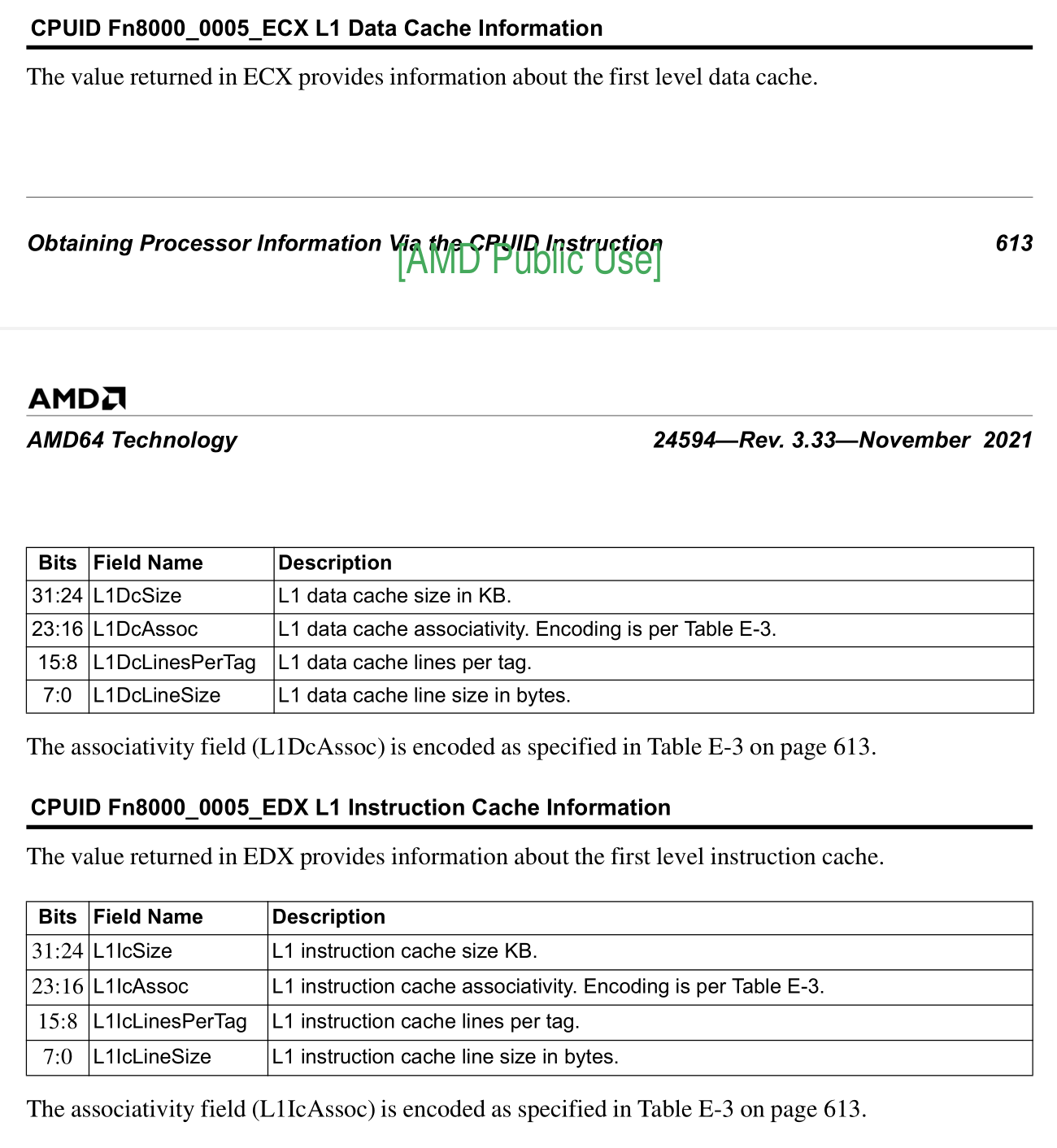
在第616页中有与L2和L3相关的信息。
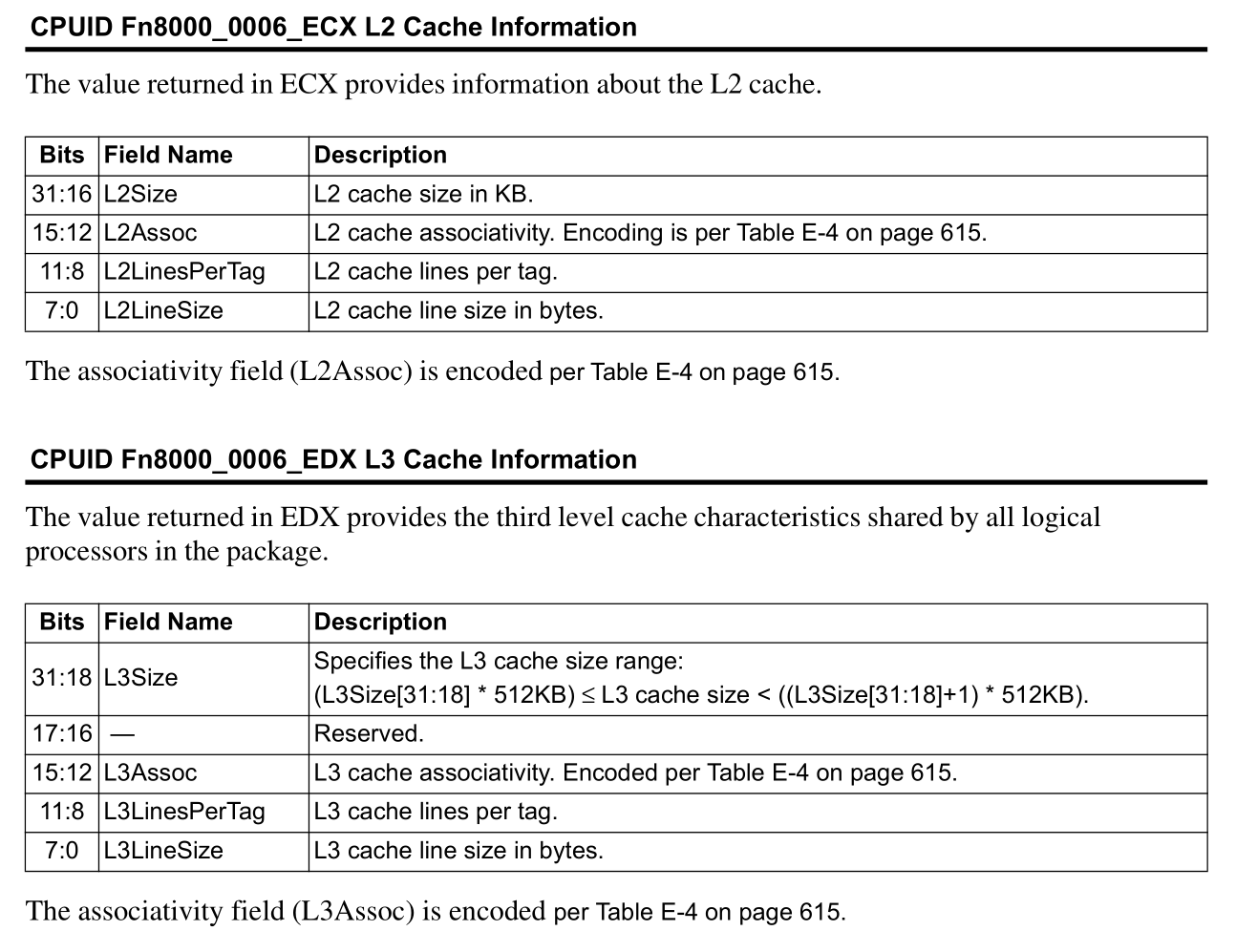
我制作了一个简单的C+assembly程序来打印这些值。
const char* amd_L2_L3_associotivity_str(uint32_t code)
{
    switch(code) {
        case 0: return "Disabled";
        case 1: return "1 way (direct mapped)";
        case 2: return "2 way";
        case 4: return "4 way";
        case 6: return "8 way";
        case 8: return "16 way";
        case 10: return "32 way";
        case 11: return "48 way";
        case 12: return "64 way";
        case 13: return "96 way";
        case 14: return "128 way";
        case 15: return "Fully Associative";
        default: assert(0);
    }
    return 0;
}

void cpuid_caches_amd()
{
    uint32_t eax, ebx, ecx, edx;
    { // L1
        eax = 0x80000005; // the specific code of the cpuid instruction for L1

        __asm__ (
            "cpuid" // cpuid is the name of the instruction that queries the info we want
            : "+a" (eax)
            , "=b" (ebx)
            , "=c" (ecx)
            , "=d" (edx)
        );

        uint32_t
            dataCache_size = ecx & 0xFF,
            dataCache_associativity = (ecx >> 8) & 0xFF,
            dataCache_linesPerTag = (ecx >> 16) & 0xFF,
            dataCache_lineSize = (ecx >> 24) & 0xFF;

        uint32_t
            instrCache_size = edx & 0xFF,
            instrCache_associativity = (edx >> 8) & 0xFF,
            instrCache_linesPerTag = (edx >> 16) & 0xFF,
            instrCache_lineSize = (edx >> 24) & 0xFF;

        printf(
            "L1 Data Cache:\n"
            "\tSize: %d KB\n"
            "\tAssociativity: %d\n"
            "\tLines per Tag: %d\n"
            "\tLine Size: %d B\n"
            "\n"
            "L1 Instruction Cache:\n"
            "\tSize: %d KB\n"
            "\tAssociativity: %d\n"
            "\tLines per Tag: %d\n"
            "\tLine Size: %d B\n"
            ,
            dataCache_size,
            dataCache_associativity,
            dataCache_linesPerTag,
            dataCache_lineSize,
            instrCache_size,
            instrCache_associativity,
            instrCache_linesPerTag,
            instrCache_lineSize
        );
    }

    { // L2, L3
        eax = 0x80000006; // the specific code of the cpuid instruction for L1

        __asm__ (
            "cpuid" // cpuid is the name of the instruction that queries the info we want
            : "+a" (eax)
            , "=b" (ebx)
            , "=c" (ecx)
            , "=d" (edx)
        );

        uint32_t
            L2_size = ecx & 0xFFFF,
            L2_associativity = (ecx >> 16) & 0xF,
            L2_linesPerTag = (ecx >> 20) & 0xF,
            L2_lineSize = (ecx >> 24) & 0xFF;


        uint32_t
            L3_size = edx & 0x3FFF,
            L3_associativity = (edx >> 16) & 0xF,
            L3_linesPerTag = (edx >> 20) & 0xF,
            L3_lineSize = (edx >> 24) & 0xFF;

        printf(
            "L2 Cache:\n"
            "\tSize: %d KB\n"
            "\tAssociativity: %s\n"
            "\tLines per Tag: %d\n"
            "\tLine Size: %d B\n"
            "\n"
            "L3 Cache:\n"
            "\tSize: %d KB\n"
            "\tAssociativity: %s\n"
            "\tLines per Tag: %d\n"
            "\tLine Size: %d B\n"
            ,
            L2_size,
            amd_L2_L3_associotivity_str(L2_associativity),
            L2_linesPerTag,
            L2_lineSize,
            L3_size * 512,
            amd_L2_L3_associotivity_str(L3_associativity),
            L3_linesPerTag,
            L3_lineSize
        );
    }
}

int main()
{
    cpuid_caches_amd();
}
这是我的Ryzen 3700X程序的输出:
L1 Data Cache:
        Size: 64 KB
        Associativity: 1
        Lines per Tag: 8
        Line Size: 32 B

L1 Instruction Cache:
        Size: 64 KB
        Associativity: 1
        Lines per Tag: 8
        Line Size: 32 B
L2 Cache:
        Size: 24896 KB
        Associativity: Disabled
        Lines per Tag: 0
        Line Size: 2 B

L3 Cache:
        Size: 2260992 KB
        Associativity: Disabled
        Lines per Tag: 0
Line Size: 1 B根据这一点,我有2GB的L3缓存,这是不可能的。根据官方规范,它应该有L1: 512 4MB,L2: 4MB,L3: 32 4MB。
另一件让我困惑的是,L1DcSize只有8位宽。这只允许表示高达255 to的L1大小,尽管我的L1应该有512 to的L1!
我的密码怎么了?如何获得实际的缓存大小?
编辑:
谢谢大家的回复。正如人们所指出的,我的位移位是颠倒的。仍然存在关于缓存L1的问题。这就是代码现在的样子:
void cpuid_caches_amd()
{
    uint32_t eax, ebx, ecx, edx;
    { // L1
        eax = 0x80000005; // the specific code of the cpuid instruction for L1

        __asm__ (
            "cpuid" // cpuid is the name of the instruction that queries the info we want
            : "+a" (eax)
            , "=b" (ebx)
            , "=c" (ecx)
            , "=d" (edx)
        );

        uint32_t
            dataCache_size = (ecx >> 24) & 0xFF,
            dataCache_associativity = (ecx >> 16) & 0xFF,
            dataCache_linesPerTag = (ecx >> 8) & 0xFF,
            dataCache_lineSize = ecx & 0xFF;

        uint32_t
            instrCache_size = (edx >> 24) & 0xFF,
            instrCache_associativity = (edx >> 16) & 0xFF,
            instrCache_linesPerTag = (edx >> 8) & 0xFF,
            instrCache_lineSize = edx & 0xFF;

        printf(
            "L1 Data Cache:\n"
            "\tSize: %d KB\n"
            "\tAssociativity: %d\n"
            "\tLines per Tag: %d\n"
            "\tLine Size: %d B\n"
            "\n"
            "L1 Instruction Cache:\n"
            "\tSize: %d KB\n"
            "\tAssociativity: %d\n"
            "\tLines per Tag: %d\n"
            "\tLine Size: %d B\n"
            ,
            dataCache_size,
            dataCache_associativity,
            dataCache_linesPerTag,
            dataCache_lineSize,
            instrCache_size,
            instrCache_associativity,
            instrCache_linesPerTag,
            instrCache_lineSize
        );
    }

    { // L2
        eax = 0x80000006; // the specific code of the cpuid instruction for L1

        __asm__ (
            "cpuid" // cpuid is the name of the instruction that queries the info we want
            : "+a" (eax)
            , "=b" (ebx)
            , "=c" (ecx)
            , "=d" (edx)
        );

        uint32_t
            L2_size = (ecx >> 16) & 0xFFFF,
            L2_associativity = (ecx >> 12) & 0xF,
            L2_linesPerTag = (ecx >> 8) & 0xF,
            L2_lineSize = ecx & 0xFF;


        uint32_t
            L3_size = (edx >> 18) & 0x3FFF,
            L3_associativity = (edx >> 12) & 0xF,
            L3_linesPerTag = (edx >> 8) & 0xF,
            L3_lineSize = (edx >> 0) & 0xFF;

        printf(
            "L2 Cache:\n"
            "\tSize: %d KB\n"
            "\tAssociativity: %s\n"
            "\tLines per Tag: %d\n"
            "\tLine Size: %d B\n"
            "\n"
            "L3 Cache:\n"
            "\tSize: %d KB\n"
            "\tAssociativity: %s\n"
            "\tLines per Tag: %d\n"
            "\tLine Size: %d B\n"
            ,
            L2_size,
            amd_L2_L3_associotivity_str(L2_associativity),
            L2_linesPerTag,
            L2_lineSize,
            L3_size * 512,
            amd_L2_L3_associotivity_str(L3_associativity),
            L3_linesPerTag,
            L3_lineSize
        );
    }
}
新的产出:
L1 Data Cache:
        Size: 32 KB
        Associativity: 8
        Lines per Tag: 1
        Line Size: 64 B

L1 Instruction Cache:
        Size: 32 KB
        Associativity: 8
        Lines per Tag: 1
        Line Size: 64 B
L2 Cache:
        Size: 512 KB
        Associativity: 8 way
        Lines per Tag: 1
        Line Size: 64 B

L3 Cache:
        Size: 32768 KB
        Associativity: Value for all fields should be determined from Fn8000_001D
        Lines per Tag: 1
Line Size: 64 B回答 1
Stack Overflow用户
发布于 2022-08-19 14:52:50
似乎你弄错了结果的位布局。大小结果在上位,但您正在提取下位。其他字段的顺序也类似地相反。
例如,L3Size在31:18中,但是您使用没有移位的0x3FFF掩码,它使用13:0。
而不是:
L3_size = edx & 0x3FFF,
L3_associativity = (edx >> 16) & 0xF,
L3_linesPerTag = (edx >> 20) & 0xF,
L3_lineSize = (edx >> 24) & 0xFF;
写入:
L3_size = (edx >> 18) & 0x3FFF,
L3_associativity = (edx >> 12) & 0xF,
L3_linesPerTag = (edx >> 8) & 0xF,
L3_lineSize = (edx >> 0) & 0xFF;
对其他寄存器也做同样的事情。字段的最低位数是您必须移动的数量。
至于关于L1大小的第二个问题,规格表有芯片总数。然而,从CPUID的角度来看,重要的是核心的缓存。如果将32 kiB of L1i和32 kiB of L1d乘以处理器中的8核,就会得到预期的512 kiB。
https://stackoverflow.com/questions/73418161
复制相似问题
腾讯云开发者

Copyright © 2013 - 2026 Tencent Cloud. All Rights Reserved. 腾讯云 版权所有
深圳市腾讯计算机系统有限公司 ICP备案/许可证号:粤B2-20090059  粤公网安备44030502008569号
腾讯云计算(北京)有限责任公司 京ICP证150476号 | 京ICP备11018762号