
在r中的摘要函数中进行过滤或基于filter - Reprex对前面的行进行求和。
我试图根据name_ex的筛选器和指定的循环数来对前面的数据行进行求和。更具体而言:
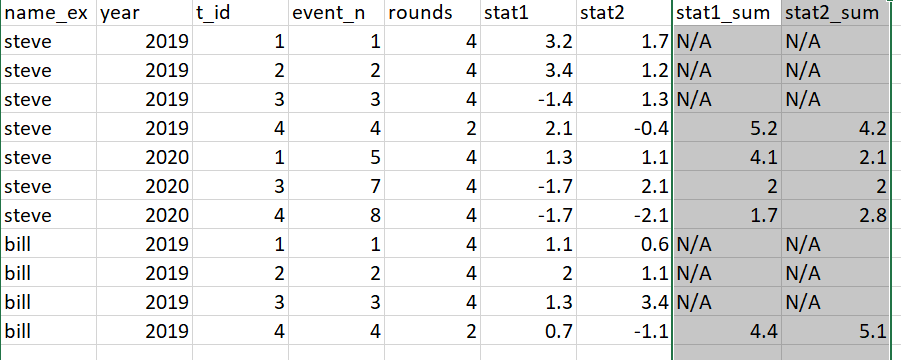
目标:分别对前3行stat1和stat2进行求和。只有在符合name_ex标准的情况下,这些总和才会出现。ie只与stat1和stat2从史蒂夫的行(之和史蒂夫的数据,比尔的数据,但避免使用史蒂夫的数据在比尔的。)
附加目标:最好是,而不是仅对最后3行进行求和,我想根据一个循环筛选器对stat1和stat2行进行求和。我不确定这在dplyr函数中是否可以实现,或者我是否需要编写一个函数来实现它。
Work: --我使用group_by函数以它想要的形式获取数据,这样我就可以使用动物园对最后3行数据进行求和。
问题:函数只调用最后3行数据,而不考虑标准。这是个问题,因为我无法按每个人的名字将数据分开(比尔从史蒂夫的名字中提取)。此外,我正在寻找一个简单的筛选器,它可以拉出符合name_ex标准并且轮数在10到12之间(累计)的行。
#Load packages
library(dplyr)
library(tidyverse)
library(zoo)

#Reprex
name_ex <- c("steve", "steve","steve", "steve","steve","steve", "steve", "bill", "bill", "bill", "bill", "bill", "bill", "bill", "bill", "john","john","john", "john","john","john", "john")
rounds <- c(4, 4, 4, 2, 4, 4, 4, 4, 4, 4, 2, 4, 2, 4, 2, 4, 4, 4, 4, 4, 4, 2)
t_id <- c(1, 2, 3, 4, 1, 3, 4, 1, 2, 3, 4, 1, 2, 3, 4, 1, 2, 4, 1, 2, 3, 4)
year <- c(2019, 2019,2019, 2019, 2020, 2020, 2020, 2019, 2019, 2019, 2019, 2020, 2020, 2020, 2020, 2019, 2019, 2019, 2020, 2020, 2020, 2020)
stat1 <- c(3.2, 3.4, -1.4, 2.1, 1.3, -1.7, -1.7, 1.1, 2.0, 1.3, .7, 1.5, 1.2, 2.5, 3.6, -1.1, 0.4, -1.2, -1.1, 1.6, 1.3, -2.7)
stat2 <- c(1.7, 1.2, 1.3, -.4, 1.1, 2.1, -2.1, .6, 1.1, 3.4, -1.1, -1.7, -1.3, 1.1, 2.4, 1.3, 2.6, .6, 1.3, .7, 2.3, -2.4)
event_n <- c(1, 2, 3, 4, 5, 7, 8, 1, 2, 3, 4, 5, 6, 7, 8, 1, 2, 4, 5, 6, 7, 8)
test_df <- do.call(rbind, Map(data.frame, name_ex =name_ex, year = year, t_id = t_id, event_n = event_n, rounds =rounds, stat1 = stat1, stat2 = stat2))

#Sum the previous 3 columns of data for stat1 and stat2
test_df2 <- test_df %>%
  group_by(name_ex, t_id, year)

test_df2$stat1_sum <- lag(rollsumr(test_df2$stat1, k = 3, fill = NA))
test_df2$stat2_sum <- lag(rollsumr(test_df2$stat2, k = 3, fill = NA))
test_df2

#bad attempt at filtering for name
#test_df2$stat1_sum <- lag(rollsumr(test_df2$stat1[name_ex == name_ex], k = 3, fill = NA))回答 1
Stack Overflow用户
发布于 2022-08-11 16:09:28
我认为,如果您首先将数据转换为长格式,那么您的第一个问题可以很容易地使用dplyr回答。(这也使您的数据整洁。)
longDF <- test_df %>%
  pivot_longer(
    starts_with("stat"),
    names_to="Statistic",
    values_to="Value"
  ) %>%
  arrange(Statistic, name_ex, year) %>%
  group_by(name_ex, Statistic) %>%
  mutate(
    ValueLag1=lag(Value),
    ValueLag2=lag(Value, 2)
  )
longDF
# A tibble: 44 × 9
# Groups:   name_ex, Statistic [6]
   name_ex  year  t_id event_n rounds Statistic Value ValueLag1 ValueLag2
   <chr>   <dbl> <dbl>   <dbl>  <dbl> <chr>     <dbl>     <dbl>     <dbl>
 1 bill     2019     1       1      4 stat1       1.1      NA        NA
 2 bill     2019     2       2      4 stat1       2         1.1      NA
 3 bill     2019     3       3      4 stat1       1.3       2         1.1
 4 bill     2019     4       4      2 stat1       0.7       1.3       2
 5 bill     2020     1       5      4 stat1       1.5       0.7       1.3
 6 bill     2020     2       6      2 stat1       1.2       1.5       0.7
 7 bill     2020     3       7      4 stat1       2.5       1.2       1.5
 8 bill     2020     4       8      2 stat1       3.6       2.5       1.2
 9 john     2019     1       1      4 stat1      -1.1      NA        NA
10 john     2019     2       2      4 stat1       0.4      -1.1      NA
# … with 34 more rows使用group_by()可以防止一个人的数据传递给另一个人。您可以在上面的输出中清楚地看到效果。
现在计算“最后三项之和”也很简单:
longDF %>%
  mutate(SumOfLastThree=Value + ValueLag1 + ValueLag2) %>%
  select(-ValueLag1, -ValueLag2)
# A tibble: 44 × 8
# Groups:   name_ex, Statistic [6]
   name_ex  year  t_id event_n rounds Statistic Value SumOfLastThree
   <chr>   <dbl> <dbl>   <dbl>  <dbl> <chr>     <dbl>          <dbl>
 1 bill     2019     1       1      4 stat1       1.1           NA
 2 bill     2019     2       2      4 stat1       2             NA
 3 bill     2019     3       3      4 stat1       1.3            4.4
 4 bill     2019     4       4      2 stat1       0.7            4
 5 bill     2020     1       5      4 stat1       1.5            3.5
 6 bill     2020     2       6      2 stat1       1.2            3.4
 7 bill     2020     3       7      4 stat1       2.5            5.2
 8 bill     2020     4       8      2 stat1       3.6            7.3
 9 john     2019     1       1      4 stat1      -1.1           NA
10 john     2019     2       2      4 stat1       0.4           NA
# … with 34 more rows
这能给你预期的产出吗?
考虑一下
longDF %>%
  mutate(
    CumulativeRounds=ifelse(
                       row_number() == 1,
                       rounds,
                       rounds+lag(rounds)
                     )
  )
# A tibble: 44 × 10
# Groups:   name_ex, Statistic [6]
   name_ex  year  t_id event_n rounds Statistic Value ValueLag1 ValueLag2 CumulativeRounds
   <chr>   <dbl> <dbl>   <dbl>  <dbl> <chr>     <dbl>     <dbl>     <dbl>            <dbl>
 1 bill     2019     1       1      4 stat1       1.1      NA        NA                  4
 2 bill     2019     2       2      4 stat1       2         1.1      NA                  8
 3 bill     2019     3       3      4 stat1       1.3       2         1.1                8
 4 bill     2019     4       4      2 stat1       0.7       1.3       2                  6
 5 bill     2020     1       5      4 stat1       1.5       0.7       1.3                6
 6 bill     2020     2       6      2 stat1       1.2       1.5       0.7                6
 7 bill     2020     3       7      4 stat1       2.5       1.2       1.5                6
 8 bill     2020     4       8      2 stat1       3.6       2.5       1.2                6
 9 john     2019     1       1      4 stat1      -1.1      NA        NA                  4
10 john     2019     2       2      4 stat1       0.4      -1.1      NA                  8
# … with 34 more rows
所以
longDF %>%
  select(-ValueLag1, -ValueLag2) %>%
  mutate(
    CumulativeRounds=ifelse(
                       row_number() == 1,
                       rounds,
                       rounds+lag(rounds)
                     )
  ) %>%
  filter(CumulativeRounds >= 8 & CumulativeRounds <= 10)
# A tibble: 22 × 8
# Groups:   name_ex, Statistic [6]
   name_ex  year  t_id event_n rounds Statistic Value CumulativeRounds
   <chr>   <dbl> <dbl>   <dbl>  <dbl> <chr>     <dbl>            <dbl>
 1 bill     2019     2       2      4 stat1       2                  8
 2 bill     2019     3       3      4 stat1       1.3                8
 3 john     2019     2       2      4 stat1       0.4                8
 4 john     2019     4       4      4 stat1      -1.2                8
 5 john     2020     1       5      4 stat1      -1.1                8
 6 john     2020     2       6      4 stat1       1.6                8
 7 john     2020     3       7      4 stat1       1.3                8
 8 steve    2019     2       2      4 stat1       3.4                8
 9 steve    2019     3       3      4 stat1      -1.4                8
10 steve    2020     3       7      4 stat1      -1.7                8
我相信这是你想要的。
编辑
OP现在发布了一张图片,澄清了“最后三行”的含义。我为他们问题的第一部分建议的解决方案可以很容易地适应,以产生所需的结果。
test_df %>%
  pivot_longer(
    starts_with("stat"),
    names_to="Statistic",
    values_to="Value"
  ) %>%
  arrange(Statistic, name_ex, year, t_id) %>%
  group_by(name_ex, Statistic) %>%
  mutate(
    ValueLag1=lag(Value),
    ValueLag2=lag(Value, 2),
    ValueLag3=lag(Value, 3),
    SumOfPreviousThree=ValueLag1 + ValueLag2 + ValueLag3
  ) %>%
  select(-ValueLag1, -ValueLag2, -ValueLag3)
# A tibble: 44 × 8
# Groups:   name_ex, Statistic [6]
   name_ex  year  t_id event_n rounds Statistic Value SumOfPreviousThree
   <chr>   <dbl> <dbl>   <dbl>  <dbl> <chr>     <dbl>              <dbl>
 1 bill     2019     1       1      4 stat1       1.1               NA
 2 bill     2019     2       2      4 stat1       2                 NA
 3 bill     2019     3       3      4 stat1       1.3               NA
 4 bill     2019     4       4      2 stat1       0.7                4.4
 5 bill     2020     1       5      4 stat1       1.5                4
 6 bill     2020     2       6      2 stat1       1.2                3.5
 7 bill     2020     3       7      4 stat1       2.5                3.4
 8 bill     2020     4       8      2 stat1       3.6                5.2
 9 john     2019     1       1      4 stat1      -1.1               NA
10 john     2019     2       2      4 stat1       0.4               NA
# … with 34 more rows
若要返回OP的无序格式,请将以下内容添加到管道的末尾:
%>%
  pivot_wider(
    values_from=c(Value, SumOfPreviousThree),
    names_from=Statistic
)https://stackoverflow.com/questions/73323518
复制相似问题
腾讯云开发者

Copyright © 2013 - 2026 Tencent Cloud. All Rights Reserved. 腾讯云 版权所有
深圳市腾讯计算机系统有限公司 ICP备案/许可证号:粤B2-20090059  粤公网安备44030502008569号
腾讯云计算(北京)有限责任公司 京ICP证150476号 | 京ICP备11018762号