
基于语义相似度的聚类不返回值
我有'Key_Phrases‘作为一个专栏在熊猫数据的df。其目的是根据语义相似性对它们进行聚类。我使用的是SentenceTransformer模型。
 df['Key Phrases'] is as follows

                'Key_Phrases'

0              ['BYD' 'Daiwa Capital Markets analyst' 'NIO' 'Order flows'\n 'consumer preferences' 'cost pressures' 'raw materials'\n 'regulatory pressure' 'sales cannibalization' 'sales volume growth'\n 'vehicle batteries']
1              ['CANADA' 'Canada' 'Global Carbon Pricing Challenge'\n 'Major Economies Forum' 'climate finance commitment'\n 'developing countries' 'energy security' 'food security'\n 'international shipping' 'pollution pricing']
2              ['Clean Power Plan' 'EPA' 'Environmental Protection Agency'\n 'Supreme Court' 'Supreme Court decision' 'Virginia' 'West Virginia'\n 'renewable energy' 'tax subsidies']
3              ['BlueOvalSK' 'Ford' 'Ford Motor' 'Kathleen Valley' 'LG Energy' 'Liontown'\n 'Liontown Resources' 'SK Innovation' 'SK On' 'Tesla' 'battery metals'\n 'joint venture' 'lithium spodumene concentrate'\n 'lithium supply agreement']
4              ['Emissions Trading System' 'European Commission' 'European Parliament'\n 'ICIS' 'carbon border adjustment mechanism' 'carbon leakage']
5              ['Digital Industries' 'MG Motor India' 'MindSphere'\n 'Plant Simulation software' 'Siemens' 'carbon footprints'\n 'digitalisation' 'experience' 'intelligent manufacturing'\n 'production efficiency' 'strategic collaborations']
6              ['Malaysia' 'Mosti' 'NTIS' 'National Technology and Innovation Sandbox'\n 'National Urbanisation Policy' 'Sunway Innovation Labs'\n 'Sunway iLabs Super Accelerator' 'economic growth'\n 'memorandum of understanding' 'quality of life' 'safe environment'\n 'smart cities' 'smart city sandbox' 'urban management' 'urban population']
7              ['Artificial Intelligence' 'Electricity and Water Authority'\n 'Green Mobility' 'Grid Automation' 'Internet of Things' 'Smart Dubai'\n 'Smart Energy Solutions' 'Smart Grid' 'Smart Water'\n 'artificial intelligence' 'blockchain' 'connected services'\n 'energy storage' 'integrated systems' 'interoperability' 'smart city'\n 'smart grid' 'sustainability' 'water network']
8              ['Artificial Intelligence' 'Clean Energy Strategy 2050'\n 'Dubai Electricity and Water Authority' 'Green Mobility'\n 'Grid Automation' 'Internet of Things' 'Smart Dubai'\n 'Smart Energy Solutions' 'Smart Grid' 'Smart Water'\n 'Zero Carbon Emissions Strategy' 'artificial intelligence' 'blockchain'\n 'clean energy sources' 'connected services' 'energy storage'\n 'integrated systems' 'interoperability' 'smart city' 'smart grid'\n 'sustainability']

Key_Phrases_list_1 = df['Key Phrases'].tolist()
from sentence_transformers import SentenceTransformer, util
import numpy as np

model = SentenceTransformer('distilbert-base-nli-stsb-quora-ranking')
#Encoding is done with one simple step
embeddings = model.encode(Key_Phrases_list_1, show_progress_bar=True, convert_to_numpy=True)
然后创建以下函数:
def detect_clusters(embeddings, threshold=0.90, min_community_size=20):
    # Compute cosine similarity scores
    cos_scores = util.pytorch_cos_sim(embeddings, embeddings)

    #we filter those scores according to the minimum community size we specified earlier
    # Minimum size for a community
    top_k_values, _ = cos_scores.topk(k=min_community_size, largest=True)
    # Filter for rows >= min_threshold
    extracted_communities = []
    for i in range(len(top_k_values)):
        if top_k_values[i][-1] >= threshold:
            new_cluster = []

    # Only check top k most similar entries
            top_val_large, top_idx_large = cos_scores[i].topk(k=init_max_size, largest=True)
            top_idx_large = top_idx_large.tolist()
            top_val_large = top_val_large.tolist()

            if top_val_large[-1] < threshold:
                for idx, val in zip(top_idx_large, top_val_large):
                    if val < threshold:
                        break
                        new_cluster.append(idx)
            else:
                # Iterate over all entries (slow)
                for idx, val in enumerate(cos_scores[i].tolist()):
                    if val >= threshold:
                        new_cluster.append(idx)

            extracted_communities.append(new_cluster)

    unique_communities = []
    extracted_ids = set()

    for community in extracted_communities:
        add_cluster = True
        for idx in community:
            if idx in extracted_ids:
                add_cluster = False
                break
        if add_cluster:
            unique_communities.append(community)
            for idx in community:
                extracted_ids.add(idx)
    return unique_communities
然后调用该函数:
clusters = detect_clusters(embeddings, min_community_size=6, threshold=0.75)我没有得到任何回报。我是否遗漏了detect_clusters函数中的任何内容。
回答 1
Stack Overflow用户
发布于 2022-08-03 08:51:32
当OP要求一个自动选择集群数量的解决方案时,更容易使用一些更健壮的东西,比如sklearn:
from sentence_transformers import SentenceTransformer, util
import numpy as np
model = SentenceTransformer('distilbert-base-nli-stsb-quora-ranking')
from sklearn.cluster import KMeans
from sklearn.metrics import silhouette_score
def choose_classifier(X):
    X1 = X / (X**2).sum(axis=-1, keepdims=True)
    vv = []
    cc = np.arange(2, len(X))
    for nclusters in cc:
        km_model = KMeans(nclusters).fit(X1)
        labels = km_model.labels_
        v = silhouette_score(X1, labels)
        vv.append(v)
    nclusters = cc[np.argmax(vv)]
    return KMeans(nclusters).fit(X1)
像这样使用它
phrases = [
    'I like ice cream',
    'I like cake',
    'You are so kind',
    'You are very intelligent'
]
embeddings = model.encode(phrases, show_progress_bar=True, convert_to_numpy=True)

classifier = choose_classifier(embeddings)

for i, (v, s) in enumerate(zip(embeddings, phrases)):
print(classifier.predict(v[np.newaxis]), s)[1] I like ice cream
[1] I like cake
[0] You are so kind
[0] You are very intelligentGPU能力解决方案
乍一看,我无法掌握您在代码中所做的一切,但让我建议您一些简化的方法。我使用pytorch_kmeans,并探讨了平方欧几里德距离是dot(A-B,A-B) = dot(A,A) + dot(B,B) - 2 * dot(A, B),余弦相似性是dot(A, B) / sqrt(dot(A,A) * dot(B,B))的事实。因此,(1)将A或B乘以一个标量并不会改变余弦相似性,(2)如果A和B具有相同的长度,则欧几里得极大地提高了余弦相似性。给定你想要聚类的向量集合,你可以(1)标准化所有向量,使它们具有相同的长度,(2)计算最小欧氏距离的簇。然后你就有了最大的余弦相似性的簇。
pip install kmeans_pytorch设置
既然你没有给出数据,我会自己做一个例子
import torch;
# 2D Example Data
# Generate some random data in three clusters
NPC=10
X = torch.cat([
  (torch.randn((NPC, 2)) + c) * (torch.rand((NPC,1))**2+1)/2
      for c in torch.tensor([[5,3], [-7,0], [-0, -7]])])
解决方案
这是密码
from kmeans_pytorch import kmeans
import torch
def detect_clusters(X, nclusters, tol=1e-6):
  X = torch.as_tensor(X)
  assert X.ndim == 2
  # Project the points in a hypersphere
  X1 = X / torch.sqrt(torch.sum(X**2, axis=-1, keepdims=True))

  # Run kmeans on the normalized points with euclidean distance
  cluster_ID, C = kmeans(X1, nclusters, distance='euclidean', tol=tol)
  return cluster_ID, C
示例可视化
import matplotlib.pyplot as plt
import numpy as np
import torch;

#### THE RESUTLS ####
cluster_ID, C = detect_clusters(X, 3)
# Avoid distortion of the angles
plt.axes().set_aspect('equal')
# Initial points
plt.plot(X[:,0], X[:,1], '.')
# Reference circle
theta = torch.linspace(0, 2*np.pi, 1000)
plt.plot(torch.cos(theta), torch.sin(theta), '--k')
plt.plot(X1[:,0], X1[:,1], '.')
xlim = plt.xlim()
ylim = plt.ylim()
plt.xlim(xlim)
plt.ylim(ylim)

# Draw lines in the directions given by the centroids
R = 20
for c in C:
    plt.plot([0, c[0]*R], [0, c[1]*R]);

plt.grid();
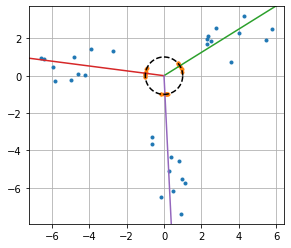
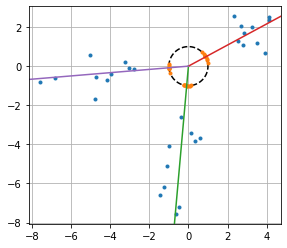
与句子嵌入一起使用
一些示例嵌入
from sentence_transformers import SentenceTransformer, util
import numpy as np

model = SentenceTransformer('distilbert-base-nli-stsb-quora-ranking')


phrases = [
    'I like ice cream',
    'I like cake',
    'You are so kind',
    'You are very intelligent'
]
embeddings = model.encode(phrases, show_progress_bar=True, convert_to_numpy=True)然后,您可以将嵌入传递给我前面提供的detect_cluster函数。
label, center = detect_clusters(torch.as_tensor(embeddings), 2)
for c, s in zip(label, phrases):
    print(f'[{c}] {s}')
,这将给出相应的聚类的句子。
[0] I like ice cream
[0] I like cake
[1] You are so kind
[1] You are very intelligenthttps://stackoverflow.com/questions/73183103
复制相似问题
腾讯云开发者

Copyright © 2013 - 2026 Tencent Cloud. All Rights Reserved. 腾讯云 版权所有
深圳市腾讯计算机系统有限公司 ICP备案/许可证号:粤B2-20090059  粤公网安备44030502008569号
腾讯云计算(北京)有限责任公司 京ICP证150476号 | 京ICP备11018762号