
Python:试图计算整数中的1位数,但缺少1位
Python:试图计算整数中的1位数,但缺少1位
提问于 2022-05-31 03:01:47
Input: n = 00000000000000000000000000001011
Output: 3
Explanation: The input binary string 00000000000000000000000000001011 has a total of three '1' bits.
当我在下面运行我的代码时,似乎只有两个1被识别.为什么会这样呢?
class Solution(object):
    def hammingWeight(self, n):
        """
        :type n: int
        :rtype: int
        """

        sum = 0

        for i in str(n):
            sum += int(i)

        return sum
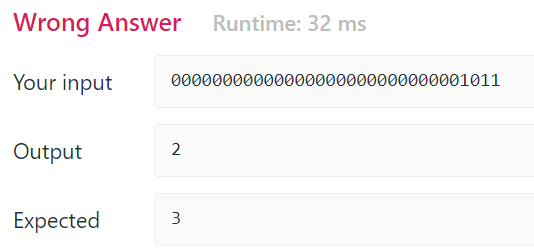
我想我误解了一些概念。希望你能给我一些指导。
回答 2
Stack Overflow用户
发布于 2022-06-02 09:13:08
Python 3.10引入了计数(),但是如果您必须自己实现该算法,那么您可以尝试如下所示:
test.py:
def count(n):
    bits = 0

    while n:
        bits += 1
        n &= n - 1

    return bits


def main():
    n = 0b110001010000000000111
    c = count(n)

    print(f"Bit length: {n.bit_length()}, bits: {c}")


if __name__ == "__main__":
    main()
测试:
$ python test.py
Bit length: 21, bits: 7该算法的时间复杂度为O(k),其中k为设置为1的位数。
Stack Overflow用户
发布于 2022-10-27 20:09:48
将str(n)转换为bin(n)[2:]。通过这种方式,您将得到带有省略"0b“前缀的n的二进制表示字符串。
顺便说一句,你不需要在循环中手动计数。Python有.count()
return bin(n).count("1")页面原文内容由Stack Overflow提供。腾讯云小微IT领域专用引擎提供翻译支持
原文链接:
https://stackoverflow.com/questions/72441824
复制相关文章
相似问题
腾讯云开发者

Copyright © 2013 - 2026 Tencent Cloud. All Rights Reserved. 腾讯云 版权所有
深圳市腾讯计算机系统有限公司 ICP备案/许可证号:粤B2-20090059  粤公网安备44030502008569号
腾讯云计算(北京)有限责任公司 京ICP证150476号 | 京ICP备11018762号