
Google云转录API
我想在双向通话中计算每一位发言者的通话时间,包括说话人的标记、转录、说话人持续时间的时间戳以及对此的信心。
例如:我有一个客户服务支持的mp3文件和两个扬声器计数。我想知道说话人带着说话人标签的时间,抄写的时间和信心。
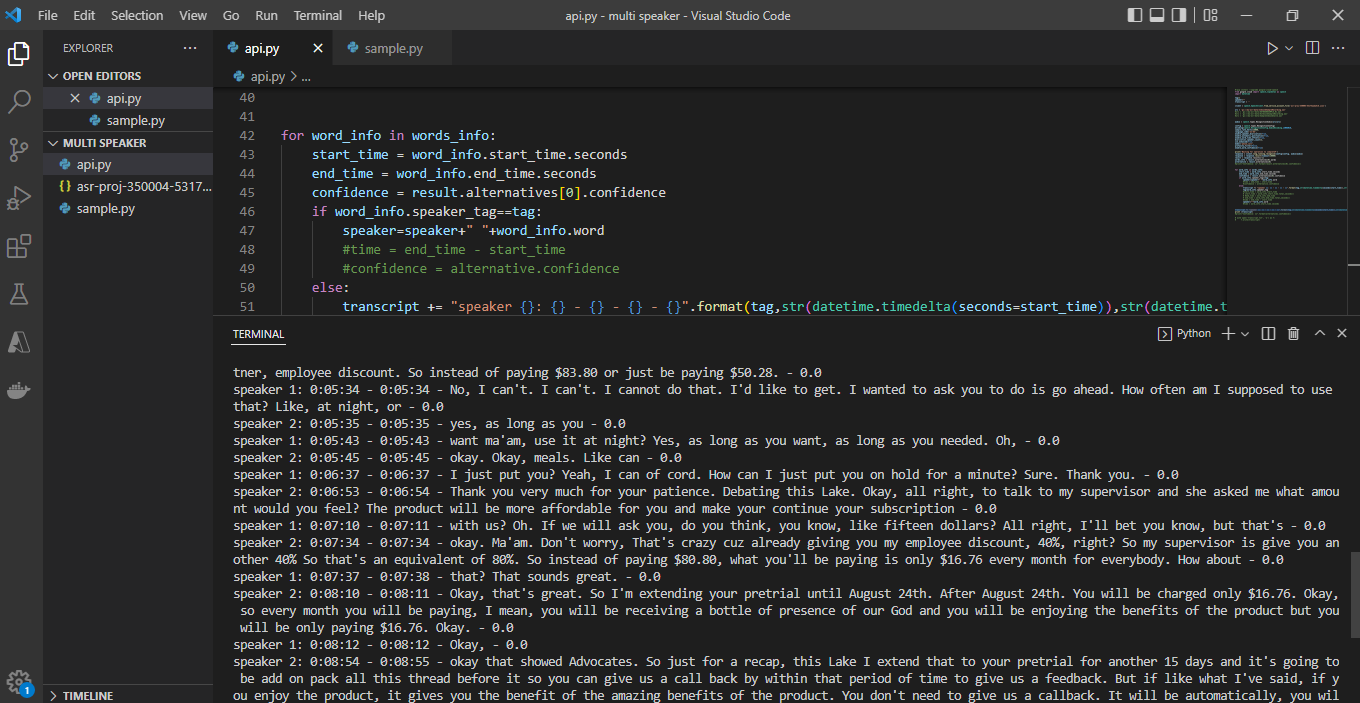
我面临的问题是结束时间和对抄写的信心。我有信心,因为0在转录和结束时间是不适合的实际结束时间。
音频链接:DKP2unNxQzMIYlNW/view?usp=共享
  **strong text**
  #!pip install --upgrade google-cloud-speech
from google.cloud import speech_v1p1beta1 as speech

import datetime

tag=1

speaker=""

transcript = ''

client = speech.SpeechClient.from_service_account_file('#cloud_credentials')


audio = speech.types.RecognitionAudio(uri=gs_uri)

config = speech.types.RecognitionConfig(
encoding=speech.RecognitionConfig.AudioEncoding.LINEAR16,
sample_rate_hertz=16000,
language_code='en-US',
enable_speaker_diarization=True,
enable_automatic_punctuation=True,
enable_word_time_offsets=True,
diarization_speaker_count=2,
use_enhanced=True,
model='phone_call',
profanity_filter=False,
enable_word_confidence=True)

print('Waiting for operation to complete…')

operation = client.long_running_recognize(config=config, audio=audio)

response = operation.result(timeout=100000)

with open('output_file.txt', "w") as text_file:

    for result in response.results:
        alternative = result.alternatives[0]
            confidence = result.alternatives[0].confidence
            current_speaker_tag=-1
            transcript = ""
            time = 0
            for word in alternative.words:
                if word.speaker_tag != current_speaker_tag:
                   if (transcript != ""):
                      print(u"Speaker {} - {} - {} - {}".format(current_speaker_tag, str(datetime.timedelta(seconds=time)), transcript, confidence), file=text_file)
                   transcript = ""
                   current_speaker_tag = word.speaker_tag
                   time = word.start_time.seconds

                transcript = transcript + " " + word.word
     if transcript != "":
         print(u"Speaker {} - {} - {} - {}".format(current_speaker_tag, str(datetime.timedelta(seconds=time)), transcript, confidence), file=text_file)
     print(u"Speech to text operation is completed, output file is created: {}".format('output_file.txt'))
回答 1
Stack Overflow用户
发布于 2022-06-15 05:40:13
问题中的代码和屏幕截图各不相同。然而,从截图中可以理解,您正在使用speech to text speaker diarization方法创建单个演讲者的演讲。
在这里,您无法计算每个说话人的不同自信,因为response包含每个文本和单个单词的confidence值。一份记录可以包含也可以不包含多个说话者的话,取决于音频。
同样,根据文档,response在最后一个结果列表中包含所有带有speaker_tag的words。从医生那里
每个结果中的文字记录是分开的,每个结果都是顺序的。然而,备选案文中的清单一词包括迄今为止所有结果中的所有词语。因此,要获得带有扬声器标记的所有单词,只需从最后结果中获取单词列表即可。
对于最后一个结果列表,置信度为0。您可以在控制台或任何文件中写入响应并自己调试。
# Detects speech in the audio file
operation = client.long_running_recognize(config=config, audio=audio)
response = operation.result(timeout=10000)

# check the whole response
with open('output_file.txt', "w") as text_file:
   print(response,file=text_file)
或者你也可以打印个人成绩单和自信,以便更好地理解.eg:
#confidence for each transcript
for result in response.results:
   alternative = result.alternatives[0]
   print("Transcript: {}".format(alternative.transcript))
   print("Confidence: {}".format(alternative.confidence))
对于每个演讲者的持续时间问题,您计算的是每个单词的开始时间和结束时间,而不是单个发言者的起始时间和结束时间。这个想法应该是这样的:-
- 获取演讲者的第一个单词的起始时间作为持续时间开始时间。
- 总是将每个单词的结束时间设置为持续结束时间,因为我们不知道下一个单词是否有不同的发言人。
- 注意说话人的变化,如果说话人是相同的,那么只需在修改后的抄本中添加单词,否则也会做同样的事情,并重新设置新发言人的开始时间。例:
tag=1
speaker=""
transcript = ''
start_time=""
end_time=""

for word_info in words_info:
   end_time = word_info.end_time.seconds   #tracking the end time of speech
   if start_time=='' :
       start_time = word_info.start_time.seconds #setting the value only for first time
   if word_info.speaker_tag==tag:
       speaker=speaker+" "+word_info.word
   else:
       transcript += "speaker {}: {}-{} - {}".format(tag,str(datetime.timedelta(seconds=start_time)),str(datetime.timedelta(seconds=end_time)),speaker) + '\n'
       tag=word_info.speaker_tag
       speaker=""+word_info.word
       start_time = word_info.start_time.seconds #resetting the starttime as we found a new speaker

transcript += "speaker {}: {}-{} - {}".format(tag,str(datetime.timedelta(seconds=start_time)),str(datetime.timedelta(seconds=end_time)),speaker) + '\n'我已经删除了修改成绩单中的信心部分,因为它将始终是0。还请记住,Speaker diarization仍处于beta开发阶段,您可能无法得到所需的确切输出。
https://stackoverflow.com/questions/72429536
复制相似问题
腾讯云开发者

Copyright © 2013 - 2026 Tencent Cloud. All Rights Reserved. 腾讯云 版权所有
深圳市腾讯计算机系统有限公司 ICP备案/许可证号:粤B2-20090059  粤公网安备44030502008569号
腾讯云计算(北京)有限责任公司 京ICP证150476号 | 京ICP备11018762号