
从熊猫数据框架创建python字典
从熊猫数据框架创建python字典
提问于 2022-05-12 08:27:17
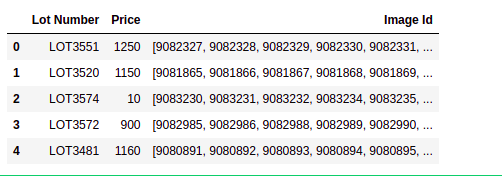
我有一只熊猫,它有三栏Lot Number,Price和Image Id。我必须用以下格式创建一个JSON文件
{'1200-1300':{'LOT3551': [9082327, 9082329],
              'LOT3293':[982832, 898762, 887654]
             },
 '1300-1400': {'LOT2219': [776542, 119234]
              }
}
字典中的第一级键,即“1200-1300”、“1300-1400”等是价格范围。价格范围内的键是属于价格范围内的批号,它们的值是来自Image列的值。
到目前为止,我已经尝试了以下代码
for idx, gid_list in enumerate(df['AV Gid']):
    data = df.iloc[idx]
    lot_no = data['Lot Number']
    price = data['Final Price']
    gids = gid_list.replace("[","").replace("]","").split(",")
    if price >= 1000 and price < 1100:
        pr = '10-11'
    elif price >= 1100 and price < 1200:
        pr = '11-12'
    else:
        continue
    print(pr)

    if lot_no in sample_dict[pr]:
        sampe_dict[pr][lot_no].append(gid)
    else:
        #print(pr)
        sample_dict[pr][lot_no] = []
其中,sample_dict有键作为价格范围。上述代码的问题在于,它还填充了其他价格范围键。
回答 2
Stack Overflow用户
发布于 2022-05-12 10:19:17
我会做这样的事
price_ranges = {'10-11': [1000, 1099], '11-12': [1100, 1199], '0-10': [0, 999]}

sample_dict = dict.fromkeys(price_ranges.keys(), {})

def look_for_range(price, price_ranges=price_ranges):
    for label, (low, high) in price_ranges.items():
        if low <= price <= high:
            return label

def compose_range_dict(row, sample_dict = sample_dict):
    range_label = look_for_range(row['PRICE'])
    if range_label is not None:
        sample_dict[range_label].update({row['LOTNUMBER']: row['IMAGE_ID']})
然后
import pandas as pd

# dictionary of lists
testdict = {'LOTNUMBER':['LOT3551', 'LOT3520', 'LOT3574', 'LOT3572'],
            'PRICE': [1250, 1150, 10, 900],
            'IMAGE_ID':[[9082327, 9082328, 9082329],
                        [9081865, 9081866, 9081867],
                        [9083230, 9083231, 9083232],
                        [9082985, 9082986, 9082988]]}

testdf = pd.DataFrame(testdict)

testdf.apply(compose_range_dict, axis = 1)

# >>> sample_dict
# {'10-11': {'LOT3520': [9081865, 9081866, 9081867], 'LOT3574': [9083230, 9083231, 9083232], 'LOT3572': [9082985, 9082986, 9082988]},
# '11-12': {'LOT3520': [9081865, 9081866, 9081867], 'LOT3574': [9083230, 9083231, 9083232], 'LOT3572': [9082985, 9082986, 9082988]},
# '0-10': {'LOT3520': [9081865, 9081866, 9081867], 'LOT3574': [9083230, 9083231, 9083232], 'LOT3572': [9082985, 9082986, 9082988]}}Stack Overflow用户
发布于 2022-05-12 11:35:15
如果df是您的数据,您可以尝试:
data = {
    f"{p}-{p + 100}": ser.to_dict()
    for p, ser in df.assign(Price=df["Price"].floordiv(100).mul(100))
                    .set_index("Lot Number")
                    .groupby("Price")["Image Id"]
}
index
- 将列
Price替换为.floordiv(100).mul(100)等效的
- Set列
Lot Number以列Price作为结果数据,获取列Image Id作为序列,并将结果放入字典中:F 114H 115字符串f"{p}-{p + 100}"作为键(d17是组的最高价格),以及H 218H 119转换为作为values
的字典的组序列。
结果为
data = {"Lot Number":["LOT1", "LOT2", "LOT3", "LOT4", "LOT5", "LOT6"],
        "Price": [1200, 1250, 10, 20, 30, 1300],
        "Image Id": [list(range(n)) for n in range(1, 7)]}
df = pd.DataFrame(data) Lot Number Price Image Id
0 LOT1 1200 [0]
1 LOT2 1250 [0, 1]
2 LOT3 10 [0, 1, 2]
3 LOT4 20 [0, 1, 2, 3]
4 LOT5 30 [0, 1, 2, 3, 4]
5 LOT6 1300 [0, 1, 2, 3, 4, 5]是
{'0-100': {'LOT3': [0, 1, 2], 'LOT4': [0, 1, 2, 3], 'LOT5': [0, 1, 2, 3, 4]},
 '1200-1300': {'LOT1': [0], 'LOT2': [0, 1]},
 '1300-1400': {'LOT6': [0, 1, 2, 3, 4, 5]}}
你可以在一次潘达斯行动中做同样的事情:
data = (
    df.assign(
        Price=df["Price"].floordiv(100).mul(100).map(lambda p: f"{p}-{p + 100}")
    )
    .set_index("Lot Number")
    .groupby("Price")["Image Id"]
    .agg(dict)
    .to_dict()
)页面原文内容由Stack Overflow提供。腾讯云小微IT领域专用引擎提供翻译支持
原文链接:
https://stackoverflow.com/questions/72212316
复制相关文章
相似问题
腾讯云开发者

Copyright © 2013 - 2026 Tencent Cloud. All Rights Reserved. 腾讯云 版权所有
深圳市腾讯计算机系统有限公司 ICP备案/许可证号:粤B2-20090059  粤公网安备44030502008569号
腾讯云计算(北京)有限责任公司 京ICP证150476号 | 京ICP备11018762号