
GCP顶点管道-为什么kfp.v2.dsl.Output作为函数参数不提供而工作?
为什么没有提供kfp.v2.dsl.Output作为函数参数?
我是跟随使用顶点管道创建并运行ML管道!木星笔记本从GCP的例子。
函数classif_model_eval_metrics接受没有默认值的metrics: Output[Metrics]和metricsc: Output[ClassificationMetrics]。
@component(
    base_image="gcr.io/deeplearning-platform-release/tf2-cpu.2-6:latest",
    output_component_file="tables_eval_component.yaml", # Optional: you can use this to load the component later
    packages_to_install=["google-cloud-aiplatform"],
)
def classif_model_eval_metrics(
    project: str,
    location: str,      # "us-central1",
    api_endpoint: str,  # "us-central1-aiplatform.googleapis.com",
    thresholds_dict_str: str,
    model: Input[Model],
    metrics: Output[Metrics],                # No default value set, hence must be mandatory
    metricsc: Output[ClassificationMetrics], # No default value set, hence must be mandatory
) -> NamedTuple("Outputs", [("dep_decision", str)]):
    # Full code at the bottom.
因此,这些参数应该是强制性的,但是函数被调用时没有这些参数。
    model_eval_task = classif_model_eval_metrics(
        project,
        gcp_region,
        api_endpoint,
        thresholds_dict_str,
        training_op.outputs["model"],
        # <--- No arguments for ``metrics: Output[Metrics]``` and ```metricsc: Output[ClassificationMetrics]```
    )
整个管道代码如下。
@kfp.dsl.pipeline(name="automl-tab-beans-training-v2",
                  pipeline_root=PIPELINE_ROOT)
def pipeline(
    bq_source: str = "bq://aju-dev-demos.beans.beans1",
    display_name: str = DISPLAY_NAME,
    project: str = PROJECT_ID,
    gcp_region: str = "us-central1",
    api_endpoint: str = "us-central1-aiplatform.googleapis.com",
    thresholds_dict_str: str = '{"auRoc": 0.95}',
):
    dataset_create_op = gcc_aip.TabularDatasetCreateOp(
        project=project, display_name=display_name, bq_source=bq_source
    )
    training_op = gcc_aip.AutoMLTabularTrainingJobRunOp(
        project=project,
        display_name=display_name,
        optimization_prediction_type="classification",
        budget_milli_node_hours=1000,
        column_transformations=COLUMNS,
        dataset=dataset_create_op.outputs["dataset"],
        target_column="Class",
    )
    model_eval_task = classif_model_eval_metrics(
        project,
        gcp_region,
        api_endpoint,
        thresholds_dict_str,
        training_op.outputs["model"],
        # <--- No arguments for ``metrics: Output[Metrics]``` and ```metricsc: Output[ClassificationMetrics]```
    )
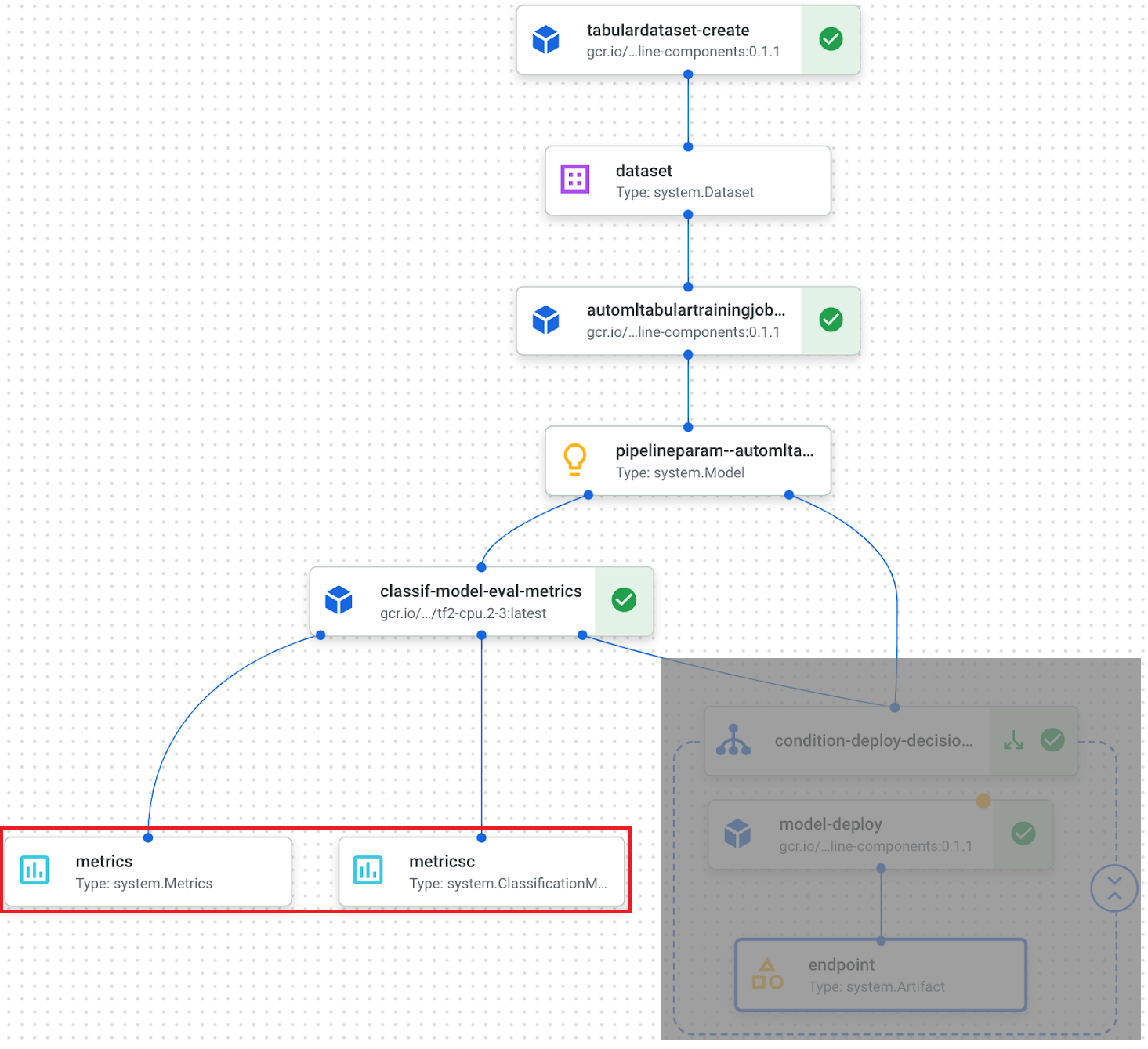
为什么要工作?metrics: Output[Metrics]和metricsc: Output[ClassificationMetrics]的kfp.v2.dsl.Output类型是什么?
classif_model_eval_metrics函数码
from kfp.v2.dsl import (
    Dataset, Model, Output, Input,
    OutputPath, ClassificationMetrics, Metrics, component
)

@component(
    base_image="gcr.io/deeplearning-platform-release/tf2-cpu.2-6:latest",
    output_component_file="tables_eval_component.yaml", # Optional: you can use this to load the component later
    packages_to_install=["google-cloud-aiplatform"],
)
def classif_model_eval_metrics(
    project: str,
    location: str,      # "us-central1",
    api_endpoint: str,  # "us-central1-aiplatform.googleapis.com",
    thresholds_dict_str: str,
    model: Input[Model],
    metrics: Output[Metrics],
    metricsc: Output[ClassificationMetrics],
) -> NamedTuple("Outputs", [("dep_decision", str)]):  # Return parameter.
    """Renders evaluation metrics for an AutoML Tabular classification model.
    Retrieves the classification model evaluation and render the ROC and confusion matrix
    for the model. Determine whether the model is sufficiently accurate to deploy.
    """
    import json
    import logging
    from google.cloud import aiplatform

    # Fetch model eval info
    def get_eval_info(client, model_name):
        from google.protobuf.json_format import MessageToDict
        response = client.list_model_evaluations(parent=model_name)
        metrics_list = []
        metrics_string_list = []
        for evaluation in response:
            metrics = MessageToDict(evaluation._pb.metrics)
            metrics_str = json.dumps(metrics)
            metrics_list.append(metrics)
            metrics_string_list.append(metrics_str)
        return (
            evaluation.name,
            metrics_list,
            metrics_string_list,
        )

    def classification_thresholds_check(metrics_dict, thresholds_dict):
        for k, v in thresholds_dict.items():
            if k in ["auRoc", "auPrc"]:  # higher is better
                if metrics_dict[k] < v:  # if under threshold, don't deploy
                    return False
        return True

    def log_metrics(metrics_list, metricsc):
        test_confusion_matrix = metrics_list[0]["confusionMatrix"]
        logging.info("rows: %s", test_confusion_matrix["rows"])
        # log the ROC curve
        fpr = [], tpr = [], thresholds = []
        for item in metrics_list[0]["confidenceMetrics"]:
            fpr.append(item.get("falsePositiveRate", 0.0))
            tpr.append(item.get("recall", 0.0))
            thresholds.append(item.get("confidenceThreshold", 0.0))
        metricsc.log_roc_curve(fpr, tpr, thresholds)
        # log the confusion matrix
        annotations = []
        for item in test_confusion_matrix["annotationSpecs"]:
            annotations.append(item["displayName"])
        metricsc.log_confusion_matrix(
            annotations,
            test_confusion_matrix["rows"],
        )
        # log textual metrics info as well
        for metric in metrics_list[0].keys():
            if metric != "confidenceMetrics":
                val_string = json.dumps(metrics_list[0][metric])
                metrics.log_metric(metric, val_string)
        # metrics.metadata["model_type"] = "AutoML Tabular classification"

    aiplatform.init(project=project)

    client = aiplatform.gapic.ModelServiceClient(client_options={"api_endpoint": api_endpoint})
    eval_name, metrics_list, metrics_str_list = get_eval_info(
        client, model.uri.replace("aiplatform://v1/", "")
    )
    log_metrics(metrics_list, metricsc)
    thresholds_dict = json.loads(thresholds_dict_str)

return ("true",) if classification_thresholds_check(metrics_list[0], thresholds_dict) else ("false", )回答 1
Stack Overflow用户
发布于 2022-05-17 15:43:32
自定义组件定义为带有@kfp.v2.dsl.component装饰器的Python函数。
@component装饰器指定三个可选参数:要使用的基本容器映像;要安装的任何包;以及要写入组件规范的yaml文件。
组件函数classif_model_eval_metrics有一些输入参数。模型参数是一个输入kfp.v2.dsl.Model artifact。
两个函数args,metrics和metricsc是组件输出,在这种情况下是Metrics和ClassificationMetrics类型。它们不是作为组件步骤的输入显式传递的,而是自动实例化的,可以在组件中使用。
@component(
    base_image="gcr.io/deeplearning-platform-release/tf2-cpu.2-3:latest",
    output_component_file="tables_eval_component.yaml",
    packages_to_install=["google-cloud-aiplatform"],
)
def classif_model_eval_metrics(
    project: str,
    location: str,  # "us-central1",
    api_endpoint: str,  # "us-central1-aiplatform.googleapis.com",
    thresholds_dict_str: str,
    model: Input[Model],
    metrics: Output[Metrics],
    metricsc: Output[ClassificationMetrics],
)例如,在下面的函数中,我们调用metricsc.log_roc_curve()和metricsc.log_confusion_matrix()在管道UI中呈现这些可视化。在编译组件时,这些输出参数将成为组件输出,并可由其他管道步骤使用。
def log_metrics(metrics_list, metricsc):
        ...
        metricsc.log_roc_curve(fpr, tpr, thresholds)
        ...
        metricsc.log_confusion_matrix(
            annotations,
            test_confusion_matrix["rows"],
)有关更多信息,您可以参考此文档。
https://stackoverflow.com/questions/72073763
复制相似问题
腾讯云开发者

Copyright © 2013 - 2026 Tencent Cloud. All Rights Reserved. 腾讯云 版权所有
深圳市腾讯计算机系统有限公司 ICP备案/许可证号:粤B2-20090059  粤公网安备44030502008569号
腾讯云计算(北京)有限责任公司 京ICP证150476号 | 京ICP备11018762号