
用于数据流采集和处理的c++多线程实现方法
用于数据流采集和处理的c++多线程实现方法
提问于 2022-03-31 08:00:15
我是c++开发的新手。我试图运行相互独立的无限函数。以下是问题陈述的笑料:
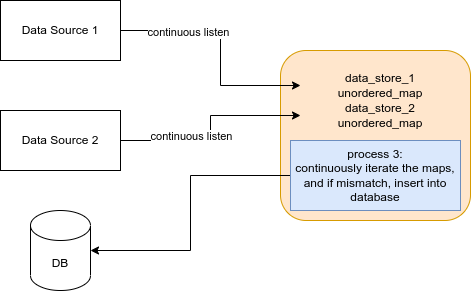
我试图实现的方法是
#include <iostream>
#include <cstdlib>
#include <pthread.h>
#include <unistd.h>
#include <mutex>

int g_i = 0;
std::mutex g_i_mutex; // protects g_i

// increment g_i by 1
void increment_itr()
{
  const std::lock_guard<std::mutex> lock(g_i_mutex);
  g_i += 1;
}

void *fun(void *s)
{
  std::string str;
  str = (char *)s;
  std::cout << str << " start\n";
  while (1)
  {
    std::cout << str << " " << g_i << "\n";
    if(g_i > 1000) break;
    increment_itr();
  }
  pthread_exit(NULL);
  std::cout << str << " end\n";
}

void *checker(void *s) {
  while (1) {
    if(g_i > 1000) {
      std::cout<<"**********************\n";
      std::cout << "checker: g_i == 100\n";
      std::cout<<"**********************\n";
      pthread_exit(NULL);
    }
  }
}


int main()
{
  int itr = 0;
  pthread_t threads[3];
  pthread_attr_t attr;
  void *status;

  // Initialize and set thread joinable
  pthread_attr_init(&attr);
  pthread_attr_setdetachstate(&attr, PTHREAD_CREATE_JOINABLE);
  int rc1 = pthread_create(&threads[0], &attr, fun, (void *)&"foo");
  int rc2 = pthread_create(&threads[1], &attr, fun, (void *)&"bar");
  int rc3 = pthread_create(&threads[2], &attr, checker, (void *)&"checker");


  if (rc1 || rc2 || rc3)
  {
    std::cout << "Error:unable to create thread," << rc1 << rc2 << rc3 << std::endl;
    exit(-1);
  }

  pthread_attr_destroy(&attr);

  std::cout << "main func continues\n";

  for (int i = 0; i < 3; i++)
  {
    rc1 = pthread_join(threads[i], &status);
    if (rc1)
    {
      std::cout << "Error:unable to join," << rc1 << std::endl;
      exit(-1);
    }
    std::cout << "Main: completed thread id :" << i;
    std::cout << "  exiting with status :" << status << std::endl;
  }

  std::cout << "main end\n";

  return 0;
}
这是可行的,但我想知道这个实现是一种标准的方法,还是可以用更好的方式完成?
回答 1
Stack Overflow用户
回答已采纳
发布于 2022-03-31 08:09:36
您在increment_itr中正确地使用了一个锁,但是您的fun函数在访问g_i时没有获得锁。
改变这一点:
void increment_itr()
{
  const std::lock_guard<std::mutex> lock(g_i_mutex);
  g_i += 1;
}
到这个
int increment_itr()
{
  std::lock_guard<std::mutex> lock(g_i_mutex);  // the const wasn't actually needed
  g_i = g_i + 1;
  return g_i;  // return the updated value of g_i
}
这不是线程安全的:
if(g_i > 1000) break;  // access g_i without acquiring the lock
increment_itr();
这个-更好:
if (increment_itr() > 1000) {
    break;
}在checker中需要类似的修复
void *checker(void *s) {
  while (1) {
    int i;
    {
      std::lock_guard<std::mutex> lock(g_i_mutex);
      i = g_i;
    }
    if(i > 1000) {
      std::cout<<"**********************\n";
      std::cout << "checker: g_i == 100\n";
      std::cout<<"**********************\n";
      break;
    }
    return NULL;
  }
关于你的设计问题。这是最根本的问题。
您正在提议一个专用线程,该线程不断地获取一个锁,并对数据结构进行某种类型的检查。如果满足某一条件,它将执行一些额外的处理,例如写入数据库。如果数据结构(这两个映射)中没有任何变化,那么在无限循环中旋转的线程将是浪费的。相反,您只希望在某些事情发生变化时运行您的完整性检查。您可以使用条件变量让检查器线程暂停,直到某些事情发生实际变化。
这是一个更好的设计。
uint64_t g_data_version = 0;
std::conditional_variable g_cv;

void *fun(void *s)
{
    while (true) {

        << wait for data from the source >>

        {
            std::lock_guard<std::mutex> lock(g_i_mutex);
            // update the data in the map while under a lock
            // e.g. g_n++;
            //

            // increment the data version to signal a new revision has been made
            g_data_version += 1;
        }

        // notify the checker thread that something has changed
        g_cv.notify_all();
    }

}然后,您的检查器函数只有在fun发出信号表示发生了变化时才会醒来。
void *checker(void *s) {
  while (1) {

      // lock the mutex
      std::unique_lock<std::mutex> lock(g_i_mutex);

      // do the data comparison check here

      // now wait for the data version to change
      uint64_t version = g_data_version;
      while (version != g_data_version) { // check for spurious wake up
         cv.wait(lock); // this atomically unlocks the mutex and waits for a notify() call on another thread to happen
      }
  }
}页面原文内容由Stack Overflow提供。腾讯云小微IT领域专用引擎提供翻译支持
原文链接:
https://stackoverflow.com/questions/71688949
复制相关文章
相似问题
腾讯云开发者

Copyright © 2013 - 2026 Tencent Cloud. All Rights Reserved. 腾讯云 版权所有
深圳市腾讯计算机系统有限公司 ICP备案/许可证号:粤B2-20090059  粤公网安备44030502008569号
腾讯云计算(北京)有限责任公司 京ICP证150476号 | 京ICP备11018762号