
生成所有给定大小的有向图,直至同构
我正在尝试生成所有具有给定节点数的有向图,直到图同构,这样我就可以将它们提供给另一个Python程序。下面是一个使用NetworkX的简单参考实现,我想加快它的速度:
from itertools import combinations, product
import networkx as nx

def generate_digraphs(n):
  graphs_so_far = list()
  nodes = list(range(n))
  possible_edges = [(i, j) for i, j in product(nodes, nodes) if i != j]
  for edge_mask in product([True, False], repeat=len(possible_edges)):
    edges = [edge for include, edge in zip(edge_mask, possible_edges) if include]
    g = nx.DiGraph()
    g.add_nodes_from(nodes)
    g.add_edges_from(edges)
    if not any(nx.is_isomorphic(g_before, g) for g_before in graphs_so_far):
      graphs_so_far.append(g)
  return graphs_so_far

assert len(generate_digraphs(1)) == 1
assert len(generate_digraphs(2)) == 3
assert len(generate_digraphs(3)) == 16这类图的数量似乎增长很快,由这个OEIS序列给出。我正在寻找一种解决方案,能够在合理的时间内生成最多7个节点的所有图(总计约10亿个图)。
将图表示为NetworkX对象并不是很重要;例如,表示具有邻接列表的图或使用不同的库对我有好处。
回答 3
Stack Overflow用户
发布于 2022-04-01 03:37:38
有一个有用的想法,我从布兰登·麦凯( Brendan )的论文“无异形无穷尽世代”(虽然我相信它早于那篇论文)中学到的。
其思想是,我们可以将同构类组织成一棵树,其中带空图的单例类是根,每个具有n>0节点的图的类都有一个具有n个−1节点的图的父类。为了枚举n>0节点的图的同构类,枚举具有n个−1节点的图的同构类,并对每个此类类以所有可能的方式将其表示扩展到n个节点,并滤除那些实际上不是子节点的同构类。
下面的Python代码使用一个基本但非平凡的图同构子例程来实现这一思想。N=6只需几分钟,而n= 7则需要几天的时间估计。对于额外的速度,请将其移植到C++,并可能找到更好的算法来处理置换组(可能在TAoCP中,尽管大多数图没有对称性,因此不清楚收益有多大)。
import cProfile
import collections
import itertools
import random


# Returns labels approximating the orbits of graph. Two nodes in the same orbit
# have the same label, but two nodes in different orbits don't necessarily have
# different labels.
def invariant_labels(graph, n):
    labels = [1] * n
    for r in range(2):
        incoming = [0] * n
        outgoing = [0] * n
        for i, j in graph:
            incoming[j] += labels[i]
            outgoing[i] += labels[j]
        for i in range(n):
            labels[i] = hash((incoming[i], outgoing[i]))
    return labels


# Returns the inverse of perm.
def inverse_permutation(perm):
    n = len(perm)
    inverse = [None] * n
    for i in range(n):
        inverse[perm[i]] = i
    return inverse


# Returns the permutation that sorts by label.
def label_sorting_permutation(labels):
    n = len(labels)
    return inverse_permutation(sorted(range(n), key=lambda i: labels[i]))


# Returns the graph where node i becomes perm[i] .
def permuted_graph(perm, graph):
    perm_graph = [(perm[i], perm[j]) for (i, j) in graph]
    perm_graph.sort()
    return perm_graph


# Yields each permutation generated by swaps of two consecutive nodes with the
# same label.
def label_stabilizer(labels):
    n = len(labels)
    factors = (
        itertools.permutations(block)
        for (_, block) in itertools.groupby(range(n), key=lambda i: labels[i])
    )
    for subperms in itertools.product(*factors):
        yield [i for subperm in subperms for i in subperm]


# Returns the canonical labeled graph isomorphic to graph.
def canonical_graph(graph, n):
    labels = invariant_labels(graph, n)
    sorting_perm = label_sorting_permutation(labels)
    graph = permuted_graph(sorting_perm, graph)
    labels.sort()
    return max(
        (permuted_graph(perm, graph), perm[sorting_perm[n - 1]])
        for perm in label_stabilizer(labels)
    )


# Returns the list of permutations that stabilize graph.
def graph_stabilizer(graph, n):
    return [
        perm
        for perm in label_stabilizer(invariant_labels(graph, n))
        if permuted_graph(perm, graph) == graph
    ]


# Yields the subsets of range(n) .
def power_set(n):
    for r in range(n + 1):
        for s in itertools.combinations(range(n), r):
            yield list(s)


# Returns the set where i becomes perm[i] .
def permuted_set(perm, s):
    perm_s = [perm[i] for i in s]
    perm_s.sort()
    return perm_s


# If s is canonical, returns the list of permutations in group that stabilize s.
# Otherwise, returns None.
def set_stabilizer(s, group):
    stabilizer = []
    for perm in group:
        perm_s = permuted_set(perm, s)
        if perm_s < s:
            return None
        if perm_s == s:
            stabilizer.append(perm)
    return stabilizer


# Yields one representative of each isomorphism class.
def enumerate_graphs(n):
    assert 0 <= n
    if 0 == n:
        yield []
        return
    for subgraph in enumerate_graphs(n - 1):
        sub_stab = graph_stabilizer(subgraph, n - 1)
        for incoming in power_set(n - 1):
            in_stab = set_stabilizer(incoming, sub_stab)
            if not in_stab:
                continue
            for outgoing in power_set(n - 1):
                out_stab = set_stabilizer(outgoing, in_stab)
                if not out_stab:
                    continue
                graph, i_star = canonical_graph(
                    subgraph
                    + [(i, n - 1) for i in incoming]
                    + [(n - 1, j) for j in outgoing],
                    n,
                )
                if i_star == n - 1:
                    yield graph


def test():
    print(sum(1 for graph in enumerate_graphs(5)))


cProfile.run("test()")Stack Overflow用户
发布于 2022-03-28 14:15:17
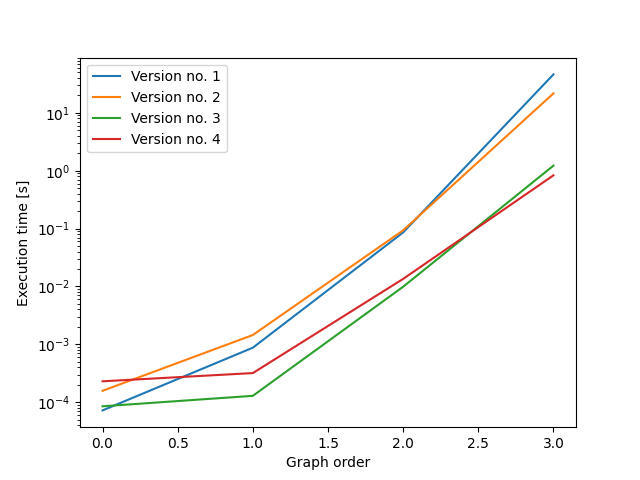
98-99%的计算时间用于同构测试,因此游戏的名称是为了减少必要的测试次数。在这里,我以批方式创建了图,因此只有在批内才需要测试图的同构。
在第一个变体(以下版本2)中,批处理中的所有图都有相同的边数。这导致了运行时间的可理解但适度的改进(对于大小为4的图,速度是4的2.5倍,对于较大的图,则有更大的速度增长)。
在第二个变体(以下版本3)中,批处理中的所有图都有相同的出度序列。这将大大提高运行时间(对于大小为4的图形,运行速度是4的35倍,而对于较大的图,则提高了更大的速度)。
在第三个变体(以下版本4)中,批处理中的所有图都有相同的出度序列。此外,在一批图中,所有图都是按内次序列排序的.这使速度比第3版略有提高(尺寸为4的图形比第4版的速度快1.3倍;尺寸5的图形的速度快2.1倍)。
#!/usr/bin/env python
"""
Efficient motif generation.
"""

import numpy as np
import matplotlib.pyplot as plt
import networkx as nx

from timeit import timeit
from itertools import combinations, product, chain, combinations_with_replacement


# for profiling with kernprof/line_profiler
try:
    profile
except NameError:
    profile = lambda x: x


@profile
def version_1(n):
    """Original implementation by @hilberts_drinking_problem"""
    graphs_so_far = list()
    nodes = list(range(n))
    possible_edges = [(i, j) for i, j in product(nodes, nodes) if i != j]
    for edge_mask in product([True, False], repeat=len(possible_edges)):
        edges = [edge for include, edge in zip(edge_mask, possible_edges) if include]
        g = nx.DiGraph()
        g.add_nodes_from(nodes)
        g.add_edges_from(edges)
        if not any(nx.is_isomorphic(g_before, g) for g_before in graphs_so_far):
            graphs_so_far.append(g)
    return graphs_so_far


@profile
def version_2(n):
    """Creates graphs in batches, where each batch contains graphs with
    the same number of edges. Only graphs within a batch have to be tested
    for isomorphisms."""
    graphs_so_far = list()
    nodes = list(range(n))
    possible_edges = [(i, j) for i, j in product(nodes, nodes) if i != j]
    for ii in range(len(possible_edges)+1):
        tmp = []
        for edges in combinations(possible_edges, ii):
            g = nx.from_edgelist(edges, create_using=nx.DiGraph)
            if not any(nx.is_isomorphic(g_before, g) for g_before in tmp):
                tmp.append(g)
        graphs_so_far.extend(tmp)
    return graphs_so_far


@profile
def version_3(n):
    """Creates graphs in batches, where each batch contains graphs with
    the same out-degree sequence. Only graphs within a batch have to be tested
    for isomorphisms."""
    graphs_so_far = list()
    outdegree_sequences_so_far = list()
    for outdegree_sequence in product(*[range(n) for _ in range(n)]):
        # skip degree sequences which we have already seen as the resulting graphs will be isomorphic
        if sorted(outdegree_sequence) not in outdegree_sequences_so_far:
            tmp = []
            for edges in generate_graphs(outdegree_sequence):
                g = nx.from_edgelist(edges, create_using=nx.DiGraph)
                if not any(nx.is_isomorphic(g_before, g) for g_before in tmp):
                    tmp.append(g)
            graphs_so_far.extend(tmp)
            outdegree_sequences_so_far.append(sorted(outdegree_sequence))
    return graphs_so_far


def generate_graphs(outdegree_sequence):
    """Generates all directed graphs with a given out-degree sequence."""
    for edges in product(*[generate_edges(node, degree, len(outdegree_sequence)) \
                           for node, degree in enumerate(outdegree_sequence)]):
        yield(list(chain(*edges)))


def generate_edges(node, outdegree, total_nodes):
    """Generates all edges for a given node with a given out-degree and a given graph size."""
    for targets in combinations(set(range(total_nodes)) - {node}, outdegree):
        yield([(node, target) for target in targets])


@profile
def version_4(n):
    """Creates graphs in batches, where each batch contains graphs with
    the same out-degree sequence.  Within a batch, graphs are sorted
    by in-degree sequence, such that only graphs with the same
    in-degree sequence have to be tested for isomorphism.
    """
    graphs_so_far = list()
    for outdegree_sequence in combinations_with_replacement(range(n), n):
        tmp = dict()
        for edges in generate_graphs(outdegree_sequence):
            g = nx.from_edgelist(edges, create_using=nx.DiGraph)
            indegree_sequence = tuple(sorted(degree for _, degree in g.in_degree()))
            if indegree_sequence in tmp:
                if not any(nx.is_isomorphic(g_before, g) for g_before in tmp[indegree_sequence]):
                    tmp[indegree_sequence].append(g)
            else:
                tmp[indegree_sequence] = [g]
        for graphs in tmp.values():
            graphs_so_far.extend(graphs)
    return graphs_so_far


if __name__ == '__main__':

    order = range(1, 5)
    t1 = [timeit(lambda : version_1(n), number=3) for n in order]
    t2 = [timeit(lambda : version_2(n), number=3) for n in order]
    t3 = [timeit(lambda : version_3(n), number=3) for n in order]
    t4 = [timeit(lambda : version_4(n), number=3) for n in order]

    fig, ax = plt.subplots()
    for ii, t in enumerate([t1, t2, t3, t4]):
        ax.plot(t, label=f"Version no. {ii+1}")
    ax.set_yscale('log')
    ax.set_ylabel('Execution time [s]')
    ax.set_xlabel('Graph order')
    ax.legend()
plt.show()Stack Overflow用户
发布于 2022-03-30 23:47:07
与使用nx.is_isomorphic比较两个图G1和G2不同,您还可以生成与G1同构的所有图,并检查G2是否在这个集合中。起初,这听起来更麻烦,但它不仅允许您检查G2是否与G1同构,还可以检查任何图是否与G1同构,而nx.is_isomorphic在比较两个图时总是从头开始。
为了让事情变得更简单,每个图都被存储成一个边列表。如果所有边的集合相同,则两个图是相同的(而不是同构的)。总是确保边的列表是一个排序的元组,这样==就可以准确地测试这个等式,并使边缘列表成为可选的。
import itertools


def all_digraphs(n):
    possible_edges = [
        (i, j) for i, j in itertools.product(range(n), repeat=2) if i != j
    ]
    for edge_mask in itertools.product([True, False], repeat=len(possible_edges)):
        # The result is already sorted
        yield tuple(edge for include, edge in zip(edge_mask, possible_edges) if include)


def unique_digraphs(n):
    already_seen = set()
    for graph in all_digraphs(n):
        if graph not in already_seen:
            yield graph
            already_seen |= {
                tuple(sorted((perm[i], perm[j]) for i, j in graph))
                for perm in itertools.permutations(range(n))
            }
与以前解决方案中的变体相比,这给出了我的机器上的下列时间:
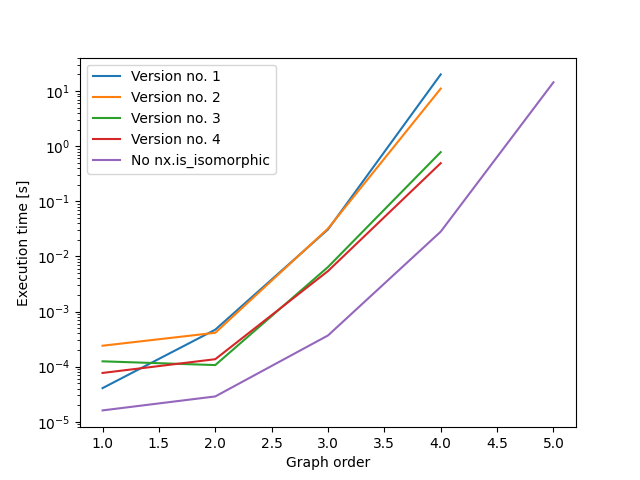
这一切看起来都很有希望,但是对于6个节点来说,我的16 for内存是不够的,Python进程已经被操作系统终止了。我相信,您可以将这段代码与为每个outdegree_sequence批量生成图结合在一起,如前面的答案所详述的那样。这将允许在每个批处理之后清空already_seen,并大大减少内存消耗。
https://stackoverflow.com/questions/71597789
复制相似问题
腾讯云开发者

Copyright © 2013 - 2026 Tencent Cloud. All Rights Reserved. 腾讯云 版权所有
深圳市腾讯计算机系统有限公司 ICP备案/许可证号:粤B2-20090059  粤公网安备44030502008569号
腾讯云计算(北京)有限责任公司 京ICP证150476号 | 京ICP备11018762号