
现代优化算法的逻辑困惑
我有以下“逻辑难题”(我认为这是一个“调度问题”):
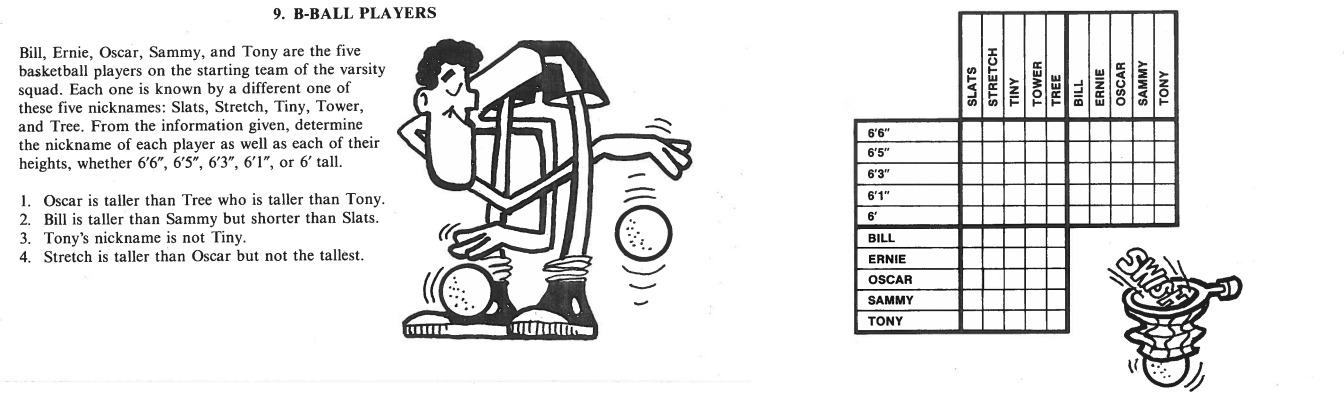
在这个问题上,有5个篮球运动员-提供了一些线索,他们的昵称和身高,你需要找到正确的组合球员-昵称-高度。
在上一篇文章(Solving Logic Puzzles Using R)中,我学习了如何使用R编程语言“蛮力”解决这个问题:
library(dplyr)

dt <- purrr::cross_df(list(
  name = list(c("Bill", "Ernie", "Oscar", "Sammy", "Tony")),
  nickname = combinat::permn(c("Slats", "Stretch", "Tiny", "Tower", "Tree")),
  height = combinat::permn(c(6.6, 6.5, 6.3, 6.1, 6))
))

dt %>%
  group_by(id = (seq_len(n()) - 1L) %/% 5L) %>%
  filter(
    height[name == "Oscar"] > height[nickname == "Tree"],
    height[nickname == "Tree"] > height[name == "Tony"],
    height[name == "Bill"] > height[name == "Sammy"],
    height[name == "Bill"] < height[nickname == "Slats"],
    nickname[name == "Tony"] != "Tiny",
    height[nickname == "Stretch"] > height[name == "Oscar"],
    height[nickname == "Stretch"] < 6.6
  )

#output
# A tibble: 5 x 4
# Groups:   id [1]
  name  nickname height    id
  <chr> <chr>     <dbl> <int>
1 Bill  Stretch     6.5 14398
2 Ernie Slats       6.6 14398
3 Oscar Tiny        6.3 14398
4 Sammy Tree        6.1 14398
5 Tony  Tower       6   14398
然而,我不认为当有成千上万的篮球运动员时,上述方法效果不佳。我想知道是否有一些更现代的优化算法(如粒子群优化、模拟退火、nelder、遗传算法等)。可以用来解决这个问题。
例如,在这个问题中,也许每个玩家高度昵称的组合所满足的“优化约束的分数”可以作为度量吗?
如果(实际上是不正确的,只是简单地勾画一个例子)
- 组合1:比尔=斯莱茨,厄尼=弹力,奥斯卡=微小,萨米=微小,托尼=树。比尔是6英尺6,厄尼是6'5,奥斯卡是6'3,萨米是6'1,托尼是6‘。满足3/4的优化约束
- 组合53 :比尔=拉伸,厄尼=斯莱茨,奥斯卡=微小,萨米=微小和托尼=树。Bill是6'6,Ernie是6'5,Oscar是6'3,Sammy是6,Tony是6'1。只满足优化约束
的2/4。
也许我们可以说,组合1比组合53具有更高的“性能指标”,因此,与组合53相比,考虑“更接近”组合1的组合可能更有利。
在过去,我曾在R中使用不同的优化算法来进行“多项式寻根”,但是,我不知道如何为这个篮球例子编写优化函数、目标度量和约束。我做了一些研究,并在R中发现了一些不同的优化库,它们可能能够处理这个问题:
- https://cran.r-project.org/web/packages/rminizinc/index.html
- https://www.r-orms.org/
- https://cran.r-project.org/web/packages/lpSolve/index.html
但我不知道如何利用这些参考资料来解决篮球问题。
有人能告诉我怎么做吗?
谢谢!
回答 1
Stack Overflow用户
发布于 2022-01-03 19:38:32
这里有一个随机的贪婪算法,允许多个向量化的搜索线程。我不能说它将如何表现与数千名球员,但与5,它的表现优于蛮力的方法,在后场。禁忌搜索方法可能会带来更大的问题,从而提高性能。
players <- c("Bill", "Ernie", "Oscar", "Sammy", "Tony")
nicknames <- c("Slats", "Stretch", "Tiny", "Tower", "Tree")
heights <- c(6, 6.1, 6.3, 6.5, 6.6)

getScore <- function(m) {
  return(
    (m[3,] > m[10,]) +
      (m[10,] > m[5,]) +
      (m[1,] > m[4,]) +
      (m[1,] < m[6,]) +
      (m[5,] != m[8,]) +
      (m[7,] > m[3,]) +
      (m[7,] != 5L))
}

fGreedy <- function(players, nicknames, heights, fScore, maxScore = 0L, threads = 1L, maxIter = Inf) {
  nPlayers <- length(players)
  # the first 5 rows of the config matrix are the height orders by player name
  # the second 5 are the rows are the height orders by nickname
  # each column is a different search thread
  config <- replicate(threads, c(sample(nPlayers), sample(nPlayers)))
  currScore <- fScore(config)
  mIdx1 <- matrix(1:threads, nrow = threads, ncol = 2)
  mIdx2 <- matrix(1:threads, nrow = threads, ncol = 2)
  iter <- setNames(1L, "iterations")

  while (max(currScore) < maxScore && iter < maxIter) {
    proposal <- config
    blnNicknameSwap <- sample(c(TRUE, FALSE), threads, replace = TRUE)
    mIdx1[,1] <- sample(5, threads, replace = TRUE)
    mIdx2[,1] <- ((mIdx1[,1] + sample(0:3, threads, replace = TRUE)) %% 5L) + 1L
    mIdx1[blnNicknameSwap, 1] <- mIdx1[blnNicknameSwap, 1] + 5L
    mIdx2[blnNicknameSwap, 1] <- mIdx2[blnNicknameSwap, 1] + 5L
    temp <- proposal[mIdx1]
    proposal[mIdx1] <- proposal[mIdx2]
    proposal[mIdx2] <- temp
    newScore <- fScore(proposal)
    blnReplace <- newScore >= currScore
    config[,blnReplace] <- proposal[,blnReplace]
    currScore[blnReplace] <- newScore[blnReplace]
    iter <- iter + 1L
  }

  # print(iter)
  ans <- config[,which.max(currScore)]
  return(data.frame(name = players[order(ans[1:5])], nickname = nicknames[order(ans[6:10])], height = heights))
}


library(dplyr)

dt <- purrr::cross_df(list(
  name = list(c("Bill", "Ernie", "Oscar", "Sammy", "Tony")),
  nickname = combinat::permn(c("Slats", "Stretch", "Tiny", "Tower", "Tree")),
  height = combinat::permn(c(6.6, 6.5, 6.3, 6.1, 6))
))

fEnum <- function(dt) {
  dt %>%
    group_by(id = (seq_len(n()) - 1L) %/% 5L) %>%
    filter(
      height[name == "Oscar"] > height[nickname == "Tree"],
      height[nickname == "Tree"] > height[name == "Tony"],
      height[name == "Bill"] > height[name == "Sammy"],
      height[name == "Bill"] < height[nickname == "Slats"],
      nickname[name == "Tony"] != "Tiny",
      height[nickname == "Stretch"] > height[name == "Oscar"],
      height[nickname == "Stretch"] < 6.6
    )
}

fGreedy(players, nicknames, heights, getScore, 7L, 100L)
#>    name nickname height
#> 1  Tony    Tower    6.0
#> 2 Sammy     Tree    6.1
#> 3 Oscar     Tiny    6.3
#> 4  Bill  Stretch    6.5
#> 5 Ernie    Slats    6.6
fEnum(dt)
#> # A tibble: 5 x 4
#> # Groups:   id [1]
#>   name  nickname height    id
#>   <chr> <chr>     <dbl> <int>
#> 1 Bill  Stretch     6.5 14398
#> 2 Ernie Slats       6.6 14398
#> 3 Oscar Tiny        6.3 14398
#> 4 Sammy Tree        6.1 14398
#> 5 Tony  Tower       6   14398

microbenchmark::microbenchmark("enum" = fEnum(dt),
                               "1" = fGreedy(players, nicknames, heights, getScore, 7L, 1L),
                               "10" = fGreedy(players, nicknames, heights, getScore, 7L, 10L),
                               "100" = fGreedy(players, nicknames, heights, getScore, 7L, 100L))
#> Unit: microseconds
#>  expr        min         lq       mean     median         uq        max neval
#>  enum 349753.801 361069.301 377810.821 368307.051 386885.301 490222.700   100
#>     1    772.602   4274.502  14209.154   9021.252  19660.551  79180.201   100
#>    10    508.701   1645.201   2892.640   2398.501   3841.801   9889.700   100
#> 100 1358.001 2225.301 2986.916 2773.552 3237.601 9725.301 100https://stackoverflow.com/questions/70559892
复制相似问题
腾讯云开发者

Copyright © 2013 - 2026 Tencent Cloud. All Rights Reserved. 腾讯云 版权所有
深圳市腾讯计算机系统有限公司 ICP备案/许可证号:粤B2-20090059  粤公网安备44030502008569号
腾讯云计算(北京)有限责任公司 京ICP证150476号 | 京ICP备11018762号