
在MySQL中利用关系搜索本体树
我正在使用以下模式处理一个MySQL数据库:
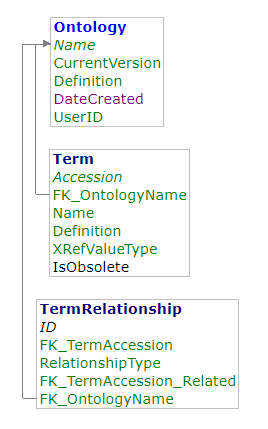
其中我们保存来自不同本体(外翻)的信息。其中一些术语有关系(exmp: MS:1000004,样本质量),这些关系由relationship:或is_a:表示。为了解决这个问题,让我们把重点放在is_a关系上。我们现在想提供一个选项来搜索这些is_a关系。因此,一个函数,我们给MS:1000004/sample mass作为输入,并得到所有通过is_a关系连接到它的术语。但不仅仅是直接与MS:1000004相关的所有术语,还包括所有与孩子相关的术语等等。这个图像更好地描述了这一点,thing将是MS:1000004/sample mass,下面的一切都是我想要的结果。目前,我们使用一个相当未优化的递归函数作为存储过程来执行此操作:

DELIMITER $$
CREATE DEFINER=`root`@`localhost` PROCEDURE `getAllTermsByParentTerm`(IN `parentOntology` varchar(512))
BEGIN
    WITH RECURSIVE previous (accession, FK_OntologyName, name, definition, xrefvaluetype, isobsolete, fk_termAccession, relationshiptype, fk_termAccession_related, depth_level) AS (
        SELECT
            t.accession,
            t.FK_OntologyName,
            t.name,
            t.definition,
            t.xrefvaluetype,
            t.isobsolete,
            trt.fk_termAccession,
            trt.relationshiptype,
            trt.fk_termAccession_related,
            0 depth_level
        FROM Term t
        INNER JOIN (TermRelationship AS trt, Term AS ref) ON(
            t.Accession = trt.FK_TermAccession
            AND trt.FK_TermAccession_Related = ref.Accession
            AND (trt.RelationshipType = `is_a` OR trt.RelationshipType = `part_of`)
            AND
                (
                    trt.FK_TermAccession_Related = ref.Accession
                    AND ref.Name = parentOntology
                )
        )
        UNION All
        SELECT
            t2.accession,
            t2.FK_OntologyName,
            t2.name,
            t2.definition,
            t2.xrefvaluetype,
            t2.isobsolete,
            trt2.fk_termAccession,
            trt2.relationshiptype,
            trt2.fk_termAccession_related,
            (previous.depth_level+1) depth_level
        FROM Term t2
        INNER JOIN (TermRelationship AS trt2, previous) ON(
            t2.Accession = trt2.FK_TermAccession
            AND trt2.FK_TermAccession_Related = previous.Accession
        )
    )
    SELECT
        t.Accession,
        t.FK_OntologyName,
        t.Name,
        t.Definition,
        t.xRefValueType,
        t.IsObsolete,
        p.depth_level
    FROM previous p
    Inner JOIN Term AS t ON (
        p.Accession = t.Accession
    );
END$$
DELIMITER ;
对于这个问题:我对MySQL没有那么丰富的经验,所以是否有任何选择来优化这个函数,或者MySQL总体上是一个错误的工具?
示例行:
术语
| Accession | FK_OntologyName | Name | Definition | XRefValueType | IsObsolete |
|------------|-----------------|----------------------------------------------------------------|--------------------------------------------------------------------------------------------------------------------------------------------------------------------------------------------------------------------------------------------------------------------------------------------------------------------------------------------------------------------------------------------------------------------------------------------------------------------------------------------------------------------------------------------------------------------------------------------------------------------------------------------------------------|-------------------------------------------------------------------|------------|
| TEST:0000000 | TEST | Proteomics Standards Initiative Mass Spectrometry Vocabularies | "Proteomics Standards Initiative Mass Spectrometry Vocabularies." [PSI:MS] | | 0 |
| TEST:1000001 | TEST | sample number | "A reference number relevant to the sample under study." [PSI:MS] | value-type:xsd\:string "The allowed value-type for this CV term." | 0 |
| TEST:1000002 | TEST | sample name | "A reference string relevant to the sample under study." [PSI:MS] | value-type:xsd\:string "The allowed value-type for this CV term." | 0 |
| TEST:1000003 | TEST | sample state | "The chemical phase of a pure sample, or the state of a mixed sample." [PSI:MS] | | 0 |
| TEST:1000004 | TEST | sample mass | "Total mass of sample used." [PSI:MS] | value-type:xsd\:float "The allowed value-type for this CV term." | 0 |
| TEST:1000005 | TEST | sample volume | "Total volume of solution used." [PSI:MS] | value-type:xsd\:float "The allowed value-type for this CV term." | 0 |
| TEST:1000006 | TEST | sample concentration | "Concentration of sample in picomol/ul, femtomol/ul or attomol/ul solution used." [PSI:MS] | value-type:xsd\:float "The allowed value-type for this CV term." | 0 |
| TEST:1000007 | TEST | inlet type | "The nature of the sample inlet." [PSI:MS] | | 0 |
| TEST:1000008 | TEST | ionization type | "The method by which gas phase ions are generated from the sample." [PSI:MS] | | 0 |
| TEST:1000011 | TEST | mass resolution | "Smallest mass difference between two equal magnitude peaks so that the valley between them is a specified fraction of the peak height." [PSI:MS] | value-type:xsd\:string "The allowed value-type for this CV term." | 0 |
| TEST:1000012 | TEST | resolution measurement method | "Which of the available standard measures is used to define whether two peaks are separate." [PSI:MS] | | 0 |
| TEST:1000014 | TEST | accuracy | "Accuracy is the degree of conformity of a measured mass to its actual value." [PSI:MS] | value-type:xsd\:float "The allowed value-type for this CV term." | 0 |
| TEST:1000015 | TEST | scan rate | "Rate in Th/sec for scanning analyzers." [PSI:MS] | value-type:xsd\:float "The allowed value-type for this CV term." | 0 |
| TEST:1000016 | TEST | scan start time | "The time that an analyzer started a scan, relative to the start of the MS run." [PSI:MS] | value-type:xsd\:float "The allowed value-type for this CV term." | 0 |
| TEST:1000018 | TEST | scan direction | "Direction in terms of m/z of the scan for scanning analyzers (low to high, or high to low)." [PSI:MS] | | 0 |
| TEST:1000019 | TEST | scan law | "Describes the function in control of the m/z scan (for scanning instruments). Commonly the scan function is linear, but in principle any function can be used." [PSI:MS] | | 0 |
| TEST:1000021 | TEST | reflectron state | "Status of the reflectron, turned on or off." [PSI:MS] | | 0 |
| TEST:1000022 | TEST | TOF Total Path Length | "The length of the field free drift space in a time of flight mass spectrometer." [PSI:MS] | value-type:xsd\:float "The allowed value-type for this CV term." | 0 | | value-type:xsd\:int "The allowed value-type for this CV term." | 0 |TermRelationship
| ID     | FK_TermAccession | RelationshipType | FK_TermAccession_Related | FK_OntologyName |
|--------|------------------|------------------|--------------------------|-----------------|
| 0 | TEST:1000001          | is_a             | TEST:0000000             | TEST            |
| 1 | TEST:1000002          | is_a             | TEST:0000000             | TEST            |
| 2 | TEST:1000003          | is_a             | TEST:1000002             | TEST            |
| 3 | TEST:1000004          | is_a             | TEST:1000002             | TEST            |
| 4 | TEST:1000005          | is_a             | TEST:1000002             | TEST            |
| 5 | TEST:1000006          | is_a             | TEST:1000002             | TEST            |
| 6 | TEST:1000007          | is_a             | TEST:1000002             | TEST            |
| 7 | TEST:1000008          | is_a             | TEST:1000007             | TEST            |
| 8 | TEST:1000011          | is_a             | TEST:1000007             | TEST            |
| 9 | TEST:1000022 | is_a | TEST:0000000 | TEST |预期的结果是为TEST:0000000/Proteomics Standards Initiative Mass Spectrometry Vocabularies执行函数并获得以下所有术语,因为它们是TEST:0000000的子/外孙术语。
TEST:1000001
TEST:1000002
TEST:1000003
TEST:1000004
TEST:1000005
TEST:1000006
TEST:1000007
TEST:1000008
TEST:1000011
TEST:1000022回答 1
Stack Overflow用户
发布于 2021-12-15 21:19:41
其中一些可能有助于业绩:
t:  INDEX(Accession)
trt:  INDEX(FK_TermAccession_Related,  relationshiptype, FK_TermAccession)
trt:  INDEX(FK_TermAccession, FK_TermAccession_Related,  relationshiptype)
ref:  INDEX(Accession,  Name)
previous: INDEX(Accession, depth_level)请使用JOIN...ON而不是(TermRelationship AS trt, Term AS ref)
parentOntology在哪张桌子上?
trt.FK_TermAccession_Related = ref.Accession冗余地出现了。
https://stackoverflow.com/questions/70365468
复制相似问题
腾讯云开发者

Copyright © 2013 - 2026 Tencent Cloud. All Rights Reserved. 腾讯云 版权所有
深圳市腾讯计算机系统有限公司 ICP备案/许可证号:粤B2-20090059  粤公网安备44030502008569号
腾讯云计算(北京)有限责任公司 京ICP证150476号 | 京ICP备11018762号