
蒙特卡罗容差模拟
蒙特卡罗容差模拟
提问于 2021-12-09 21:51:12
我是新的工作蒙特卡罗模拟,我试图找到最佳的公差适合两个部分。该模型应产生符合规格的部件的概率。这应该很简单,但我不知道如何使用truncnorm.rvs:
n = 1000000 # number of trials

Component specifications
sigma = 3       # assume 99.7% of components in tolerance spec
dp = 3.900       # (Part Number 721634) diameter
tol_dpmax = 3.9015   # (Part Number 721634) diameter tolerance + (0.0015)
tol_dpmin = 3.9000   # 721634 diameter tolerance - (-0.0)
do = 3.900          # d ring diameter
tol_domax = 3.90   # d ring diameter tolerance + (+0.0)
tol_domin = 3.8995   # d ring diameter tolerance - (-0.0005)

dp_std= (tol_dpmax-tol_dpmin/2/3)
do_std= (tol_domax-tol_domin/2/3)
def calculateInterference(dp, do):
    """
    in: diameters
    out: o ring interference
    """

    interference = dp - do
    return interference

def checkInterference(interference, lower, upper):
    """
    in: o ring interference
    out: Bool, T for pass, F for fail
    """

    if interference < lower or interference > upper:
        return False
    else:
        return True

# set interference limits
lower = 0.0 # smallest permissible interference
upper = 0.0005 # largest permissible interference

interference_list = []  # initialize a list to store interference values per trial
results = []            # initialize a list to store our trial results

# Main simulation loop
for trial in range(n):
    # Sample PDF for each component

    piston_sample = scipy.stats.truncnorm.rvs((tol_dpmin-dp)/sigma,(tol_dpmax-dp)/sigma)
    #piston_sample = scipy.stats.truncnorm.rvs((tol_dpmin-dp)/sigma,(tol_dpmax-dp)/sigma,dp,dp_std) #good one ish


    #oring_sample = np.random.normal(do, tol_domin/sigma)
    oring_sample = scipy.stats.truncnorm.rvs((tol_domin-do)/sigma,(tol_domax-do)/sigma)
    #oring_sample = scipy.stats.truncnorm.rvs((tol_domin-do)/sigma,(tol_domax-do)/sigma,do,do_std) #good one ish
    #cylinder_sample = np.random.normal(dc, tol_dc/sigma)

    # compute and store interference
    interference = calculateInterference(piston_sample, oring_sample)
    interference_list.append(interference)

    # Trial check: log results of interference check
    results.append(checkInterference(interference, lower, upper))

# results check
goodAssemblyCount = sum(results)
failurePercentage =  100*((n - goodAssemblyCount) / n)
对此我将不胜感激。
谢谢!
回答 1
Stack Overflow用户
发布于 2021-12-09 22:18:13
要正确使用truncnorm,请尝试生成大量的示例并检查它们的范围:
sigma = 3
dp = 3.900
tol_dpmax = 3.9015
tol_dpmin = 3.9000

ntest = 10000
samp = scipy.stats.truncnorm.rvs((tol_dpmin-dp)/sigma,(tol_dpmax-dp)/sigma, size=ntest)
# scale & translate to original (non-normalized) location
samp_non_norm = (samp*sigma)+dp
print(f'minimum value: {samp_non_norm.min()}')
print(f'maximum value: {samp_non_norm.max()}')

import matplotlib.pyplot as plt
plt.hist(samp_non_norm, 100)
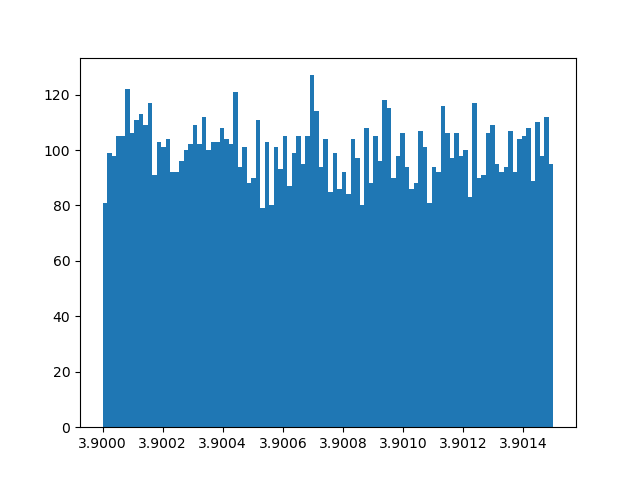
从直方图中我们可以看到截断和预期的一样工作,但是分布看起来是一致的。这会引起人们对sigma参数的注意,这是过程中的标准差。评论
# assume 99.7% of components in tolerance spec提示sigma = 3与0.0015的耐受范围不一致。考虑重新调整模型的中心位置
dp_new = (tol_dpmin + tol_dpmax)/2调整标准差,使单面范围为三西格玛:
dp_std = (tol_dpmax - dp_new)/sigma # top boundary is "three sigmas" from center并重新建模:
ntest = 10000
samp = scipy.stats.truncnorm.rvs((tol_dpmin-dp_new)/dp_std,(tol_dpmax-dp_new)/dp_std, size=ntest)
# scale & translate to original (non-normalized) location
samp_non_norm = (samp*dp_std)+dp_new
print(f'minimum value: {samp_non_norm.min()}')
print(f'maximum value: {samp_non_norm.max()}')

plt.hist(samp_non_norm, 100)
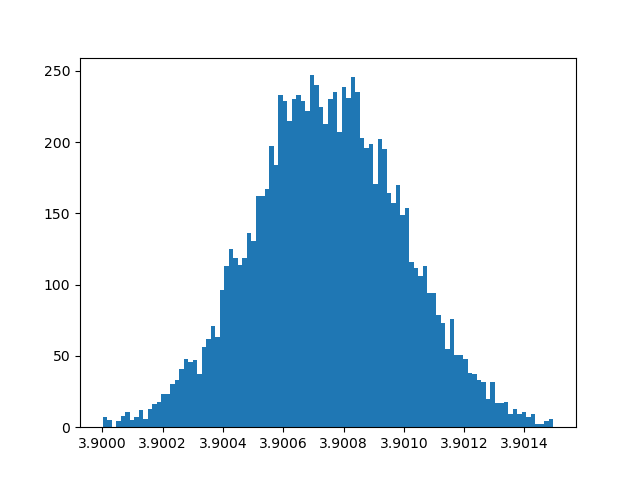
这看起来好多了!这是一个正态分布,在上下边界有轻微的截断。
..。然后重复这个过程,得到d环模型的参数。
页面原文内容由Stack Overflow提供。腾讯云小微IT领域专用引擎提供翻译支持
原文链接:
https://stackoverflow.com/questions/70297169
复制相关文章
相似问题
腾讯云开发者

Copyright © 2013 - 2026 Tencent Cloud. All Rights Reserved. 腾讯云 版权所有
深圳市腾讯计算机系统有限公司 ICP备案/许可证号:粤B2-20090059  粤公网安备44030502008569号
腾讯云计算(北京)有限责任公司 京ICP证150476号 | 京ICP备11018762号