我用Gemini的提示词,7天搞定了3个月的工作量

我用Gemini的提示词,7天搞定了3个月的工作量

用户11203141
发布于 2026-01-28 14:28:54
发布于 2026-01-28 14:28:54
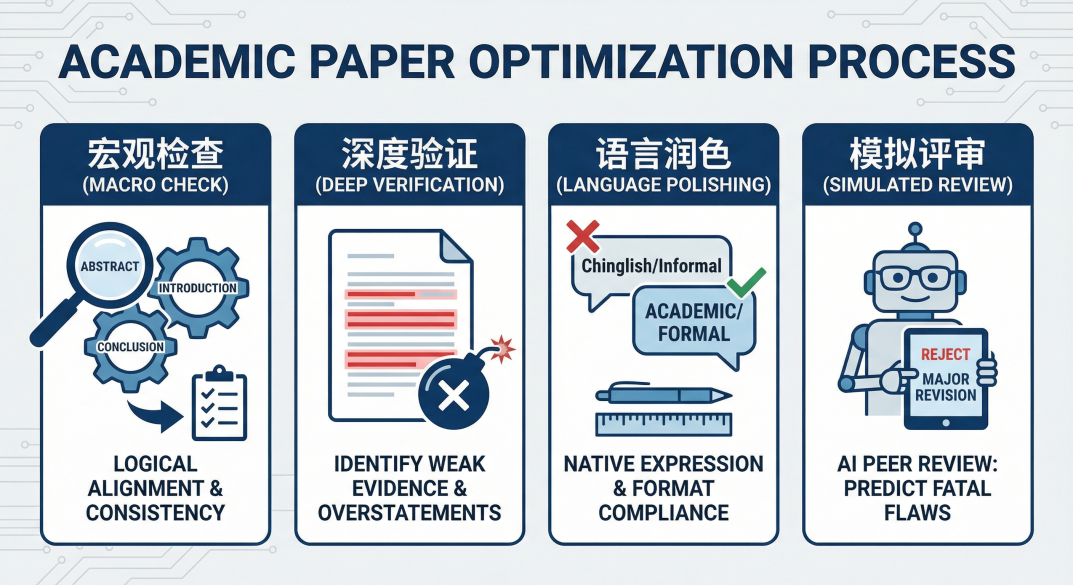
宏观检查
:确保你的摘要、引言和结论能严丝合缝地对上,逻辑不自相矛盾。
深度验证
:揪出论证过程中证据不足、过度推断的“隐形炸弹”。
语言润色
:把中式英语、口语化表达通通改成地道的学术语言,格式也调得规规矩矩。
模拟评审
:直接让AI扮演最严苛的审稿人,提前预判那些可能导致拒稿的“致命伤”。
辛辛苦苦肝完一篇论文,最怕什么?不是实验失败,也不是数据跑偏,而是信心满满投出去,几个月后等来一封拒稿信,理由还特别扎心:“逻辑有断层”、“创新性不足”、“语言表达欠佳”……
别慌,今天分享一个我自己在用的“秘密武器”——用 Gemini 搭建一套高效的论文预评审流程。说白了,就是在正式投稿前,先给自己找个“AI审稿人”,把能踩的坑提前踩一遍,把能补的漏洞提前补上。
我自己用这套方法优化过3篇论文,投稿后的返修意见明显变少,其中一篇甚至直接“小修”接受。亲测有效,而且全程傻瓜式操作,核心就是下面这四步:
- 宏观检查:确保你的摘要、引言和结论能严丝合缝地对上,逻辑不自相矛盾。
- 深度验证:揪出论证过程中证据不足、过度推断的“隐形炸弹”。
- 语言润色:把中式英语、口语化表达通通改成地道的学术语言,格式也调得规规矩矩。
- 模拟评审:直接让AI扮演最严苛的审稿人,提前预判那些可能导致拒稿的“致命伤”。
下面,我就把这套流程拆解开,连同每一步的核心提示词(Prompt)模板都给你准备好,直接复制就能用。
01.阶段:先给AI“立规矩”,设定精准的审稿人角色
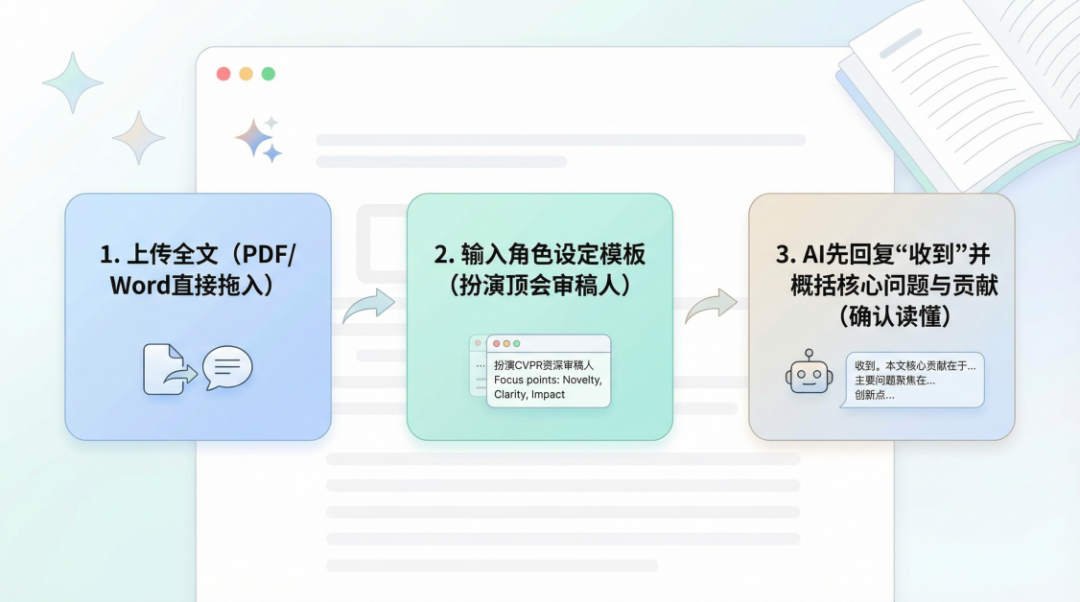
A clean, modern infographic-style illustration for an academic article, clearly explaining the first-stage AI paper review process in a three-step horizontal flowchart. Three connected rounded boxes in soft gradient blues and greens, linked by arrows. First box: Chinese text "1. 上传全文(PDF/Word直接拖入)" with icon of uploading a document to chat. Second box: "2. 输入角色设定模板(扮演顶会审稿人)" with visible prompt template snippets like "扮演CVPR资深审稿人" and focus points. Third box: "3. AI先回复‘收到’并概括核心问题与贡献(确认读懂)" with icon of AI response summary (3-5 sentences). Subtle background with faint Gemini-style chat interface and open paper pages. Fresh, airy flat design, ample white space, soft pastel palette (light blue, mint green, warm neutral), clean sans-serif Chinese fonts, high readability, professional yet approachable, publication-quality, balanced rule-of-thirds composition --ar 16:9 --v 6 --q 2 --stylize 400
很多朋友用AI看论文,第一句就是“帮我看看这篇论文”。这指令太模糊了,AI顶多给你泛泛而谈。想让反馈有用,首先得告诉AI:“你该用谁的标准来看”。
具体怎么做?
- 上传全文:直接把论文PDF或Word文档拖给Gemini。它现在上下文长度很给力,整篇上传能保持最好的连贯性,不用你一段段喂。
- 角色设定:用下面这个提示词模板,给AI一个明确的“人设”。比如你要投计算机视觉顶会CVPR,就告诉它扮演CVPR的资深审稿人。
【第一阶段核心提示词模板】
我已经上传了完整的论文文件。请你扮演 [你的学科领域,如:计算机视觉] 领域顶级期刊/会议(如:[目标期刊/会议名称,如:CVPR])的资深审稿人。请严格依据该层级会议的学术标准和同行评审规范,对这篇论文进行深度阅读。
这么做的妙处:通过AI的概括,你第一眼就能判断它有没有“读懂”你的论文。如果它总结的贡献和你心里想的南辕北辙,那大概率是你的摘要或引言部分没写清楚,需要立刻回头修改——这一步就值回票价了。
02.阶段:捏捏论文的“骨架”,看逻辑硬不硬
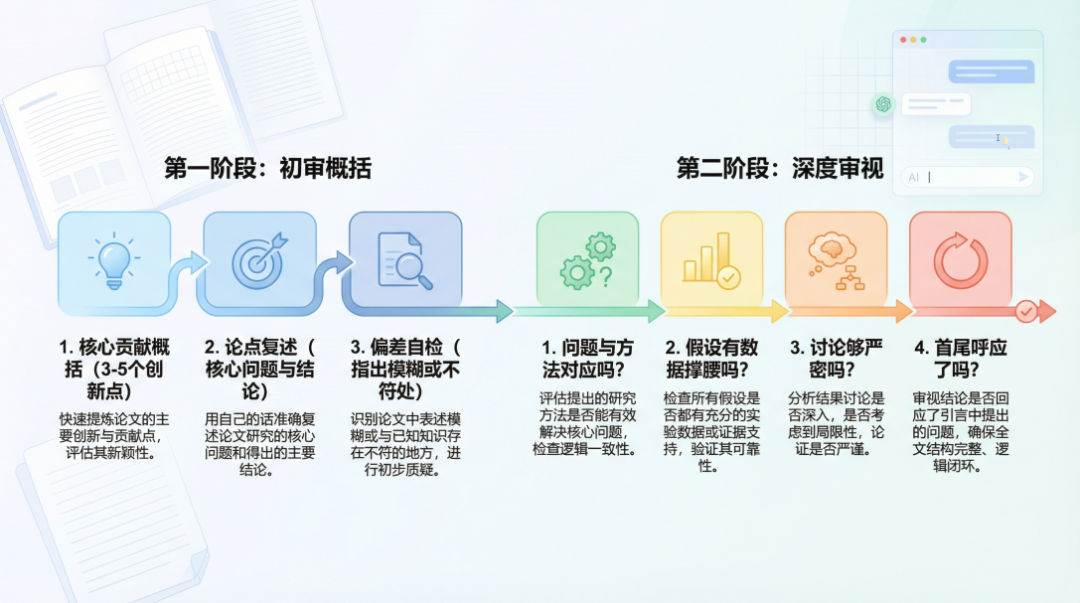
A clean, modern infographic-style illustration for an academic article, clearly explaining the complete second-stage AI paper review process in a two-part horizontal flowchart. Left section (first phase): three connected rounded boxes in soft blue tones with Chinese text "1. 核心贡献概括(3-5个创新点)", "2. 论点复述(核心问题与结论)", "3. 偏差自检(指出模糊或不符处)", each with simple icons (lightbulb, target, magnifying glass) and brief Chinese descriptions below. Right section (second phase): four connected rounded boxes in gradient colors (green, yellow, orange, red) with Chinese text "1. 问题与方法对应吗?", "2. 假设有数据撑腰吗?", "3. 讨论够严密吗?", "4. 首尾呼应了吗?", connected by arrows forming a strong logical chain. Subtle background with faint open paper pages and AI chat interface. Fresh, airy flat design, ample white space, soft pastel palette, clean sans-serif Chinese fonts, high readability, professional and approachable, publication-quality, balanced composition --ar 16:9 --v 6 --q 2 --stylize 400
确认AI读懂后,进入核心环节:检查论文的“骨架”,也就是宏观逻辑链条。很多拒稿信里写的“逻辑不清”,问题都出在这里。
【第二阶段核心提示词模板1:核心论点验证】
请基于对全文的理解,提取并总结这篇论文的核心贡献与主要论点。请执行以下具体任务:
- 核心贡献概括:请列出本文最关键的3-5个创新点或贡献,用项目符号清晰呈现。
2. 论点复述:用一段话清晰地重述本文试图解决的核心科学问题以及最终得出的主要结论。
3. 偏差自检:如果你发现论文中某些段落的表述导致核心意图模糊,或者总结出的重点与常规逻辑不符,请明确指出这些具体的章节或段落(例如:“在第2.3节,您提到X,但这与引言中设定的Y目标关联较弱”)。
这一步是自我纠偏。接着,我们要进行更细致的逻辑体检:
【第二阶段核心提示词模板2:逻辑连贯性审查】
请对论文进行深度的宏观逻辑审查,检查文章的骨架是否完整。请重点评估以下四点,并给出具体分析:
- 问题与方法对应吗?:引言里抛出的问题,在方法部分是不是给出了直接、可行的解决方案?有没有“开篇说治头疼,方法却在讲脚疼”的情况?
2. 假设有数据撑腰吗?:你提出的假设,后面的实验数据是不是充分支持了?有没有数据显得单薄、说服力不够的地方?
3. 讨论够严密吗?:讨论部分是不是扎扎实实地在解释结果?有没有出现“数据只显示A和B相关,你却直接说A导致了B”这种过度推断?
4. 首尾呼应了吗?:结论部分,是不是圆满回答了摘要里立下的“军令状”?有没有摘要里强调的重点,结论里却一笔带过?
让AI引用原文来指出问题,你能快速定位到需要重写或加强衔接的具体段落,效率比你自己来回翻高得多。
03.阶段:直面最严苛的“灵魂拷问”
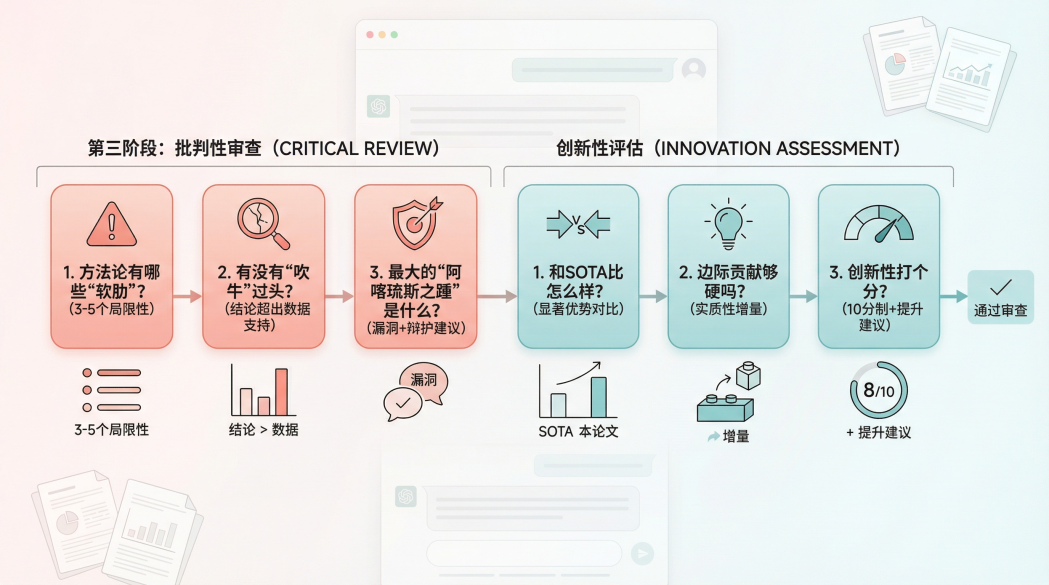
A clean, modern infographic-style illustration for an academic article, clearly explaining the third-stage AI paper review process in a two-part horizontal flowchart. Left section (Critical Review): three connected rounded boxes in soft red-orange gradient tones with Chinese text "1. 方法论有哪些‘软肋’?(3-5个局限性)", "2. 有没有‘吹牛’过头?(结论超出数据支持)", "3. 最大的‘阿喀琉斯之踵’是什么?(漏洞+辩护建议)", each with simple critical icons (warning sign, magnifying glass on flaw, shield). Right section (Innovation Assessment): three connected rounded boxes in soft blue-green gradient tones with Chinese text "1. 和SOTA比怎么样?(显著优势对比)", "2. 边际贡献够硬吗?(实质性增量)", "3. 创新性打个分?(10分制+提升建议)", each with comparison icons (versus arrow, lightbulb, score gauge). Arrows connect all steps forming a complete chain. Subtle background with faint AI chat interface and open academic paper pages. Fresh, airy flat design, ample white space, soft pastel palette, clean sans-serif Chinese fonts, high readability, professional yet approachable, publication-quality, balanced rule-of-thirds composition --ar 16:9 --v 6 --q 2 --stylize 400
论文骨架没问题,就该检验“血肉”了。这部分最刺激,我们要主动邀请AI来“找茬”,模拟最较真的审稿人。
【第三阶段核心提示词模板1:批判性找茬】
请继续保持资深审稿人的身份,对这篇论文的方法论和结果解释进行最严厉的批判性审查。请不要客气,我的目标是找出所有潜在的拒稿理由。 请重点回答:
- 方法论有哪些“软肋”?:请详细列出实验设计、数据采集或分析方法上最主要的3-5个局限性。比如,有没有没控制好的干扰变量?样本量是不是太小?
2. 有没有“吹牛”过头?:请仔细检查“讨论”和“结论”部分,指出所有结论超出了数据实际支持范围的地方。哪些只是相关关系却被说成了因果关系?
3. 最大的“阿喀琉斯之踵”是什么?:如果一个反对你方法的专家读这篇论文,他最可能攻击哪个漏洞?请具体说明,并给出预想的辩护思路或修改建议。
自己夸自己容易,难的是提前看到弱点。AI的这个“攻击点预测”功能特别实用,能让你在补充实验或强化论述上更有针对性。
【第三阶段核心提示词模板2:创新性定位】
请将这篇论文放在当前的学科背景下,客观评估其创新性和贡献。请执行以下对比分析:
- 和SOTA比怎么样?:将本文的方法/理论与领域内公认的最新成果(SOTA)或经典工作对比。在性能、效率或应用场景上,是否有显著且合理的优势?
2. 边际贡献够硬吗?:比起现有研究,本文的实质性增量到底是什么?是“巧妙地应用了现有方法”,还是“提出了有新意的视角/架构”?这贡献够在目标期刊发表吗?
3. 创新性打个分?:如果颠覆性创新是10分,请给本文的创新性打分,并说明扣分原因。如果分数不高,请给出提升理论深度或技术价值的具体、可操作建议。
这一步能帮你精准定位论文的“卖点”,并在引言和讨论中更好地突出它,避免审稿人觉得“新意不足”。
04.阶段:打磨细节,拒绝因“颜值”被拒
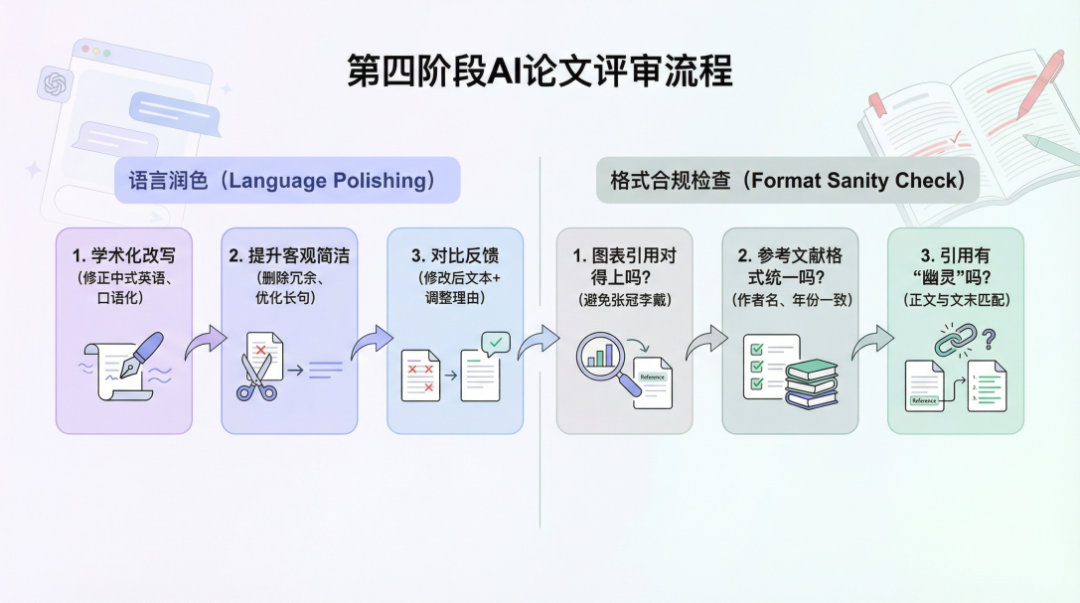
A clean, modern infographic-style illustration for an academic article, clearly explaining the fourth-stage AI paper review process in a two-part horizontal flowchart. Left section (Language Polishing): three connected rounded boxes in soft purple-blue gradient tones with Chinese text "1. 学术化改写(修正中式英语、口语化)", "2. 提升客观简洁(删除冗余、优化长句)", "3. 对比反馈(修改后文本+调整理由)", each with simple editing icons (pen, scissors, before-after arrow). Right section (Format Sanity Check): three connected rounded boxes in soft grey-green gradient tones with Chinese text "1. 图表引用对得上吗?(避免张冠李戴)", "2. 参考文献格式统一吗?(作者名、年份一致)", "3. 引用有‘幽灵’吗?(正文与文末匹配)", each with check icons (magnifying glass on figure, list check, link chain). Arrows connect all steps forming a complete polishing chain. Subtle background with faint AI chat interface and open academic paper pages with red markup. Fresh, airy flat design, ample white space, soft pastel palette, clean sans-serif Chinese fonts, high readability, professional yet approachable, publication-quality, balanced rule-of-thirds composition --ar 16:9 --v 6 --q 2 --stylize 400
内容再硬核,如果满篇语法错误、格式混乱,也会给审稿人留下极差的印象。最后一步,就是让AI当你的语言编辑和格式校对。
【第四阶段核心提示词模板1:语言精修】
请你担任顶级学术出版机构的专业语言编辑。我将发送论文的一个段落给你,请执行以下润色任务:
- 学术化改写:识别并修正不符合学术英语习惯的表达(如中式英语、口语化短语),替换为更精准、正式的词汇。
2. 提升客观简洁:删除冗余或情绪化修饰词(如 “very”, “extremely”),确保语言客观冷静。优化长难句结构,提升清晰度。
3. 对比反馈:提供修改后的文本,并附一个简短的“修改说明”,解释关键术语或句式的调整理由。
请准备好,以下是需要润色的段落:
`[在此处粘贴你的论文段落]`
建议逐段进行,尤其是摘要、引言和结论这些关键部分。AI不仅能改错,还能解释为什么这么改,相当于请了个免费外教。
【第四阶段核心提示词模板2:格式“ sanity check”】
请对论文进行最后的格式与引用一致性检查。请关注以下细节,并列出所有潜在错误:
- 图表引用对得上吗?:检查正文中“如图3所示”是否真的在讨论图3?有没有引用错乱或张冠李戴?
2. 参考文献格式统一吗?:检查参考文献列表的格式(作者名、年份、期刊名缩写等)是否全文一致?
3. 引用有“幽灵”吗?:确认正文中的每个引用标记 `[12]` 在文末都有对应条目;反之,文末的每条文献是否都在正文中被引用过?
这些细节错误自己检查眼花缭乱,但对AI来说轻而易举。花十分钟做一次全面检查,能避免很多不必要的扣分项。
05.最后说两句
这套方法的核心,不是完全依赖AI,而是把它变成一个不知疲倦、极度客观的“第一读者”和“挑刺专家”。它帮你把那些因写作疲劳、思维定式而忽略的问题,一个个摆在台面上。
你需要做的,是保持批判性思维,理性判断AI的每一条建议,吸收有价值的,忽略不相关的。经过这样一轮甚至多轮的“预评审”打磨,你的论文在逻辑、创新性和规范性上都会更上一层楼。
投稿时,心里也会更有底。毕竟,该踩的坑,咱们已经提前踩平了。
祝你下一篇文章,一击即中!

A clean, modern motivational infographic-style illustration for the concluding section of an academic article, depicting a confident young researcher standing at a minimalist desk in a bright study room, smiling while clicking "submit" on a laptop screen showing a journal submission portal with an accepted paper icon. Subtle background elements include four faint interconnected icons representing the four AI review stages (upload document, logical chain, critical warning, polishing pen). Surrounding the central scene, four soft rounded quote bubbles in pastel colors with key Chinese text: "AI:不知疲倦的挑刺专家", "保持批判性思维", "理性判断每条建议", "一击即中,自信投稿". Overall atmosphere is uplifting, productive, and triumphant. Fresh airy flat design with ample white space, soft natural window light, harmonious pastel palette (light blue, mint, warm peach), clean sans-serif Chinese fonts, high readability, professional yet inspiring, publication-quality, balanced rule-of-thirds composition --ar 16:9 --v 6 --q 2 --stylize 500
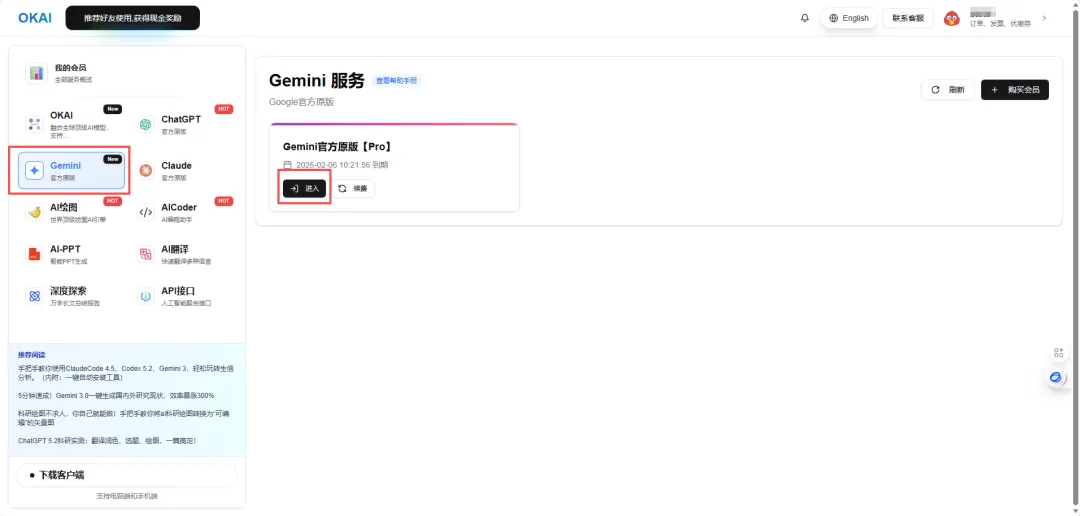
06.怎么无门槛使用上最新版Gemini 3 pro?
为了让广大用户可以用上平价且方便(无须因为地缘或者账号折腾)的原生正版Gemini,我们推荐一个宝藏ai网站,里面包含Gemini官方正版镜像套餐(完全同步官网更新无需二次付费):
1.注册账号并登陆
网址:https://dafoai.com
2.订阅服务
图片
本文参与 腾讯云自媒体同步曝光计划,分享自微信公众号。
原始发表:2026-01-21,如有侵权请联系 cloudcommunity@tencent.com 删除
评论
登录后参与评论
推荐阅读
腾讯云开发者

Copyright © 2013 - 2026 Tencent Cloud. All Rights Reserved. 腾讯云 版权所有
深圳市腾讯计算机系统有限公司 ICP备案/许可证号:粤B2-20090059  粤公网安备44030502008569号
腾讯云计算(北京)有限责任公司 京ICP证150476号 | 京ICP备11018762号