【C++高级主题】异常处理(一)

【C++高级主题】异常处理(一)

byte轻骑兵
发布于 2026-01-20 17:22:35
发布于 2026-01-20 17:22:35
C++ 异常处理机制为程序提供了一种处理运行时错误的结构化方式,使代码的错误处理逻辑与正常业务逻辑分离。通过抛出(throw)和捕获(catch)异常,程序能够在错误发生时进行栈展开(Stack Unwinding),并将控制权转移到合适的异常处理代码中。
一、异常处理基础
1.1 异常的基本概念
异常是程序在执行期间发生的特殊情况,如内存不足、文件打开失败、除零错误等。C++ 异常处理机制允许程序在错误发生时跳转到特定的错误处理代码,而不是通过返回错误码层层传递错误信息。
异常处理的三个关键步骤:
- 抛出异常:使用
throw语句在错误发生点抛出异常对象 - 捕获异常:使用
try-catch块捕获并处理异常 - 栈展开:异常抛出后,程序沿调用栈向上寻找匹配的 catch 块,期间自动销毁局部对象
1.2 异常处理的语法
try {
    // 可能抛出异常的代码
    if (error_condition) {
        throw ExceptionType("Error message"); // 抛出异常对象
    }
    // 正常代码
} catch (const ExceptionType1& e) {
    // 处理ExceptionType1类型的异常
} catch (const ExceptionType2& e) {
    // 处理ExceptionType2类型的异常
} catch (...) {
    // 捕获所有异常
    // 通常用于资源清理或记录日志
}
1.3 异常类的设计
C++ 标准库提供了一套异常类层次结构,基类为std::exception,位于<exception>头文件中。常见的标准异常类包括:
std::logic_error:逻辑错误(如无效参数)std::runtime_error:运行时错误(如资源耗尽)std::bad_alloc:内存分配失败std::out_of_range:越界访问
用户可以通过继承这些标准异常类来创建自定义异常:
#include <stdexcept>
#include <string>

class MyException : public std::runtime_error {
public:
    MyException(const std::string& message)
        : std::runtime_error(message) {}
};
二、函数抛出类类型的异常
2.1 抛出内置类型异常
C++ 允许抛出任何类型的异常,但推荐使用类类型异常,因为它们可以携带更多信息并支持继承层次结构。不过,为了演示,我们先看一个抛出内置类型异常的例子:
#include <iostream>

void divide(int a, int b) {
    if (b == 0) {
        throw 0; // 抛出int类型异常
    }
    std::cout << "Result: " << a / b << std::endl;
}

int main() {
    try {
        divide(10, 0);
    } catch (int e) {
        std::cout << "Error: Division by zero!" << std::endl;
    }
    return 0;
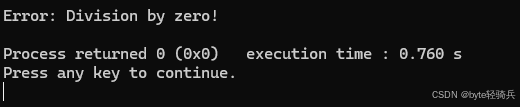
}
2.2 抛出类类型异常
更常见的做法是抛出类类型异常,尤其是从标准异常类派生的自定义异常:
#include <iostream>
#include <stdexcept>

class DivideByZeroException : public std::runtime_error {
public:
    DivideByZeroException() : std::runtime_error("Division by zero") {}
};

double safeDivide(double numerator, double denominator) {
    if (denominator == 0) {
        throw DivideByZeroException(); // 抛出类类型异常
    }
    return numerator / denominator;
}

int main() {
    try {
        double result = safeDivide(10.0, 0.0);
        std::cout << "Result: " << result << std::endl;
    } catch (const DivideByZeroException& e) {
        std::cout << "Exception caught: " << e.what() << std::endl;
    } catch (const std::exception& e) {
        std::cout << "General exception: " << e.what() << std::endl;
    }
    return 0;
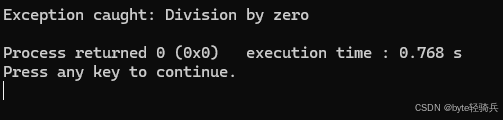
}
2.3 异常对象的拷贝语义
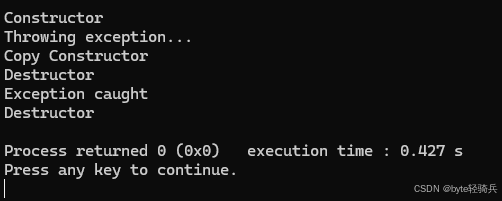
当抛出异常时,异常对象会被复制到一个特殊的内存区域(异常对象副本),即使原对象在栈展开过程中被销毁,该副本仍然存在。意味着:
- 异常对象必须是可拷贝的(或可移动的)
- 捕获异常时,通常通过引用捕获以避免二次拷贝
- 异常对象的生命周期持续到最后一个匹配的 catch 块结束
class MyException {
public:
    MyException() { std::cout << "Constructor" << std::endl; }
    MyException(const MyException&) { std::cout << "Copy Constructor" << std::endl; }
    ~MyException() { std::cout << "Destructor" << std::endl; }
};

void func() {
    MyException e;
    std::cout << "Throwing exception..." << std::endl;
    throw e; // 拷贝构造异常对象副本
}

int main() {
    try {
        func();
    } catch (const MyException& e) {
        std::cout << "Exception caught" << std::endl;
    }
    return 0;
}
三、栈展开(Stack Unwinding)
3.1 栈展开的过程
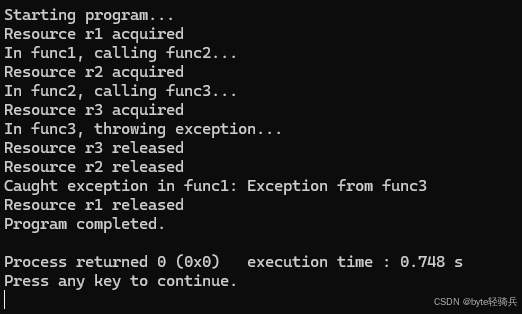
当抛出异常时,程序会暂停当前函数的执行,开始沿调用栈向上寻找匹配的 catch 块。这个过程称为栈展开,具体步骤如下:
- 抛出异常后,当前函数的执行立即停止
- 局部对象按构造的相反顺序析构
- 控制权转移到最近的匹配 catch 块
- 如果当前函数没有匹配的 catch 块,继续向上一层调用函数展开
- 重复步骤 2-4,直到找到匹配的 catch 块或到达 main 函数
3.2 栈展开的示例
#include <iostream>
#include <stdexcept>
#include <string>

class Resource {
public:
    Resource(const std::string& name) : name(name) {
        std::cout << "Resource " << name << " acquired" << std::endl;
    }
    ~Resource() {
        std::cout << "Resource " << name << " released" << std::endl;
    }
private:
    std::string name;
};

void func3() {
    Resource r3("r3");
    std::cout << "In func3, throwing exception..." << std::endl;
    throw std::runtime_error("Exception from func3");
}

void func2() {
    Resource r2("r2");
    std::cout << "In func2, calling func3..." << std::endl;
    func3();
}

void func1() {
    Resource r1("r1");
    std::cout << "In func1, calling func2..." << std::endl;
    try {
        func2();
    } catch (const std::exception& e) {
        std::cout << "Caught exception in func1: " << e.what() << std::endl;
    }
}

int main() {
    std::cout << "Starting program..." << std::endl;
    func1();
    std::cout << "Program completed." << std::endl;
    return 0;
}
3.3 栈展开与资源管理
栈展开机制确保了局部对象的析构函数会被正确调用,这为 RAII(资源获取即初始化)技术提供了坚实的基础。通过将资源封装在对象中,可以确保在异常发生时资源被正确释放。
class File {
public:
    File(const std::string& filename) : file_ptr(fopen(filename.c_str(), "r")) {
        if (!file_ptr) {
            throw std::runtime_error("Failed to open file");
        }
    }

    ~File() {
        if (file_ptr) {
            fclose(file_ptr);
        }
    }

    // 禁用拷贝构造和赋值
    File(const File&) = delete;
    File& operator=(const File&) = delete;

private:
    FILE* file_ptr;
};

void processFile(const std::string& filename) {
    File file(filename); // 资源获取即初始化
    // 处理文件...
    // 无论是否抛出异常,File析构函数都会关闭文件
}
四、捕获异常
4.1 异常捕获的语法
异常通过 catch 块捕获,语法如下:
catch (ExceptionType1 e) { /* 按值捕获 */ }
catch (ExceptionType2& e) { /* 按引用捕获 */ }
catch (const ExceptionType3& e) { /* 按const引用捕获(推荐) */ }
catch (...) { /* 捕获所有异常 */ }
4.2 按值、引用和指针捕获的区别
①按值捕获(catch (ExceptionType e)):
- 异常对象被拷贝到 catch 参数中
- 可能发生切片(slicing)问题(如果捕获基类但异常是派生类)
- 效率较低(需要额外拷贝)
②按引用捕获(catch (ExceptionType& e)):
- 直接引用异常对象副本
- 避免拷贝开销
- 可以修改异常对象(不推荐)
③按 const 引用捕获(catch (const ExceptionType& e)):
- 推荐做法
- 避免拷贝开销
- 防止意外修改异常对象
- 可以正确处理多态(通过基类引用捕获派生类对象)
④按指针捕获(catch (ExceptionType* e)):
- 必须抛出指针(
throw &e;),不推荐(容易导致悬空指针) - 异常对象生命周期管理复杂
- 很少使用
4.3 捕获顺序与多态
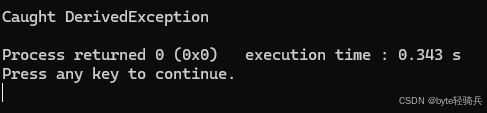
catch 块按顺序匹配,一旦找到匹配的 catch 块,后续的 catch 块将被忽略。因此,捕获派生类异常的 catch 块应放在捕获基类异常的 catch 块之前。
class BaseException : public std::exception {};
class DerivedException : public BaseException {};

void func() {
    throw DerivedException();
}

int main() {
    try {
        func();
    } catch (const DerivedException& e) {
        std::cout << "Caught DerivedException" << std::endl;
    } catch (const BaseException& e) {
        std::cout << "Caught BaseException" << std::endl;
    } catch (const std::exception& e) {
        std::cout << "Caught std::exception" << std::endl;
    } catch (...) {
        std::cout << "Caught unknown exception" << std::endl;
    }
    return 0;
}
4.4 捕获所有异常(catch-all)
使用catch (...)可以捕获所有类型的异常,通常用于:
- 记录致命错误
- 执行必要的资源清理
- 重新抛出异常(见下文)
try {
    // 可能抛出异常的代码
} catch (...) {
    std::cerr << "Unknown exception caught!" << std::endl;
    // 资源清理
    throw; // 重新抛出异常
}
五、重新抛出异常
5.1 什么是重新抛出异常?
在 catch 块中,可以使用throw;语句将当前捕获的异常重新抛出,让上层调用者处理。重新抛出的异常就是原来的异常对象,不会创建新的异常对象。
try {
    // 可能抛出异常的代码
} catch (const std::exception& e) {
    std::cerr << "Logging exception: " << e.what() << std::endl;
    throw; // 重新抛出,让上层处理
}
5.2 重新抛出的用途
- 分层处理异常:底层函数捕获并记录异常,然后重新抛出让高层函数处理
- 异常转换:捕获一种异常,转换为另一种异常抛出
- 资源清理:在重新抛出前执行必要的资源清理
5.3 异常转换示例
class DatabaseException : public std::runtime_error {
public:
    DatabaseException(const std::string& msg) : std::runtime_error(msg) {}
};

class NetworkException : public std::runtime_error {
public:
    NetworkException(const std::string& msg) : std::runtime_error(msg) {}
};

void connectToDatabase() {
    // 尝试连接数据库
    if (connection_failed) {
        throw NetworkException("Database connection failed");
    }
}

void processData() {
    try {
        connectToDatabase();
        // 处理数据
    } catch (const NetworkException& e) {
        // 记录网络异常
        std::cerr << "Network error: " << e.what() << std::endl;
        // 转换为数据库异常并重新抛出
        throw DatabaseException("Database operation failed");
    }
}
六、函数测试块与构造函数异常
6.1 函数测试块(Function Try Block)
函数测试块允许对整个函数体进行异常捕获,语法如下:
ReturnType FunctionName(Parameters)
try {
    // 函数体
} catch (const ExceptionType& e) {
    // 异常处理
}
函数测试块特别适用于构造函数,因为构造函数没有返回值,无法通过返回错误码表示失败。
6.2 构造函数异常
构造函数可以抛出异常,但需要注意以下几点:
- 如果构造函数抛出异常,对象的析构函数不会被调用(因为对象尚未完全构造)
- 基类构造函数抛出异常时,派生类构造函数中已构造的成员会被正确析构
- 可以使用函数测试块捕获构造函数中的异常
class MyClass {
private:
    Resource* res;
    int* data;

public:
    MyClass() try : res(new Resource), data(new int[100]) {
        // 可能抛出异常的初始化代码
        if (initialization_failed) {
            throw std::runtime_error("Initialization failed");
        }
    } catch (const std::exception& e) {
        // 清理已分配的资源
        delete res;
        delete[] data;
        throw; // 重新抛出异常
    }

    ~MyClass() {
        delete res;
        delete[] data;
    }
};
6.3 使用智能指针简化构造函数异常处理
使用智能指针(如std::unique_ptr和std::shared_ptr)可以自动管理资源,避免手动清理:
#include <memory>

class MyClass {
private:
    std::unique_ptr<Resource> res;
    std::unique_ptr<int[]> data;

public:
    MyClass() : res(std::make_unique<Resource>()), data(std::make_unique<int[]>(100)) {
        // 如果构造过程中抛出异常,智能指针会自动释放已分配的资源
        if (initialization_failed) {
            throw std::runtime_error("Initialization failed");
        }
    }
};
七、异常规范(Exception Specification)
7.1 已弃用的异常规范
在 C++98/03 中,可以使用异常规范声明函数可能抛出的异常:
void func() throw(std::exception); // 可能抛出std::exception或其子类
void func2() throw(); // 不抛出任何异常
但这种异常规范在实践中被证明是有问题的,因此在 C++11 中被弃用,并在 C++17 中移除。
7.2 noexcept 说明符
C++11 引入了noexcept说明符,用于声明函数是否会抛出异常:
void func() noexcept; // 承诺不会抛出任何异常
void func2() noexcept(true); // 同上
void func3() noexcept(false); // 可能抛出异常noexcept有两个主要用途:
- 性能优化:编译器可以针对不抛出异常的函数进行优化
- 移动语义:容器在重新分配内存时,会优先使用
noexcept的移动构造函数
7.3 noexcept 与析构函数
析构函数默认是noexcept(true),即不会抛出异常。如果需要析构函数可能抛出异常,必须显式声明为noexcept(false):
class MyClass {
public:
    ~MyClass() noexcept(false) {
        // 可能抛出异常的析构代码
    }
};
八、异常处理的最佳实践
8.1 异常安全保证
C++ 提供了三种异常安全级别:
- 基本保证:操作失败后,对象仍处于有效状态,没有资源泄漏
- 强保证:操作要么成功,要么对对象没有任何影响(原子性)
- 不抛异常保证:操作绝对不会抛出异常
设计函数时应明确提供哪种异常安全保证,并在文档中说明。
8.2 异常处理的常见误区
①捕获异常后不处理也不重新抛出:
try {
    // 代码
} catch (...) {
    // 忽略异常,不处理也不重新抛出
}
②抛出字符串而非异常类:
throw "Error occurred"; // 不推荐
throw std::runtime_error("Error occurred"); // 推荐③在析构函数中抛出异常:
~MyClass() {
    // 可能抛出异常的操作(危险!)
}
8.3 异常处理的推荐做法
- 使用 RAII 管理资源:确保资源在异常发生时自动释放
- 按 const 引用捕获异常:避免拷贝开销和切片问题
- 保持异常层次结构:从标准异常类派生自定义异常
- 明确函数的异常规范:使用
noexcept说明函数是否会抛出异常 - 避免在关键路径上使用异常:异常处理比条件检查慢
- 记录异常信息:在捕获异常时记录足够的上下文信息
九、完整示例:异常处理综合应用
#include <iostream>
#include <stdexcept>
#include <memory>
#include <vector>
#include <cstdio>  // 提供FILE*和fopen/fclose/fgets等函数

// 自定义异常类
class FileOpenException : public std::runtime_error {
public:
    FileOpenException(const std::string& filename)
        : std::runtime_error("Failed to open file: " + filename) {}
};

class DatabaseConnectionException : public std::runtime_error {
public:
    DatabaseConnectionException(const std::string& msg)
        : std::runtime_error("Database error: " + msg) {}
};

// 资源管理类(RAII)
class File {
public:
    File(const std::string& filename) : file_ptr(fopen(filename.c_str(), "r")) {
        if (!file_ptr) {
            throw FileOpenException(filename);
        }
    }

    ~File() {
        if (file_ptr) {
            fclose(file_ptr);
        }
    }

    // 禁用拷贝,支持移动
    File(const File&) = delete;
    File& operator=(const File&) = delete;

    File(File&& other) noexcept : file_ptr(other.file_ptr) {
        other.file_ptr = nullptr;
    }

    File& operator=(File&& other) noexcept {
        if (this != &other) {
            if (file_ptr) {
                fclose(file_ptr);
            }
            file_ptr = other.file_ptr;
            other.file_ptr = nullptr;
        }
        return *this;
    }

    bool readLine(char* buffer, size_t size) {
        return fgets(buffer, size, file_ptr) != nullptr;
    }

private:
    FILE* file_ptr;
};

// 数据库连接类
class Database {
public:
    Database(const std::string& connectionString)
        : connected(false), connectionString(connectionString) {
        connect();
    }

    ~Database() {
        disconnect();
    }

    void connect() {
        // 模拟连接数据库
        if (connectionString.empty()) {
            throw DatabaseConnectionException("Invalid connection string");
        }

        // 模拟连接成功
        connected = true;
        std::cout << "Connected to database" << std::endl;
    }

    void disconnect() noexcept {
        if (connected) {
            // 模拟断开连接
            std::cout << "Disconnected from database" << std::endl;
            connected = false;
        }
    }

    void executeQuery(const std::string& query) {
        if (!connected) {
            throw DatabaseConnectionException("Not connected to database");
        }

        // 模拟查询执行
        std::cout << "Executing query: " << query << std::endl;

        // 模拟查询失败
        if (query.empty()) {
            throw std::invalid_argument("Empty query");
        }
    }

private:
    bool connected;
    std::string connectionString;
};

// 业务逻辑类
class DataProcessor {
public:
    DataProcessor(const std::string& filename, const std::string& dbConnection)
        : file(filename), db(dbConnection) {}

    void processData() {
        try {
            char buffer[1024];
            while (file.readLine(buffer, sizeof(buffer))) {
                // 处理每一行数据
                std::string query = "INSERT INTO table VALUES ('" + std::string(buffer) + "')";
                db.executeQuery(query);
            }
        } catch (const std::invalid_argument& e) {
            std::cerr << "Invalid query: " << e.what() << std::endl;
            // 可以选择继续处理其他数据或终止
            throw; // 重新抛出,让上层处理
        }
    }

private:
    File file;
    Database db;
};

int main() {
    try {
        DataProcessor processor("data.txt", "localhost:3306/mydb");
        processor.processData();
    } catch (const FileOpenException& e) {
        std::cerr << "File error: " << e.what() << std::endl;
        return 1;
    } catch (const DatabaseConnectionException& e) {
        std::cerr << "Database error: " << e.what() << std::endl;
        return 2;
    } catch (const std::exception& e) {
        std::cerr << "General error: " << e.what() << std::endl;
        return 3;
    } catch (...) {
        std::cerr << "Unknown error occurred" << std::endl;
        return 4;
    }

    std::cout << "Data processing completed successfully" << std::endl;
    return 0;
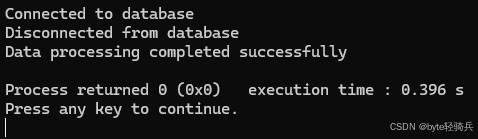
}
十、总结
C++ 异常处理机制为程序提供了一种强大而灵活的错误处理方式,通过抛出异常、栈展开和捕获异常,可以将错误处理逻辑与正常业务逻辑分离,提高代码的可读性和可维护性。
关键要点:
- 异常基础:使用
throw抛出异常,try-catch捕获异常 - 栈展开:异常抛出后,程序沿调用栈向上寻找匹配的 catch 块,自动销毁局部对象
- 异常类设计:从标准异常类派生自定义异常,便于分类处理
- 捕获异常:按 const 引用捕获异常,注意捕获顺序
- 重新抛出:在 catch 块中使用
throw;重新抛出当前异常 - 构造函数异常:构造函数可抛出异常,但需注意资源清理
- 异常安全:提供明确的异常安全保证(基本、强、不抛异常)
- 最佳实践:使用 RAII 管理资源,避免常见误区
合理使用异常处理机制,可以使代码更加健壮、可靠,同时保持良好的性能。但需注意,异常不应替代正常的错误检查,而应仅用于处理真正的异常情况。
本文参与 腾讯云自媒体同步曝光计划,分享自作者个人站点/博客。
原始发表:2025-05-27,如有侵权请联系 cloudcommunity@tencent.com 删除
评论
登录后参与评论
推荐阅读
目录
腾讯云开发者

Copyright © 2013 - 2026 Tencent Cloud. All Rights Reserved. 腾讯云 版权所有
深圳市腾讯计算机系统有限公司 ICP备案/许可证号:粤B2-20090059  粤公网安备44030502008569号
腾讯云计算(北京)有限责任公司 京ICP证150476号 | 京ICP备11018762号