C++进阶:(十一)深度解析——用哈希表封装 unordered_map 和 unordered_set

C++进阶:(十一)深度解析——用哈希表封装 unordered_map 和 unordered_set

_OP_CHEN
发布于 2026-01-14 10:53:47
发布于 2026-01-14 10:53:47
前言
在 C++ 的 STL 容器家族中,unordered_map 和 unordered_set 是高频使用的关联式容器。它们凭借哈希表的底层实现,实现了 O (1) 级别的平均查找、插入和删除效率,在处理大规模数据时展现出显著优势。但你是否好奇过,这两个容器是如何基于哈希表实现的?为什么 unordered_set 不支持修改元素,而 unordered_map 只能修改 value 不能修改 key?本文将带你从源码分析入手,一步步拆解哈希表封装 unordered_map 和 unordered_set 的完整实现过程,包含详细的代码实现和原理讲解,让你不仅知其然,更知其所以然。下面就让我我们正式开始吧!
一、前置知识:STL 中哈希表与 unordered 系列容器的渊源
在正式开始实现之前,我们先回顾一下 STL 中哈希表与 unordered_map、unordered_set 的历史渊源。这能帮助我们更好地理解设计思路的由来。
1.1 SGI-STL 的历史遗留问题
如果你翻阅过 SGI-STL 3.0 版本的源代码,会发现一个有趣的现象:这个版本中并没有 unordered_map 和 unordered_set 容器。因为 SGI-STL 3.0 是 C++11 标准之前的实现,而 unordered_map 和 unordered_set 是 C++11 才正式纳入标准的容器。
但这并不意味着 SGI-STL 没有提供哈希表相关的容器 —— 它实现了 hash_map 和 hash_set,只不过这两个容器属于非标准扩展(即 C++ 标准并未强制要求所有编译器实现)。它们的底层核心是一个名为 hashtable 的哈希表实现,相关源代码分散在 hash_map.h、hash_set.h、stl_hash_table.h 等文件中。
1.2 核心设计思路:复用哈希表底层
SGI-STL 中 hash_map 和 hash_set 的设计遵循了 "复用底层" 的原则,这也是 STL 容器设计的核心思想之一。从源码中可以看到:
- hash_set 的底层是 hashtable,存储的是单一 key 值,传给 hashtable 的模板参数是 Value(实际为 key);
- hash_map 的底层同样是 hashtable,存储的是 pair<const Key, T> 键值对;
- 两者都通过 hashtable 提供的 insert_unique、find 等接口实现自身的核心功能。
这种设计的优势在于:只需要实现一个通用的哈希表,就能通过不同的模板参数和适配层,封装出两种不同用途的容器。我们后续的实现也将沿用这个思路,先实现一个通用的哈希表(HashTable),再基于它分别封装 unordered_map 和 unordered_set。
1.3 源码中的 "小瑕疵":命名不规范
值得一提的是,即使是 STL 源码,也存在命名不规范的情况。比如 hash_set 的模板参数用 Value 命名(实际存储的是 key),而 hash_map 用 Key 和 T 命名(分别对应键和值)。这给阅读源码带来了一定的困扰。因此,在我们自己的实现中,会采用更清晰的命名规则:用 K 表示 key 类型,V 表示 value 类型,T 表示哈希表中存储的实际数据类型(可能是 K,也可能是 pair<K, V>)。
二、通用哈希表(HashTable)的实现
哈希表是 unordered_map 和 unordered_set 的底层核心,其实现质量直接决定了上层容器的性能。一个完整的哈希表需要支持节点存储、哈希计算、冲突解决、扩容、迭代器等核心功能。尽管在之前的博客中,我已经带大家实现过哈希表这一数据结构了,本期博客我还是再以STL中对于哈希表的实现,带大家复习一下通用哈希表的实现。下面我们一步步实现这个通用哈希表。
2.1 哈希表的核心结构设计
哈希表的经典实现是 "数组 + 链表" 的结合体(也称为链地址法):
2.1.1 哈希节点(HashNode)的实现
哈希节点需要存储数据和下一个节点的指针,设计成模板类以支持不同的数据类型:
// HashTable.h
namespace hash_bucket {
    // 哈希节点结构
    template<class T>
    struct HashNode {
        T _data;          // 存储的数据
        HashNode<T>* _next; // 指向下一个节点的指针

        // 构造函数
        HashNode(const T& data)
            : _data(data)
            , _next(nullptr) {}
    };
}
2.1.2 哈希函数的设计
哈希函数的作用是将 key 值映射为桶数组的索引(即哈希值)。由于 key 的类型可能是 int、string 等不同类型,我们需要设计一个通用的哈希函数接口,并针对不同类型进行特化。
首先实现默认的哈希函数模板(适用于整形类型):
// HashTable.h
// 默认哈希函数模板(适用于整形类型)
template<class K>
struct HashFunc {
    size_t operator()(const K& key) {
        // 直接将整形key转换为size_t作为哈希值
        return (size_t)key;
    }
};
对于 string 类型,不能直接转换为整形,需要设计专门的哈希算法。这里采用经典的字符串哈希算法:
// HashTable.h
// 字符串类型的哈希函数特化
template<>
struct HashFunc<string> {
    size_t operator()(const string& key) {
        size_t hash = 0;
        for (char ch : key) {
            // 经典哈希算法:每次迭代累加字符ASCII值并乘以一个质数(131)
            hash = hash * 131 + ch;
        }
        return hash;
    }
};
2.1.3 键提取函数(KeyOfT)的设计
哈希表中存储的数据类型 T 可能有两种情况:
- 对于 unordered_set:T 就是 key 类型(K)
- 对于 unordered_map:T 是 pair<const K, V> 类型
哈希表在进行哈希计算和键比较时,只需要用到 key 值,因此需要一个 "键提取函数",从 T 类型中提取出 K 类型的 key。这个函数不能硬编码,需要由上层容器(unordered_map/unordered_set)提供,因此我们将其设计为模板参数,由上层传入。
例如:
- unordered_set 的键提取函数:直接返回 T(因为 T 就是 key)
- unordered_map 的键提取函数:返回 pair 中的 first 成员(即 key)
2.2 哈希表的核心成员与构造、析构函数
2.2.1 核心成员变量
// HashTable.h
namespace hash_bucket {
    template<class K, class T, class KeyOfT, class Hash>
    class HashTable {
    public:
        typedef HashNode<T> Node; // 哈希节点类型别名

    private:
        vector<Node*> _tables; // 桶数组:存储节点指针的vector
        size_t _n;             // 哈希表中存储的元素个数
        KeyOfT _kot;           // 键提取函数对象
        Hash _hash;            // 哈希函数对象
    };
}
2.2.2 构造函数:桶数组的初始化
桶数组的初始大小需要选择一个合适的质数(质数能减少哈希冲突)。STL 源码中提供了一个质数列表,我们可以直接复用这个列表,初始化时选择第一个质数(53)作为初始桶大小:
// HashTable.h
namespace hash_bucket {
    template<class K, class T, class KeyOfT, class Hash>
    class HashTable {
        // 质数列表(来自SGI-STL源码)
        static const unsigned long __stl_prime_list[];
        static const int __stl_num_primes = 28;

        // 查找大于等于n的最小质数(用于扩容)
        inline unsigned long __stl_next_prime(unsigned long n) {
            const unsigned long* first = __stl_prime_list;
            const unsigned long* last = __stl_prime_list + __stl_num_primes;
            // 二分查找第一个大于等于n的质数
            const unsigned long* pos = lower_bound(first, last, n);
            return pos == last ? *(last - 1) : *pos;
        }

    public:
        // 构造函数:初始化桶数组
        HashTable() {
            // 初始桶大小为第一个质数53
            size_t initial_size = __stl_next_prime(0);
            _tables.resize(initial_size, nullptr);
            _n = 0;
        }
    };

    // 初始化质数列表
    template<class K, class T, class KeyOfT, class Hash>
    const unsigned long HashTable<K, T, KeyOfT, Hash>::__stl_prime_list[] = {
        53, 97, 193, 389, 769,
        1543, 3079, 6151, 12289, 24593,
        49157, 98317, 196613, 393241, 786433,
        1572869, 3145739, 6291469, 12582917, 25165843,
        50331653, 100663319, 201326611, 402653189, 805306457,
        1610612741, 3221225473, 4294967291
    };
}
2.2.3 析构函数:释放节点资源
析构函数需要遍历所有桶,释放每个桶中的链表节点,避免内存泄漏:
// HashTable.h
namespace hash_bucket {
    template<class K, class T, class KeyOfT, class Hash>
    class HashTable {
    public:
        // 析构函数
        ~HashTable() {
            // 遍历每个桶
            for (size_t i = 0; i < _tables.size(); ++i) {
                Node* cur = _tables[i];
                // 释放当前桶中的所有节点
                while (cur) {
                    Node* next = cur->_next;
                    delete cur;
                    cur = next;
                }
                _tables[i] = nullptr; // 置空桶指针
            }
        }
    };
}
2.3 哈希表的核心操作:插入(Insert)
插入操作是哈希表最核心的操作之一,需要处理哈希计算、冲突解决、扩容等关键逻辑。插入的核心流程如下:
- 检查插入的 key 是否已存在(存在则返回失败);
- 计算 key 的哈希值,确定对应的桶索引;
- 检查负载因子(_n / 桶数组大小),若达到 1 则进行扩容;
- 将新节点以头插法插入到对应的桶中;
- 更新元素个数_n,返回插入成功的迭代器和成功标志。
2.3.1 扩容逻辑
当负载因子(元素个数 / 桶数组大小)达到 1 时,哈希冲突的概率会显著增加,此时需要扩容。扩容的核心步骤:
- 计算新的桶大小(选择大于当前桶大小的最小质数)
- 创建新的桶数组(大小为新的桶大小,初始化为 nullptr)
- 遍历旧桶数组中的所有节点,重新计算每个节点在新桶数组中的索引
- 将节点插入到新桶数组对应的位置(头插法)
- 释放旧桶数组的资源,将新桶数组与旧桶数组交换
2.3.2 插入函数的实现
// HashTable.h
namespace hash_bucket {
    template<class K, class T, class KeyOfT, class Hash>
    class HashTable {
    public:
        // 插入元素,返回pair<迭代器, bool>:迭代器指向插入的元素,bool表示是否插入成功
        pair<Iterator, bool> Insert(const T& data) {
            // 1. 检查key是否已存在
            K key = _kot(data);
            Iterator it = Find(key);
            if (it != End()) {
                // key已存在,插入失败
                return make_pair(it, false);
            }

            // 2. 检查负载因子,达到1则扩容
            if (_n == _tables.size()) {
                // 计算新的桶大小
                size_t new_size = __stl_next_prime(_tables.size() + 1);
                // 创建新的桶数组
                vector<Node*> new_tables(new_size, nullptr);

                // 遍历旧桶数组,将所有节点重新映射到新桶
                for (size_t i = 0; i < _tables.size(); ++i) {
                    Node* cur = _tables[i];
                    while (cur) {
                        // 保存下一个节点
                        Node* next = cur->_next;
                        // 重新计算当前节点在新桶中的索引
                        K node_key = _kot(cur->_data);
                        size_t hashi = _hash(node_key) % new_tables.size();
                        // 头插法插入新桶
                        cur->_next = new_tables[hashi];
                        new_tables[hashi] = cur;
                        // 处理下一个节点
                        cur = next;
                    }
                    // 旧桶置空
                    _tables[i] = nullptr;
                }

                // 交换新旧桶数组
                _tables.swap(new_tables);
            }

            // 3. 计算插入位置的哈希索引
            size_t hashi = _hash(key) % _tables.size();
            // 4. 头插法插入新节点
            Node* new_node = new Node(data);
            new_node->_next = _tables[hashi];
            _tables[hashi] = new_node;
            // 5. 更新元素个数
            ++_n;

            // 返回插入成功的迭代器和true
            return make_pair(Iterator(new_node, this), true);
        }
    };
}
2.4 哈希表的核心操作:查找(Find)和删除(Erase)
2.4.1 查找函数(Find)
查找的核心逻辑:
- 计算 key 的哈希值,确定对应的桶索引;
- 遍历该桶中的链表节点,比较节点的 key 与目标 key;
- 找到则返回对应的迭代器,未找到则返回 End ()。
// HashTable.h
namespace hash_bucket {
    template<class K, class T, class KeyOfT, class Hash>
    class HashTable {
    public:
        // 查找key对应的元素,返回迭代器
        Iterator Find(const K& key) {
            // 空表直接返回End()
            if (_tables.empty()) {
                return End();
            }
            // 计算哈希索引
            size_t hashi = _hash(key) % _tables.size();
            // 遍历对应桶的链表
            Node* cur = _tables[hashi];
            while (cur) {
                if (_kot(cur->_data) == key) {
                    // 找到key,返回对应的迭代器
                    return Iterator(cur, this);
                }
                cur = cur->_next;
            }
            // 未找到,返回End()
            return End();
        }
    };
}
2.4.2 删除函数(Erase)
删除的核心逻辑:
- 计算 key 的哈希值,确定对应的桶索引
- 遍历该桶中的链表节点,找到 key 对应的节点
- 处理节点的前驱指针(若为头节点则更新桶指针,否则更新前驱节点的 next 指针)
- 释放该节点的内存,更新元素个数_n,返回删除成功标志
// HashTable.h
namespace hash_bucket {
    template<class K, class T, class KeyOfT, class Hash>
    class HashTable {
    public:
        // 删除key对应的元素,返回是否删除成功
        bool Erase(const K& key) {
            // 空表直接返回false
            if (_tables.empty()) {
                return false;
            }
            // 计算哈希索引
            size_t hashi = _hash(key) % _tables.size();
            Node* cur = _tables[hashi];
            Node* prev = nullptr; // 前驱节点指针

            // 遍历对应桶的链表
            while (cur) {
                if (_kot(cur->_data) == key) {
                    // 找到要删除的节点
                    if (prev == nullptr) {
                        // 头节点:更新桶指针
                        _tables[hashi] = cur->_next;
                    } else {
                        // 非头节点:更新前驱节点的next指针
                        prev->_next = cur->_next;
                    }
                    // 释放节点内存
                    delete cur;
                    // 更新元素个数
                    --_n;
                    return true;
                }
                // 移动指针
                prev = cur;
                cur = cur->_next;
            }

            // 未找到key,返回false
            return false;
        }
    };
}
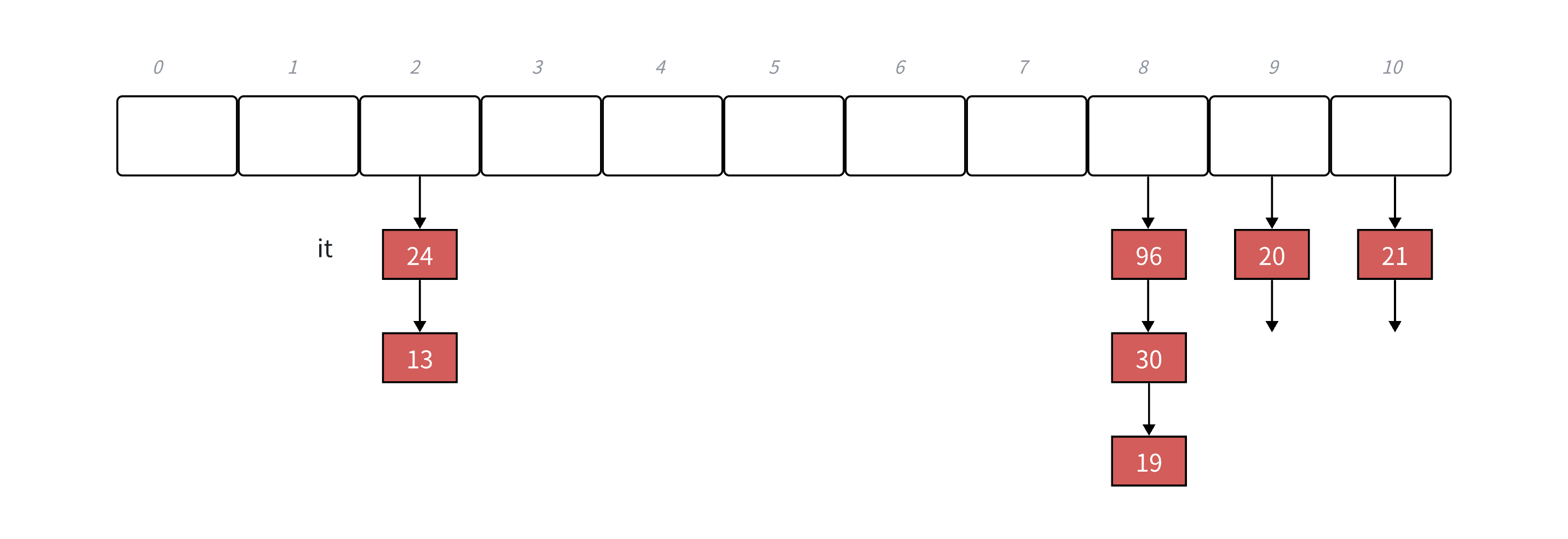
2.5.2 迭代器的实现
为了同时支持普通迭代器和 const 迭代器,我们设计一个模板化的迭代器结构 HTIterator,通过模板参数区分普通和 const 类型:
// HashTable.h
namespace hash_bucket {
    // 前置声明HashTable,因为迭代器需要访问HashTable的成员
    template<class K, class T, class KeyOfT, class Hash>
    class HashTable;

    // 哈希表迭代器:模板参数Ptr为数据指针类型,Ref为数据引用类型
    template<class K, class T, class Ptr, class Ref, class KeyOfT, class Hash>
    struct HTIterator {
        typedef HashNode<T> Node;
        typedef HTIterator<K, T, Ptr, Ref, KeyOfT, Hash> Self;

        Node* _node;                  // 当前指向的节点
        const HashTable<K, T, KeyOfT, Hash>* _pht; // 指向哈希表的指针(用于查找下一个桶)

        // 构造函数
        HTIterator(Node* node, const HashTable<K, T, KeyOfT, Hash>* pht)
            : _node(node)
            , _pht(pht) {}

        // 解引用运算符:返回数据的引用
        Ref operator*() {
            return _node->_data;
        }

        // 箭头运算符:返回数据的指针(支持->访问成员)
        Ptr operator->() {
            return &_node->_data;
        }

        // 不等运算符:用于判断迭代器是否到达末尾
        bool operator!=(const Self& s) const {
            return _node != s._node;
        }

        // 相等运算符
        bool operator==(const Self& s) const {
            return _node == s._node;
        }

        // 前置++运算符:核心实现
        Self& operator++() {
            // 1. 如果当前节点有下一个节点,直接移动到下一个节点
            if (_node->_next != nullptr) {
                _node = _node->_next;
            } else {
                // 2. 当前桶遍历完,查找下一个非空桶
                KeyOfT kot;
                Hash hash;
                // 计算当前节点所在的桶索引
                size_t hashi = hash(kot(_node->_data)) % _pht->_tables.size();
                // 从当前桶的下一个桶开始查找
                ++hashi;
                while (hashi < _pht->_tables.size()) {
                    if (_pht->_tables[hashi] != nullptr) {
                        // 找到非空桶,指向该桶的第一个节点
                        _node = _pht->_tables[hashi];
                        return *this;
                    }
                    ++hashi;
                }
                // 3. 所有桶都遍历完,迭代器指向nullptr(End())
                _node = nullptr;
            }
            return *this;
        }

        // 后置++运算符(复用前置++)
        Self operator++(int) {
            Self tmp = *this;
            ++(*this);
            return tmp;
        }
    };
}
2.5.3 哈希表的 begin () 和 end () 接口
在 HashTable 类中提供 begin () 和 end () 接口,分别返回指向第一个元素的迭代器和指向末尾的迭代器(_node 为 nullptr):
// HashTable.h
namespace hash_bucket {
    template<class K, class T, class KeyOfT, class Hash>
    class HashTable {
    public:
        // 普通迭代器类型别名
        typedef HTIterator<K, T, T*, T&, KeyOfT, Hash> Iterator;
        // const迭代器类型别名
        typedef HTIterator<K, T, const T*, const T&, KeyOfT, Hash> ConstIterator;

        // 普通迭代器begin():返回第一个非空桶的第一个节点
        Iterator Begin() {
            if (_n == 0) {
                return End();
            }
            // 遍历桶数组,找到第一个非空桶
            for (size_t i = 0; i < _tables.size(); ++i) {
                if (_tables[i] != nullptr) {
                    return Iterator(_tables[i], this);
                }
            }
            return End();
        }

        // 普通迭代器end():返回指向nullptr的迭代器
        Iterator End() {
            return Iterator(nullptr, this);
        }

        // const迭代器begin()
        ConstIterator Begin() const {
            if (_n == 0) {
                return End();
            }
            for (size_t i = 0; i < _tables.size(); ++i) {
                if (_tables[i] != nullptr) {
                    return ConstIterator(_tables[i], this);
                }
            }
            return End();
        }

        // const迭代器end()
        ConstIterator End() const {
            return ConstIterator(nullptr, this);
        }

        // 友元声明:让迭代器可以访问哈希表的私有成员(_tables)
        template<class K1, class T1, class Ptr, class Ref, class KeyOfT1, class Hash1>
        friend struct HTIterator;
    };
}
三、基于哈希表封装 unordered_set
unordered_set 是存储唯一 key 的容器,其底层复用我们实现的 HashTable。由于 unordered_set 存储的是单一 key,因此需要设计对应的键提取函数,并限制元素的修改(不允许修改 key)。
3.1 unordered_set 的类结构设计
// MyUnorderedSet.h
#include "HashTable.h"

namespace bit {
    template<class K, class Hash = HashFunc<K>>
    class unordered_set {
        // 键提取函数:unordered_set存储的是K,直接返回key
        struct SetKeyOfT {
            const K& operator()(const K& key) {
                return key;
            }
        };

    public:
        // 迭代器类型别名(复用HashTable的迭代器)
        typedef typename hash_bucket::HashTable<K, const K, SetKeyOfT, Hash>::Iterator iterator;
        typedef typename hash_bucket::HashTable<K, const K, SetKeyOfT, Hash>::ConstIterator const_iterator;

        // 迭代器接口
        iterator begin() {
            return _ht.Begin();
        }

        iterator end() {
            return _ht.End();
        }

        const_iterator begin() const {
            return _ht.Begin();
        }

        const_iterator end() const {
            return _ht.End();
        }

        // 插入元素:返回pair<iterator, bool>
        pair<iterator, bool> insert(const K& key) {
            return _ht.Insert(key);
        }

        // 查找元素
        iterator find(const K& key) {
            return _ht.Find(key);
        }

        const_iterator find(const K& key) const {
            return _ht.Find(key);
        }

        // 删除元素
        bool erase(const K& key) {
            return _ht.Erase(key);
        }

    private:
        // 底层哈希表:存储的类型是const K(不允许修改)
        hash_bucket::HashTable<K, const K, SetKeyOfT, Hash> _ht;
    };
}
3.2 关键设计说明
- 键提取函数 SetKeyOfT:由于 unordered_set 存储的是 K 类型的 key,键提取函数直接返回传入的 key 即可。
- 元素不可修改:哈希表存储的类型是 const K,因此迭代器解引用后返回的是 const K&,不允许修改元素(符合 unordered_set 的特性)。
- 接口复用:insert、find、erase 等接口直接复用哈希表的对应接口,上层只需要进行简单的封装。
3.3 unordered_set 的测试用例
// MyUnorderedSet.h
namespace bit {
    void test_unordered_set() {
        // 测试插入和遍历
        unordered_set<int> s;
        int a[] = {4, 2, 6, 1, 3, 5, 15, 7, 16, 14, 3, 3, 15};
        for (auto e : a) {
            auto ret = s.insert(e);
            if (ret.second) {
                cout << "插入成功:" << e << endl;
            } else {
                cout << "插入失败(已存在):" << e << endl;
            }
        }
        cout << endl;

        // 遍历输出(无序)
        cout << "unordered_set遍历结果:";
        for (auto e : s) {
            cout << e << " ";
        }
        cout << endl << endl;

        // 测试迭代器遍历
        cout << "迭代器遍历结果:";
        unordered_set<int>::iterator it = s.begin();
        while (it != s.end()) {
            // *it += 1; // 编译报错:不允许修改const K
            cout << *it << " ";
            ++it;
        }
        cout << endl << endl;

        // 测试find和erase
        auto find_it = s.find(5);
        if (find_it != s.end()) {
            cout << "找到元素:" << *find_it << endl;
            s.erase(5);
            cout << "删除元素5后,遍历结果:";
            for (auto e : s) {
                cout << e << " ";
            }
            cout << endl;
        } else {
            cout << "未找到元素5" << endl;
        }
    }
}
测试结果说明:
- 插入重复元素(如 3、15)会返回插入失败。
- 遍历结果是无序的,因为哈希表的存储是无序的。
- 尝试修改迭代器指向的元素会编译报错,保证了元素的不可修改性。
四、基于哈希表封装 unordered_map
unordered_map 是存储键值对(key-value)的容器,key 唯一,value 可修改。其底层同样复用 HashTable,需要设计对应的键提取函数(从 pair 中提取 key),并限制 key 的修改(value 可修改)。
4.1 unordered_map 的类结构设计
// MyUnorderedMap.h
#include "HashTable.h"

namespace bit {
    template<class K, class V, class Hash = HashFunc<K>>
    class unordered_map {
        // 键提取函数:从pair<const K, V>中提取key(first成员)
        struct MapKeyOfT {
            const K& operator()(const pair<const K, V>& kv) {
                return kv.first;
            }
        };

    public:
        // 迭代器类型别名
        typedef typename hash_bucket::HashTable<K, pair<const K, V>, MapKeyOfT, Hash>::Iterator iterator;
        typedef typename hash_bucket::HashTable<K, pair<const K, V>, MapKeyOfT, Hash>::ConstIterator const_iterator;

        // 迭代器接口
        iterator begin() {
            return _ht.Begin();
        }

        iterator end() {
            return _ht.End();
        }

        const_iterator begin() const {
            return _ht.Begin();
        }

        const_iterator end() const {
            return _ht.End();
        }

        // 插入键值对
        pair<iterator, bool> insert(const pair<K, V>& kv) {
            return _ht.Insert(kv);
        }

        // 查找元素
        iterator find(const K& key) {
            return _ht.Find(key);
        }

        const_iterator find(const K& key) const {
            return _ht.Find(key);
        }

        // 删除元素
        bool erase(const K& key) {
            return _ht.Erase(key);
        }

        // 重载[]运算符:支持插入和访问value
        V& operator[](const K& key) {
            // 插入键值对(若key不存在则插入,value为默认构造)
            pair<iterator, bool> ret = _ht.Insert(make_pair(key, V()));
            // 返回value的引用
            return ret.first->second;
        }

    private:
        // 底层哈希表:存储的是pair<const K, V>(key不可修改,value可修改)
        hash_bucket::HashTable<K, pair<const K, V>, MapKeyOfT, Hash> _ht;
    };
}
4.2 关键设计说明
- 键提取函数 MapKeyOfT:unordered_map 存储的是 pair<const K, V>,键提取函数返回 pair 的 first 成员(即 key)。
- key 不可修改,value 可修改:哈希表存储的是 pair<const K, V>,因此 key 是 const 类型(不可修改),而 value 是普通类型(可修改)。
- operator [] 的实现:这是 unordered_map 的常用接口,其核心是复用 insert 函数。当 key 不存在时,insert 会插入一个默认构造的 value;当 key 存在时,直接返回已存在的 value 的引用。这样就实现了 "访问 + 插入" 的双重功能。
4.3 unordered_map 的测试用例
// MyUnorderedMap.h
namespace bit {
    void test_unordered_map() {
        // 测试插入和遍历
        unordered_map<string, string> dict;
        dict.insert({"sort", "排序"});
        dict.insert({"left", "左边"});
        dict.insert({"right", "右边"});
        // 插入重复key
        auto ret = dict.insert({"sort", "排序(重复)"});
        if (ret.second) {
            cout << "插入成功:sort -> " << ret.first->second << endl;
        } else {
            cout << "插入失败(key已存在):sort -> " << ret.first->second << endl;
        }
        cout << endl;

        // 测试[]运算符
        dict["insert"] = "插入"; // 插入新键值对
        dict["left"] = "左边(修改后)"; // 修改已有value
        cout << "dict[\"insert\"] = " << dict["insert"] << endl;
        cout << "dict[\"left\"] = " << dict["left"] << endl;
        cout << endl;

        // 遍历输出
        cout << "unordered_map遍历结果:" << endl;
        unordered_map<string, string>::iterator it = dict.begin();
        while (it != dict.end()) {
            // it->first += "x"; // 编译报错:key是const类型,不可修改
            it->second += "(已遍历)"; // value可修改
            cout << it->first << " : " << it->second << endl;
            ++it;
        }
        cout << endl;

        // 测试find和erase
        auto find_it = dict.find("right");
        if (find_it != dict.end()) {
            cout << "找到元素:" << find_it->first << " : " << find_it->second << endl;
            dict.erase("right");
            cout << "删除元素right后,遍历结果:" << endl;
            for (auto& kv : dict) {
                cout << kv.first << " : " << kv.second << endl;
            }
        } else {
            cout << "未找到元素right" << endl;
        }
    }
}
测试结果说明:
- 插入重复 key 会返回失败,保留原有 value。
- [ ] 运算符既可以插入新键值对,也可以修改已有 value。
- 尝试修改 key 会编译报错,保证了 key 的不可修改性;value 可以自由修改。
- 遍历结果是无序的,符合 unordered_map 的特性。
五、常见问题与优化方向
5.1 常见问题解答
5.1.1 为什么 unordered_set 的元素不可修改?
因为 unordered_set 的元素是 key,而 key 是哈希表组织数据的基础。如果修改了 key,会导致其哈希值发生变化,该元素在哈希表中的位置就会失效,进而导致后续的查找、删除等操作出错。因此,unordered_set 的元素被设计为不可修改(存储为 const K)。
5.1.2 为什么 unordered_map 的 key 不可修改,而 value 可以修改?
原因与 unordered_set 类似:key 是哈希表组织数据的基础,修改 key 会导致哈希值变化,破坏哈希表的结构。而 value 只是附加数据,修改 value 不会影响 key 的哈希值和在哈希表中的位置,因此可以自由修改。
5.1.3 哈希冲突的影响及解决方式?
哈希冲突是指不同的 key 通过哈希函数计算得到相同的桶索引。我们的实现采用链地址法(链表)解决冲突:同一个桶中的多个节点通过链表连接。
哈希冲突过多会导致链表过长,使查找效率从 O (1) 退化到 O (n)。解决这个问题的关键是:
- 选择合适的哈希函数(减少冲突概率)
- 合理的扩容机制(负载因子达到 1 时扩容,减少每个桶的平均节点数)
5.1.4 为什么桶大小要选择质数?
质数能减少哈希冲突的概率。因为如果桶大小是合数,某些 key 的哈希值可能会集中在某些桶中(例如桶大小为 4,哈希值为 0、4、8 的 key 都会映射到同一个桶)。而质数的因子较少,能让 key 更均匀地分布在各个桶中,减少冲突。
5.2 优化方向
5.2.1 支持更多 key 类型
目前我们的哈希函数只支持 int 和 string 类型。可以通过模板特化,为更多类型(如 double、自定义类)提供哈希函数。
例如,为 double 类型提供哈希函数特化:
template<>
struct HashFunc<double> {
    size_t operator()(const double& key) {
        // 将double转换为整数后计算哈希值(注意精度问题)
        return (size_t)(key * 1000000000);
    }
};
5.2.2 优化哈希函数
对于 string 类型的哈希函数,我们目前采用的是简单的累加算法。可以使用更高效的哈希算法(如 MurmurHash、FNV 哈希),进一步减少冲突概率。
5.2.3 支持迭代器的 const 修饰
目前我们的迭代器已经支持 const_iterator,但可以进一步完善接口,例如提供 cbegin () 和 cend () 接口,与 STL 标准容器保持一致。
5.2.4 支持批量插入和范围构造
可以为 unordered_map 和 unordered_set 添加范围构造函数和批量插入接口,支持从其他容器(如 vector、list)批量插入元素,提升使用便利性。
总结
通过本文的实现,相信大家不仅掌握了 unordered_map 和 unordered_set 的底层原理,还学会了模板编程、泛型设计、迭代器设计等 C++ 核心技术。这些技术在实际开发中具有广泛的应用,希望能为大家提供帮助。
本文参与 腾讯云自媒体同步曝光计划,分享自作者个人站点/博客。
原始发表:2025-11-17,如有侵权请联系 cloudcommunity@tencent.com 删除
评论
登录后参与评论
推荐阅读
目录
腾讯云开发者

Copyright © 2013 - 2026 Tencent Cloud. All Rights Reserved. 腾讯云 版权所有
深圳市腾讯计算机系统有限公司 ICP备案/许可证号:粤B2-20090059  粤公网安备44030502008569号
腾讯云计算(北京)有限责任公司 京ICP证150476号 | 京ICP备11018762号