More SQL(Focus Subqueries、Join)

More SQL(Focus Subqueries、Join)

小陈又菜
发布于 2025-12-23 16:28:00
发布于 2025-12-23 16:28:00
Subqueries
- A parenthesized SELECT-FROM-WHERE statement (subquery ) can be used as a value in a number of places, including FROM and WHERE clauses.(将子查询的结果作为一张表进行查询)
- Example: in place of a relation in the FROM clause, we can use a subquery and then query its result.
- Must use a tuple-variable to name tuples of the result.(必须为子查询的这张临时表命名)
Subqueries That Return One Tuple
- If a subquery is guaranteed to produce one tuple, then the subquery can be used as a value.
- Usually, the tuple has one component.
- A run-time error occurs if there is no tuple or more than one tuple.
例题:
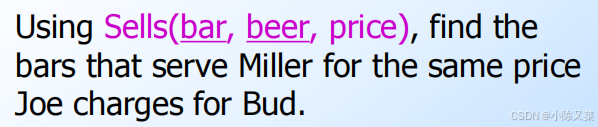
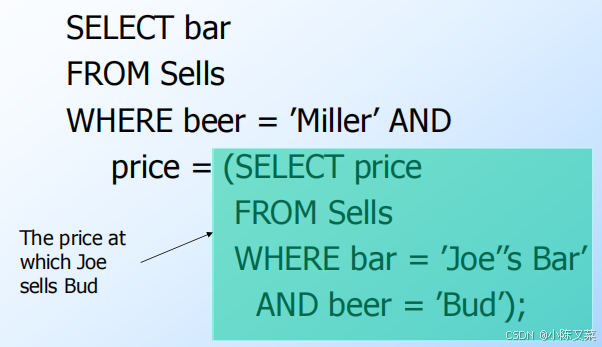
子查询的优先级比父查询的优先级更高
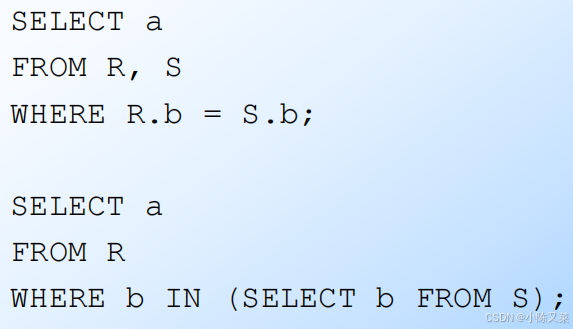
Subqueries and Self Connection
思考题:是不是所有的额子查询都能够写成连接形式,又是不是所有的连接都能写成子查询形式?并且思考两者的效率如何?
The IN Operator
- <tuple> IN (<subquery>) is true if and only if the tuple is a member of the relation produced by the subquery.(IN表达式正确当且仅当元组在子查询返回的结果中)
- Opposite: <tuple> NOT IN (<subquery>).
- IN-expressions can appear in WHERE clauses.
The Exists Operator
- EXISTS(<subquery>) is true if and only if the subquery result is not empty.
- Example: From Beers(name, manf) , find those beers that are the unique beer by their manufacturer.
SELECT name
FROM Beers b1
WHERE NOT EXISTS (
    SELECT *
    FROM Beers
    WHERE manf = b1.manf AND
    name <> b1.name);
The Operator ANY
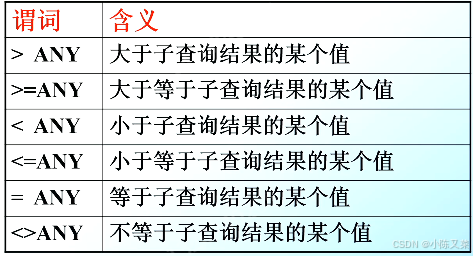
- x = ANY(<subquery>) is a boolean condition that is true if x equals at least one tuple in the subquery result.(ANY语句为真当且仅当x与其中的至少一个元组相同)
= could be any comparison operator.(=可以是其他的运算符号) Example: x >= ANY(<subquery>) means x is not the uniquely smallest tuple produced by the subquery.
- Note tuples must have one component only.
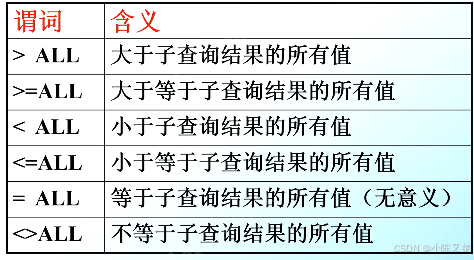
The Operator ALL
- x <> ALL(<subquery>) is true if for every tuple t in the relation, x is not equal to t.
- That is, x is not in the subquery result.
<> can be any comparison operator. Example: x >= ALL(<subquery>) means there is no tuple larger than x in the subquery result.
Union, Intersection, and Difference(交并差)
Union, intersection, and difference of relations are expressed by the following forms, each involving subqueries:
- (<subquery>) UNION (<subquery>)
- (<subquery>) INTERSECT (<subquery>)
- (<subquery>) EXCEPT (<subquery>)
要注意的是:UNION产生的结果是一个集合,集合是不允许出现重复元素的,但如果写法是(UNION ALL那么产生的结果是一个包,包中是允许重复元素的)
深入思考:交、并、差运算的前提应该都是排序,所以说在排序之后便直接产生了集合
Bag Semantics
- Although the SELECT-FROM-WHERE statement uses bag semantics, the default for union, intersection, and difference is set semantics.
- That is, duplicates are eliminated as the operation is applied.
Controlling Duplicate Elimination
- Force the result to be a set by SELECT DISTINCT . . .
- Force the result to be a bag (i.e., don’t eliminate duplicates) by ALL, as in . . . UNION ALL . . .
Inner Joins
SELECT buyer_name, sales.buyer_id, qty
FROM buyers INNER JOIN sales
ON buyers.buyer_id = sales.buyer_id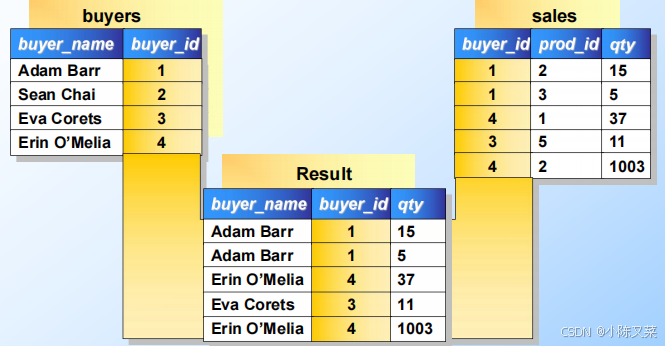
Outer Joins
SELECT buyer_name, sales.buyer_id, qty
FROM buyers LEFT OUTER JOIN sales
ON buyers.buyer_id = sales.buyer_id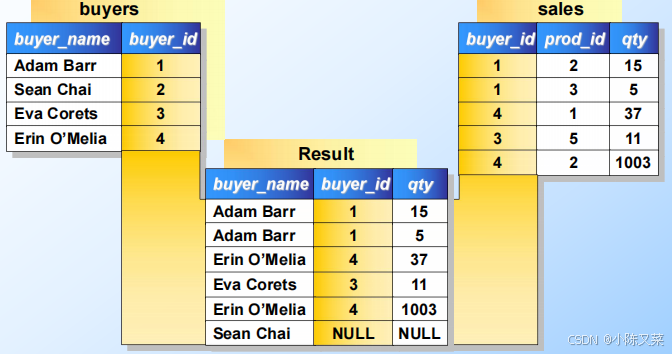
SELECT buyer_name, sales.buyer_id, qty
FROM sales RIGHT OUTER JOIN buyers
ON buyers.buyer_id = sales.buyer_id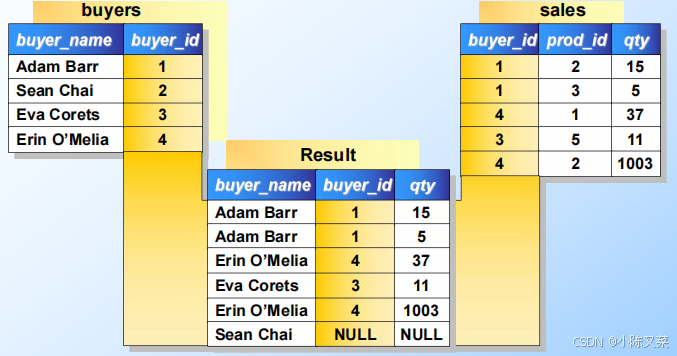
内连接和外连接的核心区别在于对于未匹配行的处理:
特性 | 内连接(INNER JOIN) | 外连接(OUTER JOIN) |
|---|---|---|
匹配策略 | 仅保留两表中完全匹配的行 | 保留至少一个表的所有行,未匹配的部分用 NULL 填充 |
结果集大小 | 可能小于或等于参与连接的表的行数之和 | 可能等于或大于参与连接的表的行数之和 |
默认关键字 | JOIN(等价于 INNER JOIN) | 必须显式指定类型(LEFT/RIGHT/FULL) |
数据完整性 | 丢弃未匹配的数据 | 保留所有数据(通过 NULL 表示无匹配) |
本文参与 腾讯云自媒体同步曝光计划,分享自作者个人站点/博客。
原始发表:2025-06-01,如有侵权请联系 cloudcommunity@tencent.com 删除
目录
腾讯云开发者

Copyright © 2013 - 2026 Tencent Cloud. All Rights Reserved. 腾讯云 版权所有
深圳市腾讯计算机系统有限公司 ICP备案/许可证号:粤B2-20090059  粤公网安备44030502008569号
腾讯云计算(北京)有限责任公司 京ICP证150476号 | 京ICP备11018762号